



 Chat with AI
Exam 20: The First Law of Thermodynamics

Exam 1: Physics and Measurement25 Questions
Exam 2: Motion in One Dimension66 Questions
Exam 3: Vectors47 Questions
Exam 4: Motion in Two Dimensions79 Questions
Exam 5: The Laws of Motion113 Questions
Exam 6: Circular Motion and Other Applications of Newtons Laws55 Questions
Exam 7: Energy of a System74 Questions
Exam 8: Conservation of Energy84 Questions
Exam 9: Linear Momentum and Collisions89 Questions
Exam 10: Rotation of a Rigid Object About a Fixed Axis82 Questions
Exam 11: Angular Momentum46 Questions
Exam 12: Static Equilibrium and Elasticity34 Questions
Exam 13: Universal Gravitation47 Questions
Exam 14: Fluid Mechanics53 Questions
Exam 15: Oscillatory Motion41 Questions
Exam 16: Wave Motion82 Questions
Exam 18: Superposition and Standing Waves72 Questions
Exam 19: Temperature47 Questions
Exam 20: The First Law of Thermodynamics61 Questions
Exam 21: The Kinetic Theory of Gases38 Questions
Exam 22: Heat Engines, Entropy, and the Second Law of Thermodynamics55 Questions
Exam 23: Electric Fields67 Questions
Exam 24: Gausss Law82 Questions
Exam 25: Electric Potential111 Questions
Exam 26: Capacitance and Dielectrics63 Questions
Exam 27: Current and Resistance34 Questions
Exam 28: Direct-Current Circuits84 Questions
Exam 29: Magnetic Fields80 Questions
Exam 30: Sources of the Magnetic Field95 Questions
Exam 31: Faradays Law62 Questions
Exam 32: Inductance23 Questions
Exam 33: Alternating-Current Circuits65 Questions
Exam 34: Electromagnetic Waves40 Questions
Exam 35: The Nature of Light and the Principles of Ray Optics37 Questions
Exam 36: Image Formation43 Questions
Exam 37: Wave Optics48 Questions
Exam 38: Diffraction Patterns and Polarization47 Questions
Exam 39: Relativity34 Questions
Exam 40: Introduction to Quantum Physics48 Questions
Exam 41: Quantum Mechanics33 Questions
Exam 42: Atomic Physics59 Questions
Exam 43: Molecules and Solids46 Questions
Exam 44: Nuclear Structure89 Questions
Exam 46: Particle Physics and Cosmology34 Questions
Select questions type


A 100 kg marble slab falls off a skyscraper and falls 200 m to the ground without hitting anyone. Its fall stops within milliseconds, so that there is no loss of thermal energy to its surroundings if its temperature is measured immediately after it stops. By how much has its temperature changed as a result of the fall, if we ignore energy gained or lost as a result of its interaction with the atmosphere? ( 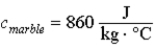 .)
.) (Multiple Choice)
4.7/5  (81)
(81) Aluminum rod #1 is 1.0 m long with cross-section area 2.0 cm2. Aluminum rod #2 is 2.0 m long with cross-section area 4.0 cm2. Aluminum rod #3 is 3.0 m long with cross-section area 9.0 cm2. If each rod has the same temperature difference applied across its ends, which rod has the greatest rate of transfer of energy between its ends?
(Multiple Choice)
4.8/5 (75)
(75) How much heat (in kcal) must be removed to make ice at −10°C from 2 kg of water at 20°C? (The specific heat of ice is 0.50 cal/g⋅°C.)
(Multiple Choice)
4.8/5 (66)
(66) Beryl states that insulation with the smallest possible thermal conductivity is best to keep a house warm in winter, but worst for keeping a house cool in summer. Sapphire insists the reverse is true: low thermal conductivity is good in the summer, but bad in the winter. Which one, if either is correct?
(Multiple Choice)
4.9/5 (75)
(75) A 5-g coin is dropped from a 300-m building. If it reaches a terminal velocity of 45 m/s, and the rest of the energy is converted to heating the coin, what is the change in temperature (in °C) of the coin? (The specific heat of copper is 387 J/kg⋅°C.)
(Multiple Choice)
4.8/5 (84)
(84) In braking an automobile, the friction between the brake drums and brake shoes converts the car's kinetic energy into heat. If a 1 500-kg automobile traveling at 30 m/s brakes to a halt, how much does the temperature rise in each of the four 8.0-kg brake drums? (The specific heat of each iron brake drum is 448 J/kg⋅°C).
(Short Answer)
4.9/5 (74)
(74) An 8 000-kg aluminum flagpole 100-m long is heated by the sun from a temperature of 10°C to 20°C. Find the heat transferred (in J) to the aluminum if the specific heat of aluminum is 0.215 cal/g⋅°C.
(Multiple Choice)
4.9/5 (83)
(83) If a person in Alaska were locked out of his house on a day when the temperature outside was −40°C, his thick clothing would mostly reduce the loss of thermal energy by
(Multiple Choice)
4.9/5 (74)
(74) A styrofoam container used as a picnic cooler contains a block of ice at 0°C. If 225 grams of ice melts in 1 hour, how much heat energy per second is passing through the walls of the container? (The heat of fusion of ice is 3.33 × 10⁵ J/kg).
(Short Answer)
4.7/5 (84)
(84) Which of the following substances has the greatest specific heat?
(Multiple Choice)
4.9/5 (84)
(84) How much heat (in kilocalories) is needed to convert 1.00 kg of ice at 0°C into steam at 100°C?
(Multiple Choice)
4.8/5 (79)
(79) In a thermodynamic process, the internal energy of a system in a container with adiabatic walls decreases by 800 J. Which statement is correct?
(Multiple Choice)
4.9/5 (66)
(66) 100 grams of liquid nitrogen at 77 K is stirred into a beaker containing 200 grams of 5°C water. If the nitrogen leaves the solution as soon as it turns to gas, how much water freezes? (The heat of evaporation of nitrogen is 6.09 cal/gram and the heat of fusion of water is 80 cal/gram.)
(Short Answer)
4.9/5 (73)
(73) How much heat, in joules, is required to convert 1.00 kg of ice at 0°C into steam at 100°C? (Lice = 333 J/g; Lsteam = 2.26 × 10³ J/g.)
(Multiple Choice)
4.9/5 (81)
(81) The work done in the expansion from an initial to a final state
(Multiple Choice)
4.9/5 (92)
(92) A 5-kg piece of lead (specific heat 0.03 cal/g⋅°C) having a temperature of 80°C is added to 500 g of water having a temperature of 20°C. What is the final equilibrium temperature (in °C) of the system?
(Multiple Choice)
4.8/5 (65)
(65) Gas in a container expands at a constant pressure of 3 atm. Find the work done (in J) by the gas if the initial volume is 5 liters and the final volume is 10 liters.
(Multiple Choice)
4.8/5 (73)
(73) A slab of concrete and an insulating board are in thermal contact with each other. The temperatures of their outer surfaces are 68°F and 50°F. Determine the rate of heat transfer (in BTU/ft2⋅h) if the R values are 1.93 and 8.7 ft2⋅°F⋅h/BTU, respectively.
(Multiple Choice)
4.8/5 (82)
(82) Star A has a radius of 200 000 km and a surface temperature of 6 000 K. Star B has a radius of 400 000 km and a surface temperature of 3 000 K. The emissivity of both stars is the same. What is the ratio of the rate of energy radiated by Star A to that of Star B?
(Short Answer)
4.7/5 (81)
(81) 
Filters
- Essay(0)
- Multiple Choice(0)
- Short Answer(0)
- True False(0)
- Matching(0)