



 Chat with AI
Exam 20: The First Law of Thermodynamics

Exam 1: Physics and Measurement25 Questions
Exam 2: Motion in One Dimension66 Questions
Exam 3: Vectors47 Questions
Exam 4: Motion in Two Dimensions79 Questions
Exam 5: The Laws of Motion113 Questions
Exam 6: Circular Motion and Other Applications of Newtons Laws55 Questions
Exam 7: Energy of a System74 Questions
Exam 8: Conservation of Energy84 Questions
Exam 9: Linear Momentum and Collisions89 Questions
Exam 10: Rotation of a Rigid Object About a Fixed Axis82 Questions
Exam 11: Angular Momentum46 Questions
Exam 12: Static Equilibrium and Elasticity34 Questions
Exam 13: Universal Gravitation47 Questions
Exam 14: Fluid Mechanics53 Questions
Exam 15: Oscillatory Motion41 Questions
Exam 16: Wave Motion82 Questions
Exam 18: Superposition and Standing Waves72 Questions
Exam 19: Temperature47 Questions
Exam 20: The First Law of Thermodynamics61 Questions
Exam 21: The Kinetic Theory of Gases38 Questions
Exam 22: Heat Engines, Entropy, and the Second Law of Thermodynamics55 Questions
Exam 23: Electric Fields67 Questions
Exam 24: Gausss Law82 Questions
Exam 25: Electric Potential111 Questions
Exam 26: Capacitance and Dielectrics63 Questions
Exam 27: Current and Resistance34 Questions
Exam 28: Direct-Current Circuits84 Questions
Exam 29: Magnetic Fields80 Questions
Exam 30: Sources of the Magnetic Field95 Questions
Exam 31: Faradays Law62 Questions
Exam 32: Inductance23 Questions
Exam 33: Alternating-Current Circuits65 Questions
Exam 34: Electromagnetic Waves40 Questions
Exam 35: The Nature of Light and the Principles of Ray Optics37 Questions
Exam 36: Image Formation43 Questions
Exam 37: Wave Optics48 Questions
Exam 38: Diffraction Patterns and Polarization47 Questions
Exam 39: Relativity34 Questions
Exam 40: Introduction to Quantum Physics48 Questions
Exam 41: Quantum Mechanics33 Questions
Exam 42: Atomic Physics59 Questions
Exam 43: Molecules and Solids46 Questions
Exam 44: Nuclear Structure89 Questions
Exam 46: Particle Physics and Cosmology34 Questions
Select questions type


Steel blocks A and B, which have equal masses, are at TA = 300 °C and TB = 400 °C. Block C, with mC = 2mA, is at TC = 350 °C. Blocks A and B are placed in contact, isolated, and allowed to come into equilibrium. Then they are placed in contact with block C. At that instant,
(Multiple Choice)
4.9/5  (81)
(81) The Earth intercepts 1.27 × 10¹⁷ W of radiant energy from the Sun. Suppose the Earth, of volume 1.08 × 10²¹ m3, was composed of water. How long would it take for the Earth at 0°C to reach 100°C, if none of the energy was radiated or reflected back out into space?
(Multiple Choice)
4.8/5 (88)
(88) If an object feels cold to the touch, the only statement that you can make that must be correct is that
(Multiple Choice)
4.8/5 (67)
(67) Determine the heat capacity (in calories/°C) of a lake containing one million gallons (approximately 4 million kilograms) of water at 15°C.
(Multiple Choice)
4.9/5 (79)
(79) The R value of fiberglass batting, 3.5 inches thick, is 11 ft2⋅°F⋅h/BTU. What is the thermal conductivity (in BTU/ft⋅°F⋅s)?
(Multiple Choice)
4.9/5 (73)
(73) Two kilograms of water at 100°C is converted to steam at 1 atm. Find the work done (in J). (The density of steam at 100°C is 0.598 kg/m3.)
(Multiple Choice)
4.9/5 (81)
(81) Which statement below regarding the First Law of Thermodynamics is most correct?
(Multiple Choice)
4.8/5 (73)
(73) Two kilograms of water at 100°C is converted to steam at 1 atm. Find the change in internal energy (in J). (Lv = 2.26 × 10⁶ J/kg.)
(Multiple Choice)
4.9/5 (83)
(83) A 100-g cube of ice is heated from −120°C to +120°C. In which of the following processes is the greatest amount of energy absorbed by this material?
(Multiple Choice)
4.9/5 (77)
(77) An 8 000-kg aluminum flagpole 100-m long is heated by the sun from a temperature of 10°C to 20°C. Find the work done (in J) by the aluminum if the linear expansion coefficient is 24 × 10−6 (°C)−1. (The density of aluminum is 2.7 × 10³ kg/m3 and 1 atm = 1.0 × 10⁵ N/m2.)
(Multiple Choice)
4.9/5 (84)
(84) We are able to define a mechanical equivalent for heat because
(Multiple Choice)
4.8/5 (68)
(68) Which of the following statements is(are) correct when an ideal gas goes from an initial to a final state in a single process?
(Multiple Choice)
4.8/5 (83)
(83) A 5-gallon container of water (approximately 20 kg) having a temperature of 212°F is added to a 50-gallon tub (approximately 200 kg) of water having a temperature of 50°F. What is the final equilibrium temperature (in °C) of the mixture?
(Multiple Choice)
4.9/5 (74)
(74) A team of people who traveled to the North Pole by dogsled lived on butter because they needed to consume 6 000 dietician's Calories each day. Because the ice there is lumpy and irregular, they had to help the dogs by pushing and lifting the load. Assume they had a 16 hour working day and that each person could lift a 500 N load. How many times would a person have to lift this weight 1.00 m upwards in a constant gravitational field where  to do the work equivalent to 6 000 Calories?
 (Multiple Choice)
4.8/5 (60)
(60) A super-insulated house is at a temperature of 20°C. The temperature outside is 0°C. The surface area of the house is 200 m2, and the emissivity is 1. Approximately how much energy is radiated (in W) per second?
(Multiple Choice)
5.0/5 (73)
(73) A 100-kg student eats a 200-Calorie doughnut. To "burn it off", he decides to climb the steps of a tall building. How high (in m) would he have to climb to expend an equivalent amount of work? (1 food Calorie = 103 calories.)
(Multiple Choice)
5.0/5 (87)
(87) A child has a temperature of 101°F. If her total cross-sectional area is 2 m2, find the energy lost each second (in W) due to radiation, assuming the emissivity is 1. (Assume the room temperature is 70°F.)
(Multiple Choice)
4.9/5 (73)
(73) A gas expands from A to B as shown in the graph. Calculate the work (in joules) done by the gas. (1 atm= 1.01 × 10⁵ N/m2.) 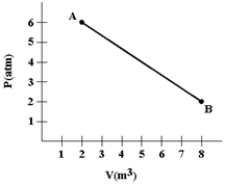
(Multiple Choice)
4.7/5 (94)
(94) A cup of coffee is enclosed on all sides in an insulated container 1/2 cm thick in the shape of a cube 10 cm on a side. The temperature of the coffee is 95°C, and the temperature of the surroundings is 21°C. Find the rate of heat loss (in J/s) due to conduction if the thermal conductivity of the cup is 2 × 10⁻⁴ cal/s⋅cm⋅°C.
(Multiple Choice)
4.8/5 (84)
(84) 
Filters
- Essay(0)
- Multiple Choice(0)
- Short Answer(0)
- True False(0)
- Matching(0)