



 Chat with AI
Exam 26: Capacitance and Dielectrics

Exam 1: Physics and Measurement25 Questions
Exam 2: Motion in One Dimension66 Questions
Exam 3: Vectors47 Questions
Exam 4: Motion in Two Dimensions79 Questions
Exam 5: The Laws of Motion113 Questions
Exam 6: Circular Motion and Other Applications of Newtons Laws55 Questions
Exam 7: Energy of a System74 Questions
Exam 8: Conservation of Energy84 Questions
Exam 9: Linear Momentum and Collisions89 Questions
Exam 10: Rotation of a Rigid Object About a Fixed Axis82 Questions
Exam 11: Angular Momentum46 Questions
Exam 12: Static Equilibrium and Elasticity34 Questions
Exam 13: Universal Gravitation47 Questions
Exam 14: Fluid Mechanics53 Questions
Exam 15: Oscillatory Motion41 Questions
Exam 16: Wave Motion82 Questions
Exam 18: Superposition and Standing Waves72 Questions
Exam 19: Temperature47 Questions
Exam 20: The First Law of Thermodynamics61 Questions
Exam 21: The Kinetic Theory of Gases38 Questions
Exam 22: Heat Engines, Entropy, and the Second Law of Thermodynamics55 Questions
Exam 23: Electric Fields67 Questions
Exam 24: Gausss Law82 Questions
Exam 25: Electric Potential111 Questions
Exam 26: Capacitance and Dielectrics63 Questions
Exam 27: Current and Resistance34 Questions
Exam 28: Direct-Current Circuits84 Questions
Exam 29: Magnetic Fields80 Questions
Exam 30: Sources of the Magnetic Field95 Questions
Exam 31: Faradays Law62 Questions
Exam 32: Inductance23 Questions
Exam 33: Alternating-Current Circuits65 Questions
Exam 34: Electromagnetic Waves40 Questions
Exam 35: The Nature of Light and the Principles of Ray Optics37 Questions
Exam 36: Image Formation43 Questions
Exam 37: Wave Optics48 Questions
Exam 38: Diffraction Patterns and Polarization47 Questions
Exam 39: Relativity34 Questions
Exam 40: Introduction to Quantum Physics48 Questions
Exam 41: Quantum Mechanics33 Questions
Exam 42: Atomic Physics59 Questions
Exam 43: Molecules and Solids46 Questions
Exam 44: Nuclear Structure89 Questions
Exam 46: Particle Physics and Cosmology34 Questions
Select questions type


A 3.0-μF capacitor charged to 40 V and a 5.0-μF capacitor charged to 18 V are connected to each other, with the positive plate of each connected to the negative plate of the other. What is the final charge on the 3.0-μF capacitor?
(Multiple Choice)
4.8/5  (78)
(78) A parallel plate capacitor of capacitance C0 has plates of area A with separation d between them. When it is connected to a battery of voltage V0, it has charge of magnitude Q0 on its plates. While it is connected to the battery the space between the plates is filled with a material of dielectric constant 3. After the dielectric is added, the magnitude of the charge on the plates and the potential difference between them are
(Multiple Choice)
4.9/5 (72)
(72) What is the equivalent capacitance of the combination shown? 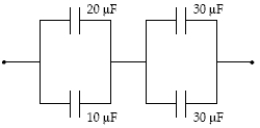
(Multiple Choice)
5.0/5 (91)
(91) Determine the equivalent capacitance of the combination shown when C = 12 pF. 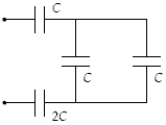
(Multiple Choice)
4.8/5 (66)
(66) Which of the following materials has the highest dielectric constant?
(Multiple Choice)
4.8/5 (83)
(83) Into the gap between the plates of a parallel plate capacitor of capacitance  a slab of metal is inserted halfway between the plates filling one fourth of the gap between the plates. What is the resulting new capacitance?
 (Multiple Choice)
4.8/5 (83)
(83) A parallel plate capacitor of capacitance C0 has plates of area A with separation d between them. When it is connected to a battery of voltage V0, it has charge of magnitude Q0 on its plates. It is then disconnected from the battery and the plates are pulled apart to a separation 2d without discharging them. After the plates are 2d apart, the magnitude of the charge on the plates and the potential difference between them are
(Multiple Choice)
4.9/5 (68)
(68) 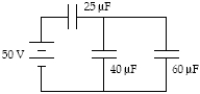
An electron is released from rest at the negative plate of a parallel plate capacitor. If the distance between the plates is 5 mm and the potential difference across the plates is 5 V, with what velocity does the electron hit the positive plate? (me = 9.1 × 10⁻³¹ kg, qe = 1.6 × 10⁻¹⁹ C.)
(Short Answer)
4.8/5 (82)
(82) A 6.0-μF capacitor charged to 50 V and a 4.0-μF capacitor charged to 34 V are connected to each other, with the two positive plates connected and the two negative plates connected. What is the total energy stored in the 6.0-μF capacitor at equilibrium?
(Multiple Choice)
4.9/5 (68)
(68) Determine the equivalent capacitance of the combination shown when C = 24 μF. 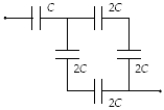
(Multiple Choice)
4.9/5 (82)
(82) A parallel plate capacitor is connected to a battery and charged to voltage V. Leah says that the charge on the plates will decrease if the distance between the plates is increased while they are still connected to the battery. Gertie says that the charge will remain the same. Which one, if either, is correct, and why?
(Multiple Choice)
4.9/5 (93)
(93) What is the potential difference across C2 when C1 = 5.0 μF, C2 = 15 μF, C3 = 30 μF, and V0 = 24 V? 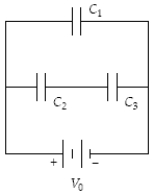
(Multiple Choice)
4.8/5 (70)
(70) A capacitor of unknown capacitance C is charged to 100 V and then connected across an initially uncharged 60-μF capacitor. If the final potential difference across the 60-μF capacitor is 40 V, determine C.
(Multiple Choice)
5.0/5 (73)
(73) Determine the equivalent capacitance of the combination shown when C = 12 nF. 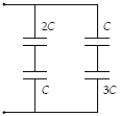
(Multiple Choice)
4.9/5 (81)
(81) A 0.16 pF parallel-plate capacitor is charged to 10 V. Then the battery is disconnected from the capacitor. When 1.00 × 10⁷ electrons are now placed on the negative plate of the capacitor, the voltage between the plates changes by
(Multiple Choice)
4.8/5 (77)
(77) Determine the equivalent capacitance of the combination shown when C = 15 mF. 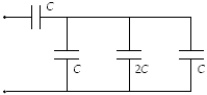
(Multiple Choice)
4.9/5 (75)
(75) If VA − VB = 50 V, how much energy is stored in the 54-μF capacitor? 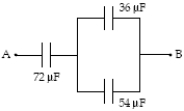
(Multiple Choice)
4.8/5 (70)
(70) 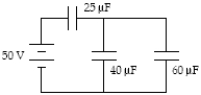
How much energy is stored in the 50-μF capacitor when Va − Vb = 22V? 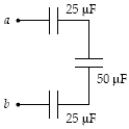
(Multiple Choice)
4.9/5 (73)
(73) 
Filters
- Essay(0)
- Multiple Choice(0)
- Short Answer(0)
- True False(0)
- Matching(0)