



 Chat with AI
Exam 26: Capacitance and Dielectrics

Exam 1: Physics and Measurement25 Questions
Exam 2: Motion in One Dimension66 Questions
Exam 3: Vectors47 Questions
Exam 4: Motion in Two Dimensions79 Questions
Exam 5: The Laws of Motion113 Questions
Exam 6: Circular Motion and Other Applications of Newtons Laws55 Questions
Exam 7: Energy of a System74 Questions
Exam 8: Conservation of Energy84 Questions
Exam 9: Linear Momentum and Collisions89 Questions
Exam 10: Rotation of a Rigid Object About a Fixed Axis82 Questions
Exam 11: Angular Momentum46 Questions
Exam 12: Static Equilibrium and Elasticity34 Questions
Exam 13: Universal Gravitation47 Questions
Exam 14: Fluid Mechanics53 Questions
Exam 15: Oscillatory Motion41 Questions
Exam 16: Wave Motion82 Questions
Exam 18: Superposition and Standing Waves72 Questions
Exam 19: Temperature47 Questions
Exam 20: The First Law of Thermodynamics61 Questions
Exam 21: The Kinetic Theory of Gases38 Questions
Exam 22: Heat Engines, Entropy, and the Second Law of Thermodynamics55 Questions
Exam 23: Electric Fields67 Questions
Exam 24: Gausss Law82 Questions
Exam 25: Electric Potential111 Questions
Exam 26: Capacitance and Dielectrics63 Questions
Exam 27: Current and Resistance34 Questions
Exam 28: Direct-Current Circuits84 Questions
Exam 29: Magnetic Fields80 Questions
Exam 30: Sources of the Magnetic Field95 Questions
Exam 31: Faradays Law62 Questions
Exam 32: Inductance23 Questions
Exam 33: Alternating-Current Circuits65 Questions
Exam 34: Electromagnetic Waves40 Questions
Exam 35: The Nature of Light and the Principles of Ray Optics37 Questions
Exam 36: Image Formation43 Questions
Exam 37: Wave Optics48 Questions
Exam 38: Diffraction Patterns and Polarization47 Questions
Exam 39: Relativity34 Questions
Exam 40: Introduction to Quantum Physics48 Questions
Exam 41: Quantum Mechanics33 Questions
Exam 42: Atomic Physics59 Questions
Exam 43: Molecules and Solids46 Questions
Exam 44: Nuclear Structure89 Questions
Exam 46: Particle Physics and Cosmology34 Questions
Select questions type


A parallel plate capacitor of capacitance C0 has plates of area A with separation d between them. When it is connected to a battery of voltage V0, it has charge of magnitude Q0 on its plates. It is then disconnected from the battery and the space between the plates is filled with a material of dielectric constant 3. After the dielectric is added, the magnitudes of the capacitance and the potential difference between the plates are
(Multiple Choice)
4.8/5  (73)
(73) Two spheres are made of conducting material. Sphere #2 has twice the radius of Sphere #1. What is the ratio of the capacitance of Sphere #2 to the capacitance of sphere #1?
(Multiple Choice)
4.8/5 (88)
(88) Determine the equivalent capacitance of the combination shown when C = 45 μF. 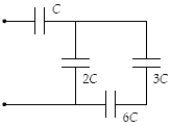
(Multiple Choice)
4.9/5 (98)
(98) If C = 10 μF, what is the equivalent capacitance for the combination shown? 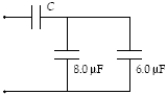
(Multiple Choice)
4.8/5 (77)
(77) A 15-μF capacitor and a 25-μF capacitor are connected in parallel, and charged to a potential difference of 60 V. How much energy is then stored in this capacitor combination?
(Multiple Choice)
4.8/5 (91)
(91) If VA − VB = 50 V, how much energy is stored in the 36-μF capacitor? 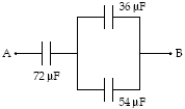
(Multiple Choice)
4.9/5 (84)
(84) What is the total energy stored in the group of capacitors shown if the charge on the 30-μF capacitor is 0.90 mC? 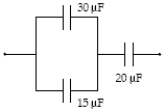
(Multiple Choice)
4.8/5 (82)
(82) An electric dipole having dipole moment of magnitude p is placed in a uniform electric field having magnitude E. What is the magnitude of the greatest change in potential energy that can happen for this dipole in this field?
(Multiple Choice)
5.0/5 (74)
(74) A 15-μF capacitor and a 30-μF capacitor are connected in series, and charged to a potential difference of 50 V. What is the resulting charge on the 30-μF capacitor?
(Multiple Choice)
4.8/5 (75)
(75) A 200-volt battery is connected to a 0.50-microfarad parallel-plate, air-filled capacitor. Now the battery is disconnected, with care taken not to discharge the plates. Some Pyrex glass is then inserted between the plates, completely filling up the space. What is the final potential difference between the plates? (The dielectric constant for Pyrex is κ = 5.6.)
(Short Answer)
4.9/5 (82)
(82) A parallel plate capacitor of capacitance C0 has plates of area A with separation d between them. When it is connected to a battery of voltage V0, it has charge of magnitude Q0 on its plates. It is then disconnected from the battery and the plates are pulled apart to a separation 2d without discharging them. After the plates are 2d apart, the new capacitance and the potential difference between the plates are
(Multiple Choice)
4.8/5 (79)
(79) Determine the equivalent capacitance of the combination shown when C = 45 μF. 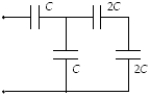
(Multiple Choice)
4.8/5 (75)
(75) A 30-μF capacitor is charged to 40 V and then connected across an initially uncharged 20-μF capacitor. What is the final potential difference across the 30-μF capacitor?
(Multiple Choice)
4.8/5 (70)
(70) Determine the charge stored by C1 when C1 = 20 μF, C2 = 10 μF, C3 = 30 μF, and V0 = 18 V. 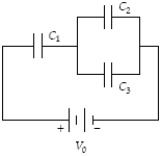
(Multiple Choice)
4.9/5 (87)
(87) A 0.120 pF parallel-plate capacitor is charged to a potential difference of 10.0 V and then disconnected from the battery. A cosmic ray burst creates 1.00 × 10⁶ electrons and 1.00 × 10⁶ positive charges between the plates. If the charges do not recombine, but reach the oppositely charged plates, by how much is the potential difference between the capacitor plates reduced?
(Multiple Choice)
4.8/5 (82)
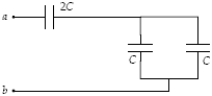
(82) 
The plates of a parallel plate capacitor of capacitance  are horizontal. Into the gap a slab of dielectric material with
 is placed, filling the bottom half of the gap between the plates. What is the resulting new capacitance?
are horizontal. Into the gap a slab of dielectric material with is placed, filling the bottom half of the gap between the plates. What is the resulting new capacitance? (Multiple Choice)
4.8/5 (74)
(74) Determine the energy stored in C1 when C1 = 10 μF, C2 = 12 μF, C3 = 15 μF, and V0 = 70 V. 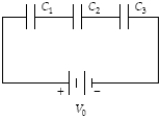
(Multiple Choice)
4.8/5 (88)
(88) A 4.0-mF capacitor initially charged to 50 V and a 6.0-mF capacitor charged to 30 V are connected to each other with the positive plate of each connected to the negative plate of the other. What is the final charge on the 6.0-mF capacitor?
(Multiple Choice)
4.9/5 (72)
(72) 
Filters
- Essay(0)
- Multiple Choice(0)
- Short Answer(0)
- True False(0)
- Matching(0)