



 Chat with AI
Exam 5: The Laws of Motion

Exam 1: Physics and Measurement25 Questions
Exam 2: Motion in One Dimension66 Questions
Exam 3: Vectors47 Questions
Exam 4: Motion in Two Dimensions79 Questions
Exam 5: The Laws of Motion113 Questions
Exam 6: Circular Motion and Other Applications of Newtons Laws55 Questions
Exam 7: Energy of a System74 Questions
Exam 8: Conservation of Energy84 Questions
Exam 9: Linear Momentum and Collisions89 Questions
Exam 10: Rotation of a Rigid Object About a Fixed Axis82 Questions
Exam 11: Angular Momentum46 Questions
Exam 12: Static Equilibrium and Elasticity34 Questions
Exam 13: Universal Gravitation47 Questions
Exam 14: Fluid Mechanics53 Questions
Exam 15: Oscillatory Motion41 Questions
Exam 16: Wave Motion82 Questions
Exam 18: Superposition and Standing Waves72 Questions
Exam 19: Temperature47 Questions
Exam 20: The First Law of Thermodynamics61 Questions
Exam 21: The Kinetic Theory of Gases38 Questions
Exam 22: Heat Engines, Entropy, and the Second Law of Thermodynamics55 Questions
Exam 23: Electric Fields67 Questions
Exam 24: Gausss Law82 Questions
Exam 25: Electric Potential111 Questions
Exam 26: Capacitance and Dielectrics63 Questions
Exam 27: Current and Resistance34 Questions
Exam 28: Direct-Current Circuits84 Questions
Exam 29: Magnetic Fields80 Questions
Exam 30: Sources of the Magnetic Field95 Questions
Exam 31: Faradays Law62 Questions
Exam 32: Inductance23 Questions
Exam 33: Alternating-Current Circuits65 Questions
Exam 34: Electromagnetic Waves40 Questions
Exam 35: The Nature of Light and the Principles of Ray Optics37 Questions
Exam 36: Image Formation43 Questions
Exam 37: Wave Optics48 Questions
Exam 38: Diffraction Patterns and Polarization47 Questions
Exam 39: Relativity34 Questions
Exam 40: Introduction to Quantum Physics48 Questions
Exam 41: Quantum Mechanics33 Questions
Exam 42: Atomic Physics59 Questions
Exam 43: Molecules and Solids46 Questions
Exam 44: Nuclear Structure89 Questions
Exam 46: Particle Physics and Cosmology34 Questions
Select questions type


A 2.0-kg block slides on a frictionless 15° inclined plane. A force acting parallel to the incline is applied to the block. The acceleration of the block is 1.5 m/s2 down the incline. What is the applied force?
(Multiple Choice)
4.8/5  (67)
(67) Exhibit 5-1
A 2.30 kg mass is suspended from the ceiling and a 1.70 kg mass is suspended from the 2.30 kg mass, as shown. The tensions in the strings are labeled  and
 .
 Use this exhibit to answer the following question(s).
-Refer to Exhibit 5-1. A hand exerts an upward force of 6.70 N on the 1.70 kg mass. The magnitudes of the tensions are
and . Use this exhibit to answer the following question(s).
-Refer to Exhibit 5-1. A hand exerts an upward force of 6.70 N on the 1.70 kg mass. The magnitudes of the tensions are (Multiple Choice)
4.8/5 (76)
(76) Two identical springs with spring constant 50 N/m support a 5.0 N weight as in the picture below. What is the tension in spring A? 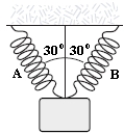
(Multiple Choice)
4.9/5 (89)
(89) The three blocks shown are released from rest and are observed to move with accelerations that have a magnitude of 1.5 m/s2. What is the magnitude of the friction force on the block that slides horizontally? Disregard any pulley mass or friction in the pulley and let M = 2.0 kg. 
(Multiple Choice)
4.8/5 (83)
(83) In the figure, if the tension in string 1 is 34 N and the tension in string 2 is 24 N, what is the mass of the object shown? 
(Multiple Choice)
4.7/5 (91)
(91) A 5.0-kg mass sits on the floor of an elevator that has a downward acceleration of 1.0 m/s2. On top of the 5.0-kg mass is an object of unknown mass. The force of the elevator on the 5.0-kg mass is 80 N up. Determine the unknown mass.
(Multiple Choice)
5.0/5 (73)
(73) In the figure, the coefficient of kinetic friction between the surface and the larger block is 0.20, and the coefficient of kinetic friction between the surface and the smaller block is 0.30. If F = 10 N and M = 1.0 kg, what is the tension in the connecting string? 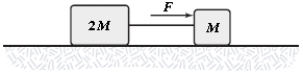
(Multiple Choice)
5.0/5 (69)
(69) A book is placed on a chair. Then a videocassette is placed on the book. The floor exerts a normal force
(Multiple Choice)
4.8/5 (88)
(88) The first of two identical boxes of mass m is sitting on level ground. The second box is sitting on a ramp that makes an angle with the ground. When a force of magnitude F is applied to each box in a direction parallel to the surface it is on, upwards on the box on the ramp, neither box moves. Which statement comparing the friction force on the box on the level, fL, to the friction force on the box on the ramp, fR, is correct?
(Multiple Choice)
4.8/5 (81)
(81) Two blocks are accelerated across a horizontal frictionless surface as shown. Frictional forces keep the two blocks from sliding relative to each other, and the two move with the same acceleration. If F = 1.2 N and M = 1.0 kg, what is the horizontal component (frictional force) of the force of the large block on the small block? 
(Multiple Choice)
4.9/5 (77)
(77) If α = 40°, β = 60°, and M = 4.0 kg, determine the tension in string 1. 
(Multiple Choice)
4.9/5 (79)
(79) A book is placed on a chair. Then a videocassette is placed on the book. The floor exerts a normal force
(Multiple Choice)
4.8/5 (76)
(76) A chair is placed on a rug. Then a book is placed on the chair. The floor exerts a normal force
(Multiple Choice)
4.9/5 (84)
(84) A 3.0-kg block moves up a 40° incline with constant speed under the action of a 26-N force acting up and parallel to the incline. What magnitude force must act up and parallel to the incline for the block to move down the incline at constant velocity?
(Multiple Choice)
4.7/5 (78)
(78) A 70-kg stunt artist rides in a rocket sled which slides along a flat inclined surface. At an instant when the sled's acceleration has a horizontal component of 6.0 m/s2 and a downward component of 2.8 m/s2, what is the magnitude of the force on the rider by the sled?
(Multiple Choice)
4.8/5 (67)
(67) If F = 4.0 N and m = 2.0 kg, what is the magnitude a of the acceleration for the block shown below? The surface is frictionless. 
(Multiple Choice)
4.8/5 (80)
(80) Exhibit 5-1
A 2.30 kg mass is suspended from the ceiling and a 1.70 kg mass is suspended from the 2.30 kg mass, as shown. The tensions in the strings are labeled and . Use this exhibit to answer the following question(s).
-Refer to Exhibit 5-1. The string supporting the 1.70 kg mass is cut. The magnitudes of the tension in string 1 before and after string 2 is cut are
and . Use this exhibit to answer the following question(s).
-Refer to Exhibit 5-1. The string supporting the 1.70 kg mass is cut. The magnitudes of the tension in string 1 before and after string 2 is cut are (Multiple Choice)
4.7/5 (91)
(91) Two blocks in contact with each other are pushed to the right across a rough horizontal surface by the two forces shown. If the coefficient of kinetic friction between each of the blocks and the surface is 0.30, determine the magnitude of the force exerted on the 2.0-kg block by the 3.0-kg block. 
(Multiple Choice)
4.9/5 (87)
(87) Two blocks connected by a string are pulled across a horizontal surface by a force applied to one of the blocks, as shown. The coefficient of kinetic friction between the blocks and the surface is 0.25. If each block has an acceleration of 2.0 m/s2 to the right, what is the magnitude F of the applied force? 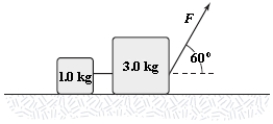
(Multiple Choice)
4.8/5 (72)
(72) Exhibit 5-2
A 4.00 kg block is suspended from the roof of an elevator. A 2.00 kg block is suspended from the 4.00 kg block. The tensions in strings 1 and 2 are labeled  and
 .
 Use this exhibit to answer the following question(s).
-Refer to Exhibit 5-2. When the elevator accelerates downwards with an acceleration of 2.20 m/s2, the magnitudes of
 and
 are
and . Use this exhibit to answer the following question(s).
-Refer to Exhibit 5-2. When the elevator accelerates downwards with an acceleration of 2.20 m/s2, the magnitudes of and are (Multiple Choice)
4.9/5 (80)
(80) 
Filters
- Essay(0)
- Multiple Choice(0)
- Short Answer(0)
- True False(0)
- Matching(0)