



 Chat with AI
Exam 5: The Laws of Motion

Exam 1: Physics and Measurement25 Questions
Exam 2: Motion in One Dimension66 Questions
Exam 3: Vectors47 Questions
Exam 4: Motion in Two Dimensions79 Questions
Exam 5: The Laws of Motion113 Questions
Exam 6: Circular Motion and Other Applications of Newtons Laws55 Questions
Exam 7: Energy of a System74 Questions
Exam 8: Conservation of Energy84 Questions
Exam 9: Linear Momentum and Collisions89 Questions
Exam 10: Rotation of a Rigid Object About a Fixed Axis82 Questions
Exam 11: Angular Momentum46 Questions
Exam 12: Static Equilibrium and Elasticity34 Questions
Exam 13: Universal Gravitation47 Questions
Exam 14: Fluid Mechanics53 Questions
Exam 15: Oscillatory Motion41 Questions
Exam 16: Wave Motion82 Questions
Exam 18: Superposition and Standing Waves72 Questions
Exam 19: Temperature47 Questions
Exam 20: The First Law of Thermodynamics61 Questions
Exam 21: The Kinetic Theory of Gases38 Questions
Exam 22: Heat Engines, Entropy, and the Second Law of Thermodynamics55 Questions
Exam 23: Electric Fields67 Questions
Exam 24: Gausss Law82 Questions
Exam 25: Electric Potential111 Questions
Exam 26: Capacitance and Dielectrics63 Questions
Exam 27: Current and Resistance34 Questions
Exam 28: Direct-Current Circuits84 Questions
Exam 29: Magnetic Fields80 Questions
Exam 30: Sources of the Magnetic Field95 Questions
Exam 31: Faradays Law62 Questions
Exam 32: Inductance23 Questions
Exam 33: Alternating-Current Circuits65 Questions
Exam 34: Electromagnetic Waves40 Questions
Exam 35: The Nature of Light and the Principles of Ray Optics37 Questions
Exam 36: Image Formation43 Questions
Exam 37: Wave Optics48 Questions
Exam 38: Diffraction Patterns and Polarization47 Questions
Exam 39: Relativity34 Questions
Exam 40: Introduction to Quantum Physics48 Questions
Exam 41: Quantum Mechanics33 Questions
Exam 42: Atomic Physics59 Questions
Exam 43: Molecules and Solids46 Questions
Exam 44: Nuclear Structure89 Questions
Exam 46: Particle Physics and Cosmology34 Questions
Select questions type


A 2.0-kg block slides on a frictionless 25° inclined plane. A force of 4.6 N acting parallel to the incline and up the incline is applied to the block. What is the acceleration of the block?
(Multiple Choice)
4.9/5  (84)
(84) A 1.5-kg mass has an acceleration of (4.0  − 3.0
 ) m/s2. Only two forces act on the mass. If one of the forces is (2.0
 − 1.4
 ) N, what is the magnitude of the other force?
− 3.0 ) m/s2. Only two forces act on the mass. If one of the forces is (2.0 − 1.4 ) N, what is the magnitude of the other force? (Multiple Choice)
5.0/5 (74)
(74) At an instant when a 4.0-kg object has an acceleration equal to  m/s2, one of the two forces acting on the object is known to be
 N. Determine the magnitude of the other force acting on the object.
m/s2, one of the two forces acting on the object is known to be N. Determine the magnitude of the other force acting on the object. (Multiple Choice)
4.8/5 (94)
(94) A 4.0-kg block is pushed up a 36° incline by a force of magnitude P applied parallel to the incline. When P is 31 N, it is observed that the block moves up the incline with a constant speed. What value of P would be required to lower the block down the incline at a constant speed?
(Multiple Choice)
4.7/5 (77)
(77) The block shown is pulled across the horizontal surface at a constant speed by the force shown. If M = 5.0 kg, F = 14 N and θ = 35°, what is the coefficient of kinetic friction between the block and the horizontal surface? 
(Multiple Choice)
4.9/5 (87)
(87) A 5.0-kg object is suspended by a string from the ceiling of an elevator that is accelerating downward at a rate of 2.6 m/s2. What is the tension in the string?
(Multiple Choice)
4.8/5 (80)
(80) 
In the figure, if F = 2.0 N and M = 1.0 kg, what is the tension in the connecting string? The pulley and all surfaces are frictionless. 
(Multiple Choice)
4.9/5 (77)
(77) The horizontal surface on which the objects slide is frictionless. If F = 12 N, what is the tension in string 1? 
(Multiple Choice)
4.7/5 (84)
(84) A block is pushed up a frictionless 30° incline by an applied force as shown. If F = 25 N and M = 3.0 kg, what is the magnitude of the resulting acceleration of the block? 
(Multiple Choice)
4.9/5 (89)
(89) If F = 8.0 N and M = 1.0 kg, what is the tension in the connecting string? The pulley and all surfaces are frictionless. 
(Multiple Choice)
4.9/5 (86)
(86) In the figure, the coefficient of kinetic friction between the surface and the larger block is 0.20, and the coefficient of kinetic friction between the surface and the smaller block is 0.30. If F = 14 N and M = 1.0 kg, what is the magnitude of the acceleration of either block? 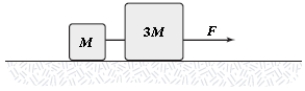
(Multiple Choice)
4.8/5 (84)
(84) A 2.0-kg object has a velocity of 4.0  m/s at t = 0. A constant resultant force of (2.0
 + 4.0
 ) N then acts on the object for 3.0 s. What is the magnitude of the object's velocity at the end of the 3.0-s interval?
m/s at t = 0. A constant resultant force of (2.0 + 4.0 ) N then acts on the object for 3.0 s. What is the magnitude of the object's velocity at the end of the 3.0-s interval? (Multiple Choice)
4.9/5 (78)
(78) If the tension, T, is 15 N and the magnitude of the acceleration, a, is 3.0 m/s2, what is the mass, m, of the suspended object? Assume that all surfaces and the pulley are frictionless. 
(Multiple Choice)
4.9/5 (91)
(91) A constant force is applied to a body that is already moving. The force is directed at an angle of 60 degrees to the direction of the body's velocity. What is most likely to happen is that
(Multiple Choice)
4.9/5 (97)
(97) Three boxes are pushed across a frictionless horizontal surface as shown. When we compare the normal force N2,5 that mass 2m exerts on mass 5m with the normal force N5,10 that mass 5m exerts on mass 10m, we find that 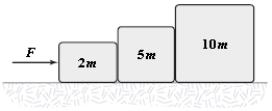
(Multiple Choice)
5.0/5 (87)
(87) A box rests on the (horizontal) back of a truck. The coefficient of static friction between the box and the surface on which it rests is 0.24. What maximum distance can the truck travel (starting from rest and moving horizontally with constant acceleration) in 3.0 s without having the box slide?
(Multiple Choice)
4.8/5 (69)
(69) A 2.0-kg block slides on a rough horizontal surface. A force (P = 6.0 N) is applied to the block as shown. The magnitude of the block's acceleration is 1.2 m/s2. What is the magnitude of the force of friction acting on the block? 
(Multiple Choice)
4.9/5 (69)
(69) In the figure shown, the coefficient of kinetic friction between the block and the incline is 0.40. What is the magnitude of the acceleration of the suspended block as it falls? Disregard any pulley mass or friction in the pulley. 
(Multiple Choice)
4.8/5 (82)
(82) If F = 40 N and M = 2.0 kg, what is the magnitude of the acceleration of the suspended object? All surfaces are frictionless. 
(Multiple Choice)
4.7/5 (68)
(68) 
Filters
- Essay(0)
- Multiple Choice(0)
- Short Answer(0)
- True False(0)
- Matching(0)