



 Chat with AI
Exam 43: The Immune System

Exam 1: Introduction: Themes in the Study of Life64 Questions
Exam 2: The Chemical Context of Life83 Questions
Exam 3: Water and Life70 Questions
Exam 4: Carbon and the Molecular Diversity of Life71 Questions
Exam 5: The Structure and Function of Large Biological Molecules109 Questions
Exam 6: A Tour of the Cell80 Questions
Exam 7: Membrane Structure and Function80 Questions
Exam 8: An Introduction to Metabolism80 Questions
Exam 9: Cellular Respiration and Fermentation107 Questions
Exam 10: Photosynthesis81 Questions
Exam 11: Cell Communication69 Questions
Exam 12: The Cell Cycle79 Questions
Exam 13: Meiosis and Sexual Life Cycles70 Questions
Exam 14: Mendel and the Gene Idea73 Questions
Exam 15: The Chromosomal Basis of Inheritance61 Questions
Exam 16: The Molecular Basis of Inheritance57 Questions
Exam 17: From Gene to Protein83 Questions
Exam 18: Regulation of Gene Expression99 Questions
Exam 19: Viruses47 Questions
Exam 20: Biotechnology72 Questions
Exam 21: Genomes and Their Evolution42 Questions
Exam 22: Descent with Modification: A Darwinian View of Life55 Questions
Exam 23: The Evolution of Populations78 Questions
Exam 24: The Origin of Species63 Questions
Exam 25: The History of Life on Earth75 Questions
Exam 26: Phylogeny and the Tree of Life73 Questions
Exam 27: Bacteria and Archaea78 Questions
Exam 28: Protists76 Questions
Exam 29: Plant Diversity I: How Plants Colonized Land74 Questions
Exam 30: Plant Diversity II: The Evolution of Seed Plants102 Questions
Exam 31: Fungi89 Questions
Exam 32: An Overview of Animal Diversity74 Questions
Exam 33: An Introduction to Invertebrates93 Questions
Exam 34: The Origin and Evolution of Vertebrates109 Questions
Exam 35: Plant Structure, Growth, and Development67 Questions
Exam 36: Resource Acquisition and Transport in Vascular Plants82 Questions
Exam 37: Soil and Plant Nutrition83 Questions
Exam 38: Angiosperm Reproduction and Biotechnology86 Questions
Exam 39: Plant Responses to Internal and External Signals108 Questions
Exam 40: Basic Principles of Animal Form and Function77 Questions
Exam 41: Animal Nutrition64 Questions
Exam 42: Circulation and Gas Exchange90 Questions
Exam 43: The Immune System100 Questions
Exam 44: Osmoregulation and Excretion69 Questions
Exam 45: Hormones and the Endocrine System72 Questions
Exam 46: Animal Reproduction94 Questions
Exam 47: Animal Development92 Questions
Exam 48: Neurons, Synapses, and Signaling73 Questions
Exam 49: Nervous Systems65 Questions
Exam 50: Sensory and Motor Mechanisms82 Questions
Exam 51: Animal Behavior69 Questions
Exam 52: An Introduction to Ecology and the Biosphere73 Questions
Exam 53: Population Ecology79 Questions
Exam 54: Community Ecology77 Questions
Exam 55: Ecosystems and Restoration Ecology81 Questions
Exam 56: Conservation Biology and Global Change67 Questions
Select questions type


The number of MHC protein combinations possible in a given population is enormous. However, an individual in that diverse population has a far more limited array of MHC molecules because
(Multiple Choice)
4.8/5  (83)
(83) Select the pathway that would lead to the activation of cytotoxic T cells.
(Multiple Choice)
4.8/5 (89)
(89) Antibodies of the different classes IgM, IgG, IgA, IgD, and IgE differ from each other
(Multiple Choice)
4.7/5 (79)
(79) Within a differentiated B cell, the rearrangement of DNA sequences between variable regions and joining regions is accomplished by
(Multiple Choice)
4.8/5 (78)
(78) A systemic inflammatory response that is often life-threatening is
(Multiple Choice)
4.8/5 (82)
(82) Bacterial infection in a previously uninfected house cat would most quickly activate its
(Multiple Choice)
4.9/5 (82)
(82) An immune response to a tissue graft will differ from an immune response to a bacterium because
(Multiple Choice)
4.8/5 (87)
(87) An epitope associates with which part of an antigen receptor or antibody?
(Multiple Choice)
4.8/5 (90)
(90) 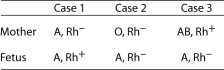 -Study the table. Giving the mother anti-Rh antibodies before delivering her baby would be a wise precaution in
 (Multiple Choice)
4.9/5 (69)
(69) Use the following information to answer the next few questions.
An otherwise healthy student in your class is infected with EBV, the virus that causes infectious mononucleosis. The same student had already been infected when she was a child, at which time she had merely experienced a mild sore throat and swollen lymph nodes in her neck. This time, though infected, she does not get sick.
-Her immune system's recognition of the second infection involves the
(Multiple Choice)
4.8/5 (71)
(71) The cells involved in innate immunity, whose absence increases the chances of developing malignant tumors, are
(Multiple Choice)
4.9/5 (79)
(79) An inflammation-causing signal released by mast cells at the site of an infection is
(Multiple Choice)
4.9/5 (83)
(83) The ability of one person to produce over a million different antibody molecules does not require over a million different genes; rather, this wide range of antibody production is due to
(Multiple Choice)
4.9/5 (79)
(79)  -According to the graph, naive B cells will produce effector cells
 (Multiple Choice)
4.8/5 (75)
(75) Secondary immune responses upon a second exposure to a pathogen are due to the activation of
(Multiple Choice)
4.9/5 (71)
(71) 
Filters
- Essay(0)
- Multiple Choice(0)
- Short Answer(0)
- True False(0)
- Matching(0)