



 Chat with AI
Exam 31: Fungi

Exam 1: Introduction: Themes in the Study of Life64 Questions
Exam 2: The Chemical Context of Life83 Questions
Exam 3: Water and Life70 Questions
Exam 4: Carbon and the Molecular Diversity of Life71 Questions
Exam 5: The Structure and Function of Large Biological Molecules109 Questions
Exam 6: A Tour of the Cell80 Questions
Exam 7: Membrane Structure and Function80 Questions
Exam 8: An Introduction to Metabolism80 Questions
Exam 9: Cellular Respiration and Fermentation107 Questions
Exam 10: Photosynthesis81 Questions
Exam 11: Cell Communication69 Questions
Exam 12: The Cell Cycle79 Questions
Exam 13: Meiosis and Sexual Life Cycles70 Questions
Exam 14: Mendel and the Gene Idea73 Questions
Exam 15: The Chromosomal Basis of Inheritance61 Questions
Exam 16: The Molecular Basis of Inheritance57 Questions
Exam 17: From Gene to Protein83 Questions
Exam 18: Regulation of Gene Expression99 Questions
Exam 19: Viruses47 Questions
Exam 20: Biotechnology72 Questions
Exam 21: Genomes and Their Evolution42 Questions
Exam 22: Descent with Modification: A Darwinian View of Life55 Questions
Exam 23: The Evolution of Populations78 Questions
Exam 24: The Origin of Species63 Questions
Exam 25: The History of Life on Earth75 Questions
Exam 26: Phylogeny and the Tree of Life73 Questions
Exam 27: Bacteria and Archaea78 Questions
Exam 28: Protists76 Questions
Exam 29: Plant Diversity I: How Plants Colonized Land74 Questions
Exam 30: Plant Diversity II: The Evolution of Seed Plants102 Questions
Exam 31: Fungi89 Questions
Exam 32: An Overview of Animal Diversity74 Questions
Exam 33: An Introduction to Invertebrates93 Questions
Exam 34: The Origin and Evolution of Vertebrates109 Questions
Exam 35: Plant Structure, Growth, and Development67 Questions
Exam 36: Resource Acquisition and Transport in Vascular Plants82 Questions
Exam 37: Soil and Plant Nutrition83 Questions
Exam 38: Angiosperm Reproduction and Biotechnology86 Questions
Exam 39: Plant Responses to Internal and External Signals108 Questions
Exam 40: Basic Principles of Animal Form and Function77 Questions
Exam 41: Animal Nutrition64 Questions
Exam 42: Circulation and Gas Exchange90 Questions
Exam 43: The Immune System100 Questions
Exam 44: Osmoregulation and Excretion69 Questions
Exam 45: Hormones and the Endocrine System72 Questions
Exam 46: Animal Reproduction94 Questions
Exam 47: Animal Development92 Questions
Exam 48: Neurons, Synapses, and Signaling73 Questions
Exam 49: Nervous Systems65 Questions
Exam 50: Sensory and Motor Mechanisms82 Questions
Exam 51: Animal Behavior69 Questions
Exam 52: An Introduction to Ecology and the Biosphere73 Questions
Exam 53: Population Ecology79 Questions
Exam 54: Community Ecology77 Questions
Exam 55: Ecosystems and Restoration Ecology81 Questions
Exam 56: Conservation Biology and Global Change67 Questions
Select questions type


The functional significance of porous septa in certain fungal hyphae is most similar to that represented by which pair of structures in animal cells and plant cells, respectively?
(Multiple Choice)
4.8/5  (78)
(78) Which statement is a correct interpretation of the data in the previous tables?
(Multiple Choice)
4.9/5 (79)
(79) Please refer to the following information to answer the next few questions.
Diploid nuclei of the ascomycete, Neurospora crassa, contain 14 chromosomes. A single diploid cell in an ascus will undergo one round of meiosis, followed in each of the daughter cells by one round of mitosis, producing a total of eight ascospores.
-What is the ploidy of a single mature ascospore?
(Multiple Choice)
4.8/5 (72)
(72) Mycorrhizae are to the roots of vascular plants as endophytes are to vascular plants'
(Multiple Choice)
4.9/5 (78)
(78) If Penicillium typically secretes penicillin without disturbing the lichen relationship in which it is engaged, then what must have been true about its partner?
(Multiple Choice)
4.8/5 (94)
(94) Fossil fungi date back to the origin and early evolution of plants. What combination of environmental and morphological change is similar in the evolution of both fungi and plants?
(Multiple Choice)
4.8/5 (82)
(82) If the fungus that produced the fairy ring can also produce arbuscules, then which of the following is most likely to be buried at location "C"?
(Multiple Choice)
4.9/5 (79)
(79) A billionaire buys a sterile volcanic island that recently emerged from the sea. To speed the arrival of conditions necessary for plant growth, the billionaire might be advised to aerially sow what over the island?
(Multiple Choice)
4.8/5 (71)
(71) Sexual reproduction has not been observed in Bd. If its morphology and genetics did not identify it as a chytridiomycete, then to which fungal group would Bd be assigned?
(Multiple Choice)
4.8/5 (78)
(78) The microsporidian, Brachiola gambiae, parasitizes the mosquito, Anopheles gambiae. Adult female mosquitoes must take blood meals in order for their eggs to develop, and it is while they take blood that they transmit malarial parasites to humans. Male mosquitoes drink flower nectar. If humans are to safely and effectively use Brachiola gambiae as a biological control to reduce human deaths from malaria, then how many of the following statements should be true?
1)Brachiola should kill the mosquitoes before the malarial parasite they carry reaches maturity.
2)The microsporidian should not be harmful to other insects.
3)Microsporidians should infect mosquito larvae, rather than mosquito adults.
4)The subsequent decline in anopheline mosquitoes should not significantly disrupt human food resources or other food webs.
5)Brachiola must be harmful to male mosquitoes, but not to female mosquitoes.
(Multiple Choice)
4.9/5 (76)
(76) If Bd cannot grow properly at temperatures above 28°C (82°F), then, assuming the amphibians can survive, in which time or place should the chytrid infection proceed most rapidly?
1)cooler months
2)warmer months
3)lower altitudes
4)higher altitudes
(Multiple Choice)
4.9/5 (76)
(76) Which of the following cells or structures are associated with asexual reproduction in fungi?
(Multiple Choice)
4.8/5 (76)
(76) Which of the following terms refers to symbiotic relationships that involve fungi living between the cells in plant leaves?
(Multiple Choice)
4.9/5 (80)
(80) Which of the following characteristics is shared by both chytrids and other kinds of fungi?
(Multiple Choice)
4.8/5 (80)
(80) You are given an organism to identify. It has a fruiting body that contains many structures with eight haploid spores lined up in a row. What kind of a fungus is this?
(Multiple Choice)
4.8/5 (61)
(61) Surface area represents the area available for exchange with the environment, whereas volume represents the cytoplasm which requires nutrients and from which waste products (usually toxic)must be removed. Which of the following should provide the most favorable conditions for effective exchange?
(Multiple Choice)
4.9/5 (65)
(65) The following figure depicts the outline of a large fairy ring that has appeared overnight in an open meadow, as viewed from above. The fairy ring represents the furthest advance of this mycelium through the soil. Locations A-D are all 0.5 meters below the soil surface. Responses may be used once, more than once, or not at all.
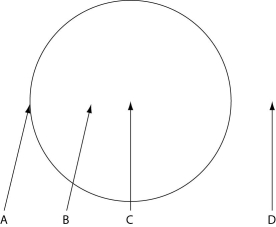 -At which location should one find the lowest concentration of fungal enzymes, assuming that the enzymes do not diffuse far from their source, and that no other fungi are present in this habitat?
 (Multiple Choice)
4.7/5 (83)
(83) The following figure depicts the outline of a large fairy ring that has appeared overnight in an open meadow, as viewed from above. The fairy ring represents the furthest advance of this mycelium through the soil. Locations A-D are all 0.5 meters below the soil surface. Responses may be used once, more than once, or not at all.
-What is the most probable location of the oldest portion of this mycelium?
-What is the most probable location of the oldest portion of this mycelium? (Multiple Choice)
4.8/5 (80)
(80) In septate fungi, what structures allow cytoplasmic streaming to distribute needed nutrients, synthesized compounds, and organelles throughout the hyphae?
(Multiple Choice)
4.7/5 (84)
(84) Among the organisms listed here, which are thought to be the closest relatives of fungi?
(Multiple Choice)
4.9/5 (81)
(81) 
Filters
- Essay(0)
- Multiple Choice(0)
- Short Answer(0)
- True False(0)
- Matching(0)