



 Chat with AI
Exam 31: Fungi

Exam 1: Introduction: Themes in the Study of Life64 Questions
Exam 2: The Chemical Context of Life83 Questions
Exam 3: Water and Life70 Questions
Exam 4: Carbon and the Molecular Diversity of Life71 Questions
Exam 5: The Structure and Function of Large Biological Molecules109 Questions
Exam 6: A Tour of the Cell80 Questions
Exam 7: Membrane Structure and Function80 Questions
Exam 8: An Introduction to Metabolism80 Questions
Exam 9: Cellular Respiration and Fermentation107 Questions
Exam 10: Photosynthesis81 Questions
Exam 11: Cell Communication69 Questions
Exam 12: The Cell Cycle79 Questions
Exam 13: Meiosis and Sexual Life Cycles70 Questions
Exam 14: Mendel and the Gene Idea73 Questions
Exam 15: The Chromosomal Basis of Inheritance61 Questions
Exam 16: The Molecular Basis of Inheritance57 Questions
Exam 17: From Gene to Protein83 Questions
Exam 18: Regulation of Gene Expression99 Questions
Exam 19: Viruses47 Questions
Exam 20: Biotechnology72 Questions
Exam 21: Genomes and Their Evolution42 Questions
Exam 22: Descent with Modification: A Darwinian View of Life55 Questions
Exam 23: The Evolution of Populations78 Questions
Exam 24: The Origin of Species63 Questions
Exam 25: The History of Life on Earth75 Questions
Exam 26: Phylogeny and the Tree of Life73 Questions
Exam 27: Bacteria and Archaea78 Questions
Exam 28: Protists76 Questions
Exam 29: Plant Diversity I: How Plants Colonized Land74 Questions
Exam 30: Plant Diversity II: The Evolution of Seed Plants102 Questions
Exam 31: Fungi89 Questions
Exam 32: An Overview of Animal Diversity74 Questions
Exam 33: An Introduction to Invertebrates93 Questions
Exam 34: The Origin and Evolution of Vertebrates109 Questions
Exam 35: Plant Structure, Growth, and Development67 Questions
Exam 36: Resource Acquisition and Transport in Vascular Plants82 Questions
Exam 37: Soil and Plant Nutrition83 Questions
Exam 38: Angiosperm Reproduction and Biotechnology86 Questions
Exam 39: Plant Responses to Internal and External Signals108 Questions
Exam 40: Basic Principles of Animal Form and Function77 Questions
Exam 41: Animal Nutrition64 Questions
Exam 42: Circulation and Gas Exchange90 Questions
Exam 43: The Immune System100 Questions
Exam 44: Osmoregulation and Excretion69 Questions
Exam 45: Hormones and the Endocrine System72 Questions
Exam 46: Animal Reproduction94 Questions
Exam 47: Animal Development92 Questions
Exam 48: Neurons, Synapses, and Signaling73 Questions
Exam 49: Nervous Systems65 Questions
Exam 50: Sensory and Motor Mechanisms82 Questions
Exam 51: Animal Behavior69 Questions
Exam 52: An Introduction to Ecology and the Biosphere73 Questions
Exam 53: Population Ecology79 Questions
Exam 54: Community Ecology77 Questions
Exam 55: Ecosystems and Restoration Ecology81 Questions
Exam 56: Conservation Biology and Global Change67 Questions
Select questions type


When pathogenic fungi are found growing on the roots of grape vines, grape farmers sometimes respond by covering the ground around their vines with plastic sheeting and pumping a gaseous fungicide into the soil. The most important concern of grape farmers who engage in this practice should be that the
(Multiple Choice)
4.8/5  (91)
(91) The adaptive advantage associated with the filamentous nature of fungal mycelia is primarily related to
(Multiple Choice)
5.0/5 (74)
(74) When a mycelium infiltrates an unexploited source of dead organic matter, what are most likely to appear within the food source soon thereafter?
(Multiple Choice)
4.8/5 (83)
(83) If all of their nuclei are equally active transcriptionally, then the cells of both dikaryotic and heterokaryotic fungi, in terms of the gene products they can make, are essentially
(Multiple Choice)
4.8/5 (69)
(69) Orchid seeds are tiny, with virtually no endosperm and with miniscule cotyledons. If such seeds are deposited in a dark, moist environment, then which of the following represents the most likely means by which fungi might assist in seed germination, given what the seeds lack?
(Multiple Choice)
5.0/5 (57)
(57) Which of the following microsporidian features are shared with many other fungi?
1)chitinous cell wall
2)two haploid nuclei per cell
3)polar filament
4)chemoheterotrophy
(Multiple Choice)
4.9/5 (73)
(73) The next few questions refer to the following phylogenetic trees.
I. 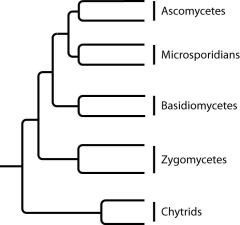 II.
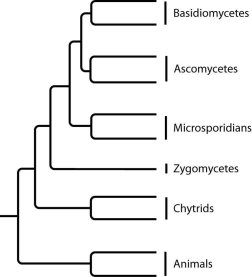 .
III.
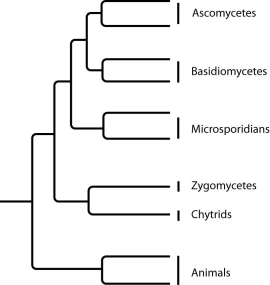 IV.
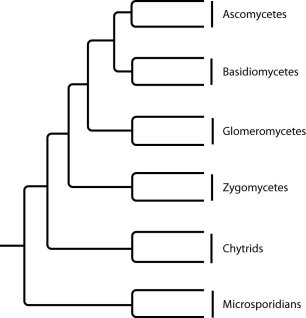 .
-Which tree depicts the microsporidians as a sister group of the fungi, rather than as a fungus?
II. .
III.
IV. .
-Which tree depicts the microsporidians as a sister group of the fungi, rather than as a fungus? (Multiple Choice)
4.9/5 (78)
(78) Humans have immune systems in which lymph nodes are important, because many phagocytes and lymphocytes reside there. Given that a successful infection by S. schenkii damages lymph nodes themselves, which of the following is most probable?
(Multiple Choice)
4.8/5 (73)
(73) In what structures do both Penicillium and Aspergillus produce asexual spores?
(Multiple Choice)
4.7/5 (86)
(86) For several decades now, amphibian species worldwide have been in decline. A significant proportion of the decline seems to be due to the spread of the chytrid fungus, Batrachochytrium dendrobatidis (Bd). Chytrid sporangia reside within the epidermal cells of infected animals, animals that consequently show areas of sloughed skin. They can also be lethargic, which is expressed through failure to hide and failure to flee. The infection cycle typically takes four to five days, at the end of which zoospores are released from sporangia into the environment. In some amphibian species, mortality rates approach 100%; other species seem able to survive the infection.
-Apart from direct amphibian-to-amphibian contact, what is the most likely means by which the zoospores spread from one free-living amphibian to another?
(Multiple Choice)
4.7/5 (88)
(88) Say S. schenkii had initially been classified as a deuteromycete. Asci were later discovered in the pus that oozed from an ulcerated lymph node, and the spores therein germinated, giving rise to S. schenkii yeasts. Which two of these are conclusions that make sense on the basis of this information?
1)S. schenkii produces asexual spores within lymph nodes.
2)S. schenkii should be reclassified.
3)S. schenkii continues to have no known sexual stage.
4)The hyphae growing in lymphatic vessels probably belonged to a different fungal species.
5)S. schenkii yeasts belonging to two different mating strains were introduced by the same thorn prick.
(Multiple Choice)
4.7/5 (79)
(79) When adult amphibian skin harbors populations of the bacterium, Janthinobacterium lividum (Jl), chytrid infection seems to be inhibited. Which of the following represents the best experimental design for conclusively determining whether this inhibition is real?
(Multiple Choice)
4.8/5 (88)
(88) Both fungus-derived antibiotics and hallucinogens used by humans probably evolved in fungi as a means to
(Multiple Choice)
4.8/5 (97)
(97) Consider two hyphae having equal dimensions: one from a septate species and the other from a coenocytic species. Compared with the septate species, the coenocytic species should have
(Multiple Choice)
4.9/5 (74)
(74) Many infected animals are induced by the parasitic microsporidians to develop huge cells, known as xenomas, which are full of spores. Given their large size, what should be true of the xenomas?
(Multiple Choice)
4.9/5 (70)
(70) Chemicals, secreted by soil fungi, that inhibit the growth of bacteria are known as
(Multiple Choice)
5.0/5 (72)
(72) Which feature seen in chytrids supports the hypothesis that they diverged earliest in fungal evolution?
(Multiple Choice)
4.9/5 (92)
(92) The hydrolytic digestion of which of the following should produce monomers that are aminated (i.e., have an amine group attached)molecules of β-glucose?
(Multiple Choice)
4.8/5 (84)
(84) Which of these paired fungal structures are structurally and functionally most alike?
(Multiple Choice)
4.8/5 (79)
(79) 
Filters
- Essay(0)
- Multiple Choice(0)
- Short Answer(0)
- True False(0)
- Matching(0)