



 Chat with AI
Exam 31: Fungi

Exam 1: Introduction: Themes in the Study of Life64 Questions
Exam 2: The Chemical Context of Life83 Questions
Exam 3: Water and Life70 Questions
Exam 4: Carbon and the Molecular Diversity of Life71 Questions
Exam 5: The Structure and Function of Large Biological Molecules109 Questions
Exam 6: A Tour of the Cell80 Questions
Exam 7: Membrane Structure and Function80 Questions
Exam 8: An Introduction to Metabolism80 Questions
Exam 9: Cellular Respiration and Fermentation107 Questions
Exam 10: Photosynthesis81 Questions
Exam 11: Cell Communication69 Questions
Exam 12: The Cell Cycle79 Questions
Exam 13: Meiosis and Sexual Life Cycles70 Questions
Exam 14: Mendel and the Gene Idea73 Questions
Exam 15: The Chromosomal Basis of Inheritance61 Questions
Exam 16: The Molecular Basis of Inheritance57 Questions
Exam 17: From Gene to Protein83 Questions
Exam 18: Regulation of Gene Expression99 Questions
Exam 19: Viruses47 Questions
Exam 20: Biotechnology72 Questions
Exam 21: Genomes and Their Evolution42 Questions
Exam 22: Descent with Modification: A Darwinian View of Life55 Questions
Exam 23: The Evolution of Populations78 Questions
Exam 24: The Origin of Species63 Questions
Exam 25: The History of Life on Earth75 Questions
Exam 26: Phylogeny and the Tree of Life73 Questions
Exam 27: Bacteria and Archaea78 Questions
Exam 28: Protists76 Questions
Exam 29: Plant Diversity I: How Plants Colonized Land74 Questions
Exam 30: Plant Diversity II: The Evolution of Seed Plants102 Questions
Exam 31: Fungi89 Questions
Exam 32: An Overview of Animal Diversity74 Questions
Exam 33: An Introduction to Invertebrates93 Questions
Exam 34: The Origin and Evolution of Vertebrates109 Questions
Exam 35: Plant Structure, Growth, and Development67 Questions
Exam 36: Resource Acquisition and Transport in Vascular Plants82 Questions
Exam 37: Soil and Plant Nutrition83 Questions
Exam 38: Angiosperm Reproduction and Biotechnology86 Questions
Exam 39: Plant Responses to Internal and External Signals108 Questions
Exam 40: Basic Principles of Animal Form and Function77 Questions
Exam 41: Animal Nutrition64 Questions
Exam 42: Circulation and Gas Exchange90 Questions
Exam 43: The Immune System100 Questions
Exam 44: Osmoregulation and Excretion69 Questions
Exam 45: Hormones and the Endocrine System72 Questions
Exam 46: Animal Reproduction94 Questions
Exam 47: Animal Development92 Questions
Exam 48: Neurons, Synapses, and Signaling73 Questions
Exam 49: Nervous Systems65 Questions
Exam 50: Sensory and Motor Mechanisms82 Questions
Exam 51: Animal Behavior69 Questions
Exam 52: An Introduction to Ecology and the Biosphere73 Questions
Exam 53: Population Ecology79 Questions
Exam 54: Community Ecology77 Questions
Exam 55: Ecosystems and Restoration Ecology81 Questions
Exam 56: Conservation Biology and Global Change67 Questions
Select questions type


The following figure depicts the outline of a large fairy ring that has appeared overnight in an open meadow, as viewed from above. The fairy ring represents the furthest advance of this mycelium through the soil. Locations A-D are all 0.5 meters below the soil surface. Responses may be used once, more than once, or not at all.
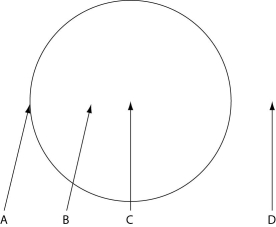 -Assume that all four locations are 0.5 m above the surface. On a breezy day with prevailing winds blowing from left to right, where should one expect to find the highest concentration of free basidiospores in an air sample?
 (Multiple Choice)
4.9/5  (91)
(91) Which of the following best describes the physical relationship of the partners involved in lichens?
(Multiple Choice)
4.9/5 (74)
(74) 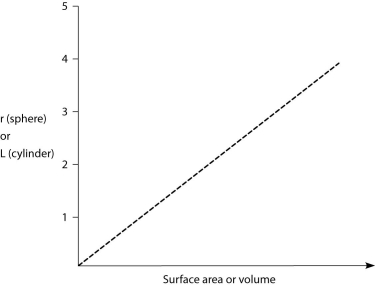 -Both axes of the graph are linear. Thus, the shape of the line plotted on this graph most accurately depicts the
 (Multiple Choice)
4.9/5 (61)
(61) A researcher took water in which a Jl population had been thriving, filtered the water to remove all bacterial cells, and then applied the water to the skins of adult amphibians to see if there would subsequently be a reduced infection rate by Bd when frog skins were inoculated with Bd. For which of the following hypotheses is the procedure described a potential test?
(Multiple Choice)
4.8/5 (83)
(83) The fact that infection by Bd causes lethargy in many infected amphibians can have what effect on efforts to accurately census the numbers of dead or dying amphibians at a particular time, in a particular habitat?
(Multiple Choice)
5.0/5 (83)
(83) Please refer to the following information to answer the next few questions.
Diploid nuclei of the ascomycete, Neurospora crassa, contain 14 chromosomes. A single diploid cell in an ascus will undergo one round of meiosis, followed in each of the daughter cells by one round of mitosis, producing a total of eight ascospores.
-If a single, diploid G₂ nucleus in an ascus contains 400 nanograms (ng)of DNA, then a single ascospore nucleus of this species should contain how much DNA (ng), carried on how many chromosomes?
(Multiple Choice)
4.7/5 (76)
(76) Which description does not apply equally well to both sexual and asexual spores?
(Multiple Choice)
4.8/5 (78)
(78) Plasmogamy can directly result in which of the following?
1)cells with a single haploid nucleus
2)heterokaryotic cells
3)dikaryotic cells
4)cells with two diploid nuclei
(Multiple Choice)
4.8/5 (94)
(94) After cytokinesis occurs in budding yeasts, the daughter cell has a
(Multiple Choice)
4.8/5 (89)
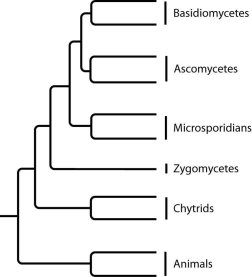
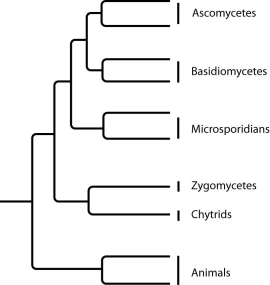
(89) The next few questions refer to the following phylogenetic trees.
I. 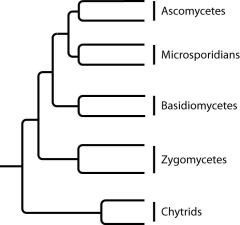 II.
 .
III.
 IV.
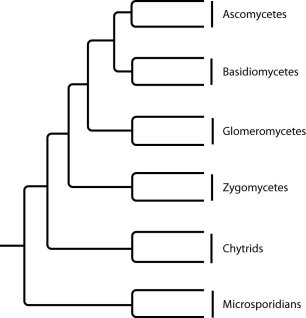 .
-Which tree depicts the closest relationship between zygomycetes and chytrids?
II. .
III.
IV. .
-Which tree depicts the closest relationship between zygomycetes and chytrids? (Multiple Choice)
4.9/5 (77)
(77) The following figure depicts the outline of a large fairy ring that has appeared overnight in an open meadow, as viewed from above. The fairy ring represents the furthest advance of this mycelium through the soil. Locations A-D are all 0.5 meters below the soil surface. Responses may be used once, more than once, or not at all.
-At which location is the mycelium currently absorbing the most nutrients per unit surface area, per unit time?
-At which location is the mycelium currently absorbing the most nutrients per unit surface area, per unit time? (Multiple Choice)
4.8/5 (63)
(63) If all fungi in an environment that perform decomposition were to suddenly die, then which group of organisms should benefit most, due to the fact that their fungal competitors have been removed?
(Multiple Choice)
4.8/5 (82)
(82) What accounts most directly for the extremely fast growth of a fungal mycelium?
(Multiple Choice)
4.9/5 (86)
(86) Which of the following has the least affiliation with all of the others?
(Multiple Choice)
4.9/5 (69)
(69) In which of the following human mycoses should one expect to find a growth pattern most similar to that of the mycelium that produced the fairy ring?
(Multiple Choice)
4.8/5 (86)
(86) Which of the following is a characteristic of hyphate fungi (fungi featuring hyphae)?
(Multiple Choice)
4.9/5 (77)
(77) Unicellular yeasts can be represented as spheres, whereas filamentous hyphae more closely resemble cylinders. As these two geometric figures increase in size, their surface area-to-volume ratios change. The following tables demonstrate how this ratio changes, first for spheres, and second for cylinders. For the cylinder, girth (i.e., radius, r) will remain constant, whereas length, L, will increase. Note the formulas below the respective tables.
A sphere's change in surface area and volume with increasing radius, r
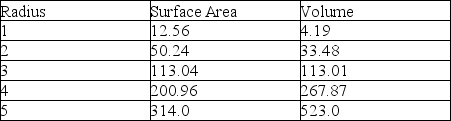 Area of a Sphere = 4r² Volume of a Sphere = 4/3r³
A cylinder's change in surface area and volume with increasing length, L
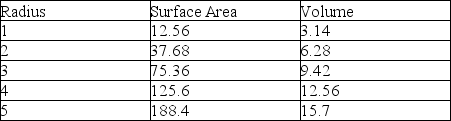 Area of a Cylinder = 2(r²) + 2rL Volume of a Cylinder = r²ᴸ
-As a direct result of increasing surface area in both yeasts and filamentous hyphae, which cell structures/materials must also increase?
1)amount of chitin
2)number of nuclei
3)amount of plasma membrane
4)number of mitochondria
5)amount of peptidoglycan
Area of a Sphere = 4r² Volume of a Sphere = 4/3r³
A cylinder's change in surface area and volume with increasing length, L
Area of a Cylinder = 2(r²) + 2rL Volume of a Cylinder = r²ᴸ
-As a direct result of increasing surface area in both yeasts and filamentous hyphae, which cell structures/materials must also increase?
1)amount of chitin
2)number of nuclei
3)amount of plasma membrane
4)number of mitochondria
5)amount of peptidoglycan (Multiple Choice)
4.7/5 (70)
(70) Please refer to the following information to answer the next few questions.
Diploid nuclei of the ascomycete, Neurospora crassa, contain 14 chromosomes. A single diploid cell in an ascus will undergo one round of meiosis, followed in each of the daughter cells by one round of mitosis, producing a total of eight ascospores.
-Each of the eight ascospores present at the end of mitosis has the same chromosome number and DNA content (ng)as each of the four cells at the end of meiosis. What must have occurred in each spore between the round of meiosis and the round of mitosis?
(Multiple Choice)
4.7/5 (91)
(91) A fungal spore germinates, giving rise to a mycelium that grows outward into the soil surrounding the site where the spore originally landed. Which of the following accounts for the fungal movement, as described here?
(Multiple Choice)
4.8/5 (86)
(86) 
Filters
- Essay(0)
- Multiple Choice(0)
- Short Answer(0)
- True False(0)
- Matching(0)