



 Chat with AI
Exam 9: Cellular Respiration and Fermentation

Exam 1: Introduction: Themes in the Study of Life64 Questions
Exam 2: The Chemical Context of Life83 Questions
Exam 3: Water and Life70 Questions
Exam 4: Carbon and the Molecular Diversity of Life71 Questions
Exam 5: The Structure and Function of Large Biological Molecules109 Questions
Exam 6: A Tour of the Cell80 Questions
Exam 7: Membrane Structure and Function80 Questions
Exam 8: An Introduction to Metabolism80 Questions
Exam 9: Cellular Respiration and Fermentation107 Questions
Exam 10: Photosynthesis81 Questions
Exam 11: Cell Communication69 Questions
Exam 12: The Cell Cycle79 Questions
Exam 13: Meiosis and Sexual Life Cycles70 Questions
Exam 14: Mendel and the Gene Idea73 Questions
Exam 15: The Chromosomal Basis of Inheritance61 Questions
Exam 16: The Molecular Basis of Inheritance57 Questions
Exam 17: From Gene to Protein83 Questions
Exam 18: Regulation of Gene Expression99 Questions
Exam 19: Viruses47 Questions
Exam 20: Biotechnology72 Questions
Exam 21: Genomes and Their Evolution42 Questions
Exam 22: Descent with Modification: A Darwinian View of Life55 Questions
Exam 23: The Evolution of Populations78 Questions
Exam 24: The Origin of Species63 Questions
Exam 25: The History of Life on Earth75 Questions
Exam 26: Phylogeny and the Tree of Life73 Questions
Exam 27: Bacteria and Archaea78 Questions
Exam 28: Protists76 Questions
Exam 29: Plant Diversity I: How Plants Colonized Land74 Questions
Exam 30: Plant Diversity II: The Evolution of Seed Plants102 Questions
Exam 31: Fungi89 Questions
Exam 32: An Overview of Animal Diversity74 Questions
Exam 33: An Introduction to Invertebrates93 Questions
Exam 34: The Origin and Evolution of Vertebrates109 Questions
Exam 35: Plant Structure, Growth, and Development67 Questions
Exam 36: Resource Acquisition and Transport in Vascular Plants82 Questions
Exam 37: Soil and Plant Nutrition83 Questions
Exam 38: Angiosperm Reproduction and Biotechnology86 Questions
Exam 39: Plant Responses to Internal and External Signals108 Questions
Exam 40: Basic Principles of Animal Form and Function77 Questions
Exam 41: Animal Nutrition64 Questions
Exam 42: Circulation and Gas Exchange90 Questions
Exam 43: The Immune System100 Questions
Exam 44: Osmoregulation and Excretion69 Questions
Exam 45: Hormones and the Endocrine System72 Questions
Exam 46: Animal Reproduction94 Questions
Exam 47: Animal Development92 Questions
Exam 48: Neurons, Synapses, and Signaling73 Questions
Exam 49: Nervous Systems65 Questions
Exam 50: Sensory and Motor Mechanisms82 Questions
Exam 51: Animal Behavior69 Questions
Exam 52: An Introduction to Ecology and the Biosphere73 Questions
Exam 53: Population Ecology79 Questions
Exam 54: Community Ecology77 Questions
Exam 55: Ecosystems and Restoration Ecology81 Questions
Exam 56: Conservation Biology and Global Change67 Questions
Select questions type


A mutation in yeast makes it unable to convert pyruvate to ethanol. How will this mutation affect these yeast cells?
(Multiple Choice)
4.9/5  (89)
(89) A young animal has never had much energy. He is brought to a veterinarian for help and is sent to the animal hospital for some tests. There they discover his mitochondria can use only fatty acids and amino acids for respiration, and his cells produce more lactate than normal. Of the following, which is the best explanation of his condition?
(Multiple Choice)
4.7/5 (77)
(77) 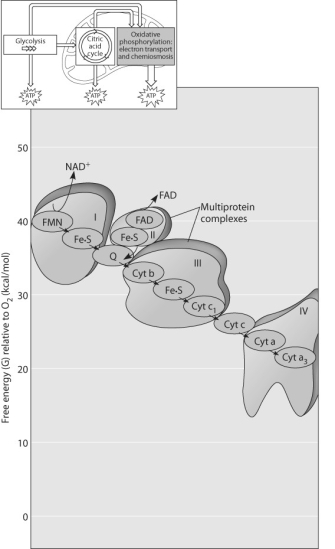 Figure 9.3
-What happens at the end of the chain in Figure 9.3?
Figure 9.3
-What happens at the end of the chain in Figure 9.3? (Multiple Choice)
4.8/5 (80)
(80) Substrate-level phosphorylation accounts for approximately what percentage of the ATP formed by the reactions of glycolysis?
(Multiple Choice)
4.7/5 (77)
(77) One function of both alcohol fermentation and lactic acid fermentation is to
(Multiple Choice)
4.7/5 (83)
(83) Why is glycolysis considered to be one of the first metabolic pathways to have evolved?
(Multiple Choice)
4.9/5 (83)
(83) Where are the proteins of the electron transport chain located?
(Multiple Choice)
4.8/5 (82)
(82) The final electron acceptor of the electron transport chain that functions in aerobic oxidative phosphorylation is
(Multiple Choice)
4.9/5 (74)
(74) Which process in eukaryotic cells will proceed normally whether oxygen (O₂)is present or absent?
(Multiple Choice)
4.8/5 (84)
(84) If a cell is able to synthesize 30 ATP molecules for each molecule of glucose completely oxidized by carbon dioxide and water, how many ATP molecules can the cell synthesize for each molecule of pyruvate oxidized to carbon dioxide and water?
(Multiple Choice)
4.8/5 (71)
(71) It is possible to prepare vesicles from portions of the inner mitochondrial membrane. Which one of the following processes could still be carried on by this isolated inner membrane?
(Multiple Choice)
4.7/5 (91)
(91) Brown fat cells produce a protein called thermogenin in their mitochondrial inner membrane. Thermogenin is a channel for facilitated transport of protons across the membrane. What will occur in the brown fat cells when they produce thermogenin?
(Multiple Choice)
4.9/5 (79)
(79) In glycolysis, for each molecule of glucose oxidized to pyruvate
(Multiple Choice)
4.7/5 (83)
(83) Which of the following normally occurs regardless of whether or not oxygen (O₂)is present?
(Multiple Choice)
5.0/5 (76)
(76) When electrons flow along the electron transport chains of mitochondria, which of the following changes occurs?
(Multiple Choice)
4.9/5 (82)
(82) The transport of pyruvate into mitochondria depends on the proton-motive force across the inner mitochondrial membrane. How does pyruvate enter the mitochondrion?
(Multiple Choice)
4.9/5 (80)
(80) Figure 9.1 illustrates some of the steps (reactions) of glycolysis in their proper sequence. Each step is lettered. Use these letters to answer the questions.
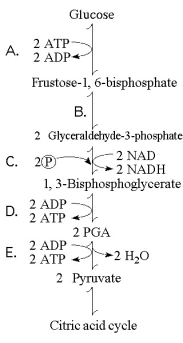 Figure 9.1
-In which step in Figure 9.1 is an inorganic phosphate added to the reactant?
Figure 9.1
-In which step in Figure 9.1 is an inorganic phosphate added to the reactant? (Multiple Choice)
4.8/5 (79)
(79) The synthesis of ATP by oxidative phosphorylation, using the energy released by movement of protons across the membrane down their electrochemical gradient, is an example of
(Multiple Choice)
4.8/5 (90)
(90) 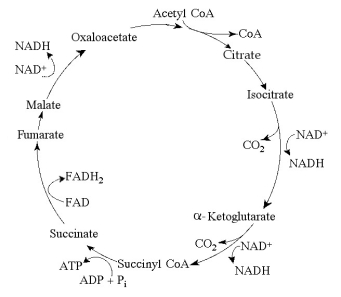 Figure 9.2 The citric acid cycle.
-Starting with one molecule of isocitrate and ending with fumarate, how many ATP molecules can be made through substrate-level phosphorylation (see Figure 9.2)?
Figure 9.2 The citric acid cycle.
-Starting with one molecule of isocitrate and ending with fumarate, how many ATP molecules can be made through substrate-level phosphorylation (see Figure 9.2)? (Multiple Choice)
4.8/5 (79)
(79) 
Filters
- Essay(0)
- Multiple Choice(0)
- Short Answer(0)
- True False(0)
- Matching(0)