



 Chat with AI
Exam 9: Cellular Respiration and Fermentation

Exam 1: Introduction: Themes in the Study of Life64 Questions
Exam 2: The Chemical Context of Life83 Questions
Exam 3: Water and Life70 Questions
Exam 4: Carbon and the Molecular Diversity of Life71 Questions
Exam 5: The Structure and Function of Large Biological Molecules109 Questions
Exam 6: A Tour of the Cell80 Questions
Exam 7: Membrane Structure and Function80 Questions
Exam 8: An Introduction to Metabolism80 Questions
Exam 9: Cellular Respiration and Fermentation107 Questions
Exam 10: Photosynthesis81 Questions
Exam 11: Cell Communication69 Questions
Exam 12: The Cell Cycle79 Questions
Exam 13: Meiosis and Sexual Life Cycles70 Questions
Exam 14: Mendel and the Gene Idea73 Questions
Exam 15: The Chromosomal Basis of Inheritance61 Questions
Exam 16: The Molecular Basis of Inheritance57 Questions
Exam 17: From Gene to Protein83 Questions
Exam 18: Regulation of Gene Expression99 Questions
Exam 19: Viruses47 Questions
Exam 20: Biotechnology72 Questions
Exam 21: Genomes and Their Evolution42 Questions
Exam 22: Descent with Modification: A Darwinian View of Life55 Questions
Exam 23: The Evolution of Populations78 Questions
Exam 24: The Origin of Species63 Questions
Exam 25: The History of Life on Earth75 Questions
Exam 26: Phylogeny and the Tree of Life73 Questions
Exam 27: Bacteria and Archaea78 Questions
Exam 28: Protists76 Questions
Exam 29: Plant Diversity I: How Plants Colonized Land74 Questions
Exam 30: Plant Diversity II: The Evolution of Seed Plants102 Questions
Exam 31: Fungi89 Questions
Exam 32: An Overview of Animal Diversity74 Questions
Exam 33: An Introduction to Invertebrates93 Questions
Exam 34: The Origin and Evolution of Vertebrates109 Questions
Exam 35: Plant Structure, Growth, and Development67 Questions
Exam 36: Resource Acquisition and Transport in Vascular Plants82 Questions
Exam 37: Soil and Plant Nutrition83 Questions
Exam 38: Angiosperm Reproduction and Biotechnology86 Questions
Exam 39: Plant Responses to Internal and External Signals108 Questions
Exam 40: Basic Principles of Animal Form and Function77 Questions
Exam 41: Animal Nutrition64 Questions
Exam 42: Circulation and Gas Exchange90 Questions
Exam 43: The Immune System100 Questions
Exam 44: Osmoregulation and Excretion69 Questions
Exam 45: Hormones and the Endocrine System72 Questions
Exam 46: Animal Reproduction94 Questions
Exam 47: Animal Development92 Questions
Exam 48: Neurons, Synapses, and Signaling73 Questions
Exam 49: Nervous Systems65 Questions
Exam 50: Sensory and Motor Mechanisms82 Questions
Exam 51: Animal Behavior69 Questions
Exam 52: An Introduction to Ecology and the Biosphere73 Questions
Exam 53: Population Ecology79 Questions
Exam 54: Community Ecology77 Questions
Exam 55: Ecosystems and Restoration Ecology81 Questions
Exam 56: Conservation Biology and Global Change67 Questions
Select questions type


Inside an active mitochondrion, most electrons follow which pathway?
(Multiple Choice)
4.9/5  (82)
(82) Which kind of metabolic poison would most directly interfere with glycolysis?
(Multiple Choice)
4.9/5 (92)
(92) During aerobic respiration, H₂O is formed. Where does the oxygen atom for the formation of the water come from?
(Multiple Choice)
4.9/5 (73)
(73) Which metabolic pathway is common to both fermentation and cellular respiration of a glucose molecule?
(Multiple Choice)
4.8/5 (80)
(80) 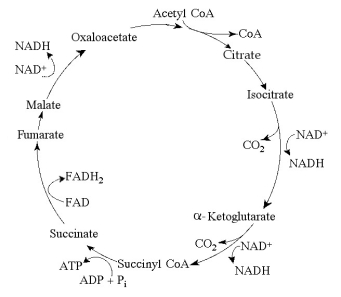 Figure 9.2 The citric acid cycle.
-If pyruvate oxidation is blocked, what will happen to the levels of oxaloacetate and citric acid in the citric acid cycle shown in Figure 9.2?
Figure 9.2 The citric acid cycle.
-If pyruvate oxidation is blocked, what will happen to the levels of oxaloacetate and citric acid in the citric acid cycle shown in Figure 9.2? (Multiple Choice)
4.7/5 (75)
(75) You have a friend who lost 7 kg (about 15 pounds)of fat on a regimen of strict diet and exercise. How did the fat leave her body?
(Multiple Choice)
4.8/5 (75)
(75) The ATP made during fermentation is generated by which of the following?
(Multiple Choice)
4.8/5 (78)
(78) In liver cells, the inner mitochondrial membranes are about five times the area of the outer mitochondrial membranes. What purpose must this serve?
(Multiple Choice)
4.9/5 (97)
(97) In addition to ATP, what are the end products of glycolysis?
(Multiple Choice)
4.9/5 (72)
(72) Which of the following occurs in the cytosol of a eukaryotic cell?
(Multiple Choice)
4.8/5 (75)
(75) Approximately how many molecules of ATP are produced from the complete oxidation of two molecules of glucose (C₆H₁₂O₆)in aerobic cellular respiration?
(Multiple Choice)
4.8/5 (74)
(74) Which of the following intermediary metabolites enters the citric acid cycle and is formed, in part, by the removal of a carbon (CO₂)from one molecule of pyruvate?
(Multiple Choice)
4.9/5 (80)
(80) Chemiosmotic ATP synthesis (oxidative phosphorylation)occurs in
(Multiple Choice)
4.7/5 (90)
(90) In prokaryotes, the respiratory electron transport chain is located
(Multiple Choice)
4.9/5 (79)
(79)
Figure 9.2 The citric acid cycle.
-For each molecule of glucose that is metabolized by glycolysis and the citric acid cycle (see Figure 9.2), what is the total number of NADH + FADH₂ molecules produced?
Figure 9.2 The citric acid cycle.
-For each molecule of glucose that is metabolized by glycolysis and the citric acid cycle (see Figure 9.2), what is the total number of NADH + FADH₂ molecules produced? (Multiple Choice)
4.9/5 (75)
(75) The oxygen consumed during cellular respiration is involved directly in which process or event?
(Multiple Choice)
4.9/5 (88)
(88) 
Filters
- Essay(0)
- Multiple Choice(0)
- Short Answer(0)
- True False(0)
- Matching(0)