



 Chat with AI
Exam 19: Geology of the Solar System

Exam 1: The Nature of Geology110 Questions
Exam 2: Investigating Geologic Questions106 Questions
Exam 3: Plate Tectonics152 Questions
Exam 4: Earth Materials131 Questions
Exam 5: Igneous Environments147 Questions
Exam 6: Volcanoes and Volcanic Hazards186 Questions
Exam 7: Sedimentary Environments155 Questions
Exam 8: Deformation and Metamorphism144 Questions
Exam 9: Geologic Time126 Questions
Exam 10: Seafloor and Continental Margins105 Questions
Exam 11: Mountains, Basins, and Continents124 Questions
Exam 12: Earthquakes and Earths Interior119 Questions
Exam 13: Climate and Weathering109 Questions
Exam 14: Glaciers, Shorelines, and Changing Sea Levels109 Questions
Exam 15: Weathering, Soil, and Unstable Slopes92 Questions
Exam 16: Streams and Flooding137 Questions
Exam 17: Water Resources142 Questions
Exam 18: Energy and Mineral Resources95 Questions
Exam 19: Geology of the Solar System77 Questions
Select questions type


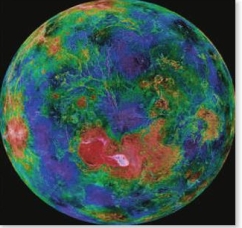
What was the main technique used to study the solid surface of Venus?
(Multiple Choice)
5.0/5  (77)
(77) What is the main control on whether a planet or moon has active tectonics and volcanism?
(Multiple Choice)
4.9/5 (68)
(68) The Moon has been volcanically and tectonically inactive for more than:
(Multiple Choice)
4.9/5 (78)
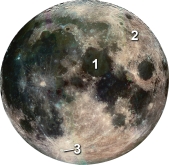
(78) 
The erosional features shown in this image from Mars are thought to have been formed by: 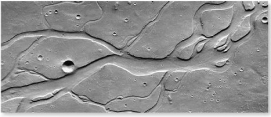
(Multiple Choice)
4.7/5 (101)
(101) Which of the following characteristics of Earth are not shared by many other planets?
(Multiple Choice)
4.9/5 (82)
(82) 
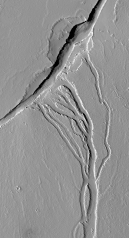
Which of the following features attracted geologists' attention on Mars?
(Multiple Choice)
4.9/5 (86)
(86) Which of the following is NOT one of the inner terrestrial planets?
(Multiple Choice)
4.8/5 (83)
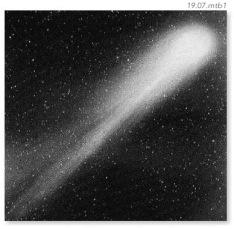
(83) 
What does this curved feature, which contains a point bar, indicate about past events on Mars? 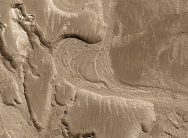
(Multiple Choice)
4.9/5 (70)
(70) 
Filters
- Essay(0)
- Multiple Choice(0)
- Short Answer(0)
- True False(0)
- Matching(0)