



 Chat with AI
Exam 19: Geology of the Solar System

Exam 1: The Nature of Geology110 Questions
Exam 2: Investigating Geologic Questions106 Questions
Exam 3: Plate Tectonics152 Questions
Exam 4: Earth Materials131 Questions
Exam 5: Igneous Environments147 Questions
Exam 6: Volcanoes and Volcanic Hazards186 Questions
Exam 7: Sedimentary Environments155 Questions
Exam 8: Deformation and Metamorphism144 Questions
Exam 9: Geologic Time126 Questions
Exam 10: Seafloor and Continental Margins105 Questions
Exam 11: Mountains, Basins, and Continents124 Questions
Exam 12: Earthquakes and Earths Interior119 Questions
Exam 13: Climate and Weathering109 Questions
Exam 14: Glaciers, Shorelines, and Changing Sea Levels109 Questions
Exam 15: Weathering, Soil, and Unstable Slopes92 Questions
Exam 16: Streams and Flooding137 Questions
Exam 17: Water Resources142 Questions
Exam 18: Energy and Mineral Resources95 Questions
Exam 19: Geology of the Solar System77 Questions
Select questions type


Which of these numbered areas on Enceladus, a moon of Jupiter, is probably the oldest? 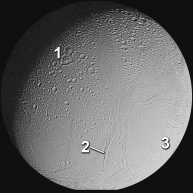
(Multiple Choice)
4.9/5  (66)
(66) The Valles Marineris system on Mars is 4,000 km long, the width of: 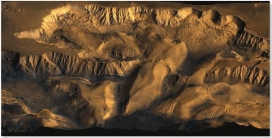
(Multiple Choice)
5.0/5 (79)
(79) This figure shows the moon at four different positions, representing four different times, as it orbits around Earth. At which position would there be a full moon as seen from Earth? 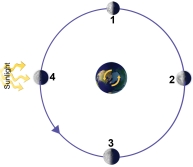
(Multiple Choice)
4.9/5 (81)
(81) Planetary geologists have successfully explored Mars using:
(Multiple Choice)
4.7/5 (72)
(72) Which feature on Earth's moon is the oldest and consists of heavily crater, feldspar rich, igneous rock? 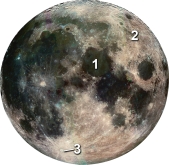
(Multiple Choice)
5.0/5 (90)
(90) During its early stages of formation, a catastrophic collision with Earth by a large body is thought to have ripped part of the Earth away to form:
(Multiple Choice)
4.9/5 (87)
(87) Which of the following is the major difference between the inner planets as a group and the outer planets as a group?
(Multiple Choice)
4.7/5 (89)
(89) The surface of this planet is obscured by an atmosphere of thick clouds and toxic gases. What planetary body is it? 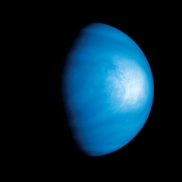
(Multiple Choice)
4.9/5 (82)
(82) What did the Cassini spacecraft and its Huygens probe discover on the surface of Titan, the largest of Saturn's moons?
(Multiple Choice)
4.9/5 (90)
(90) The density of craters on a planet's surface can help planetary scientists estimate its:
(Multiple Choice)
4.8/5 (71)
(71) Which of the following are present on Earth but not on any other planet?
(Multiple Choice)
4.9/5 (79)
(79) What does this photograph, which is representative of most of Mercury, indicate about the planet? 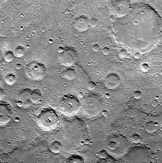
(Multiple Choice)
4.8/5 (84)
(84) This figure shows the moon at four different positions, representing four different times, as it orbits around Earth. At which position would there be a new moon as seen from Earth? 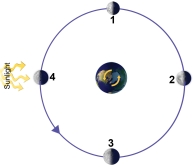
(Multiple Choice)
4.9/5 (94)
(94) 
Filters
- Essay(0)
- Multiple Choice(0)
- Short Answer(0)
- True False(0)
- Matching(0)