



 Chat with AI
Exam 9: Geologic Time

Exam 1: The Nature of Geology110 Questions
Exam 2: Investigating Geologic Questions106 Questions
Exam 3: Plate Tectonics152 Questions
Exam 4: Earth Materials131 Questions
Exam 5: Igneous Environments147 Questions
Exam 6: Volcanoes and Volcanic Hazards186 Questions
Exam 7: Sedimentary Environments155 Questions
Exam 8: Deformation and Metamorphism144 Questions
Exam 9: Geologic Time126 Questions
Exam 10: Seafloor and Continental Margins105 Questions
Exam 11: Mountains, Basins, and Continents124 Questions
Exam 12: Earthquakes and Earths Interior119 Questions
Exam 13: Climate and Weathering109 Questions
Exam 14: Glaciers, Shorelines, and Changing Sea Levels109 Questions
Exam 15: Weathering, Soil, and Unstable Slopes92 Questions
Exam 16: Streams and Flooding137 Questions
Exam 17: Water Resources142 Questions
Exam 18: Energy and Mineral Resources95 Questions
Exam 19: Geology of the Solar System77 Questions
Select questions type


How did an oxygen-rich atmosphere develop from a carbon dioxide-rich atmosphere?
(Multiple Choice)
4.7/5  (72)
(72) Which of the following time periods were dinosaurs the dominant creatures?
(Multiple Choice)
5.0/5 (64)
(64) What would fossil ages from the geologic timescale tell us about the age of this unconformity? 
(Multiple Choice)
4.8/5 (90)
(90) Which numbered layer in this photograph represents the oldest layer? 
(Multiple Choice)
4.9/5 (89)
(89) How would we use isotopic ages to infer the ages of the upper and lower unit in this diagram? 
(Multiple Choice)
4.8/5 (82)
(82) Using the data in this table, determine the age of the granite unit G on this table). 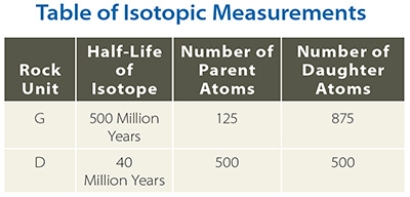
(Multiple Choice)
4.9/5 (67)
(67) 
Filters
- Essay(0)
- Multiple Choice(0)
- Short Answer(0)
- True False(0)
- Matching(0)