



 Chat with AI
Exam 9: Geologic Time

Exam 1: The Nature of Geology110 Questions
Exam 2: Investigating Geologic Questions106 Questions
Exam 3: Plate Tectonics152 Questions
Exam 4: Earth Materials131 Questions
Exam 5: Igneous Environments147 Questions
Exam 6: Volcanoes and Volcanic Hazards186 Questions
Exam 7: Sedimentary Environments155 Questions
Exam 8: Deformation and Metamorphism144 Questions
Exam 9: Geologic Time126 Questions
Exam 10: Seafloor and Continental Margins105 Questions
Exam 11: Mountains, Basins, and Continents124 Questions
Exam 12: Earthquakes and Earths Interior119 Questions
Exam 13: Climate and Weathering109 Questions
Exam 14: Glaciers, Shorelines, and Changing Sea Levels109 Questions
Exam 15: Weathering, Soil, and Unstable Slopes92 Questions
Exam 16: Streams and Flooding137 Questions
Exam 17: Water Resources142 Questions
Exam 18: Energy and Mineral Resources95 Questions
Exam 19: Geology of the Solar System77 Questions
Select questions type


Which of the following forms different layers from season to season and can be used to determine how many years the layers represent?
(Multiple Choice)
4.9/5  (74)
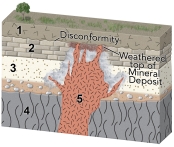
(74) 
Which fossils provide information as to the mode of formation of an oxygen-rich atmosphere by about 2 billion years ago?
(Multiple Choice)
4.7/5 (77)
(77) This figure shows two sections that partially overlap in age. Dashed lines show how the two sections correlate. What can you conclude from these correlations? 
(Multiple Choice)
4.8/5 (79)
(79) The impressions of fossil shells in this photograph probably indicate that the rock was deposited: 
(Multiple Choice)
4.7/5 (60)
(60) Which of the following is evidence that Earth's history is not short?
(Multiple Choice)
4.7/5 (70)
(70) Who came up with the concept that geologic processes operating at present are the same processes that operated in the past?
(Multiple Choice)
4.8/5 (72)
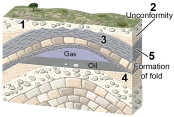
(72) 
What marks the boundary between the Mesozoic and the Cenozoic called the K-P boundary)?
(Multiple Choice)
4.9/5 (90)
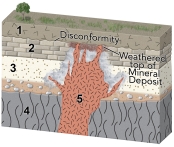
(90) What is the youngest event represented in this block diagram? 
(Multiple Choice)
4.8/5 (88)
(88) Which of the following features look like fossils but are not?
(Multiple Choice)
4.8/5 (91)
(91) This figure has rock units and geologic features that are assigned letters that are not in any particular order. From the geologic relations, what is the oldest unit or feature of those listed below? 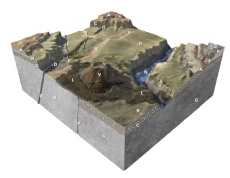
(Multiple Choice)
4.7/5 (74)
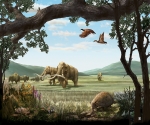
(74) 
In geology, determining time equivalency in rocks is called:
(Multiple Choice)
4.9/5 (81)
(81) Which principle can be used to determine the relative age of an igneous intrusion called a dike?
(Multiple Choice)
4.9/5 (71)
(71) Which of the following is a reason why rock units may change from one section to another?
(Multiple Choice)
4.8/5 (77)
(77) 
This figure shows the main subdivisions of the geologic timescale. Which of these is the Paleozoic? 
(Multiple Choice)
4.8/5 (75)
(75) 
Filters
- Essay(0)
- Multiple Choice(0)
- Short Answer(0)
- True False(0)
- Matching(0)