



 Chat with AI
Exam 5: Activity-Based Costing and Management

Exam 1: The Changing Role of Managerial Accounting in a Dynamic Business Environment85 Questions
Exam 2: Basic Cost Management Concepts115 Questions
Exam 3: Product Costing and Cost Accumulation in a Batch Production Environment95 Questions
Exam 4: Process Costing and Hybrid Product-Costing Systems88 Questions
Exam 5: Activity-Based Costing and Management103 Questions
Exam 6: Activity Analysis, Cost Behavior, and Cost Estimation90 Questions
Exam 7: Cost-Volume-Profit Analysis109 Questions
Exam 8: Variable Costing and the Costs of Quality and Sustainability74 Questions
Exam 9: Financial Planning and Analysis: the Master Budget112 Questions
Exam 10: Standard Costing and Analysis of Direct Costs97 Questions
Exam 11: Flexible Budgeting and Analysis of Overhead Costs89 Questions
Exam 12: Responsibility Accounting, Operational Performance Measures, and the Balanced Scorecard89 Questions
Exam 13: Investment Centers and Transfer Pricing101 Questions
Exam 14: Decision Making: Relevant Costs and Benefits96 Questions
Exam 15: Target Costing and Cost Analysis for Pricing Decisions107 Questions
Exam 16: Capital Expenditure Decisions120 Questions
Exam 17: Allocation of Support Activity Costs and Joint Costs81 Questions
Exam 18: The Sarbanes-Oxley Act, Internal Controls, and Management Accounting20 Questions
Exam 19: Compound Interest and the Concept of Present Value27 Questions
Exam 20: Inventory Management20 Questions
Select questions type


Willow Springs produces various wooden bookcases, tables, storage units, and chairs. Which of the following would be included in a listing of the company's non-value-added activities?
(Multiple Choice)
4.9/5  (85)
(85) Use the following information to answer the following Questions
St. Vincent’s, Inc., currently uses traditional costing procedures, applying $800,000 of overhead to products Beta and Zeta on the basis of direct labor hours. The company is considering a shift to activity-based costing and the creation of individual cost pools that will use direct labor hours (DLH), production setups (SU), and number of parts components (PC) as cost drivers. Data on the cost pools and respective driver volumes follow.
 -The overhead cost allocated to Beta by using traditional costing procedures would be:
 (Multiple Choice)
4.8/5 (84)
(84) Consider the following factors:
I. The degree of correlation between consumption of an activity and consumption of a particular cost driver.
II. The likelihood that a particular cost driver will induce a desired behavioral effect.
III. The likelihood that a particular cost driver will cause an increase in the cost of measurement.
Which of these factors should be considered in the selection of a cost driver?
(Multiple Choice)
4.9/5 (88)
(88) Storyboarding may be used to develop a detailed process flowchart.
(True/False)
4.8/5 (69)
(69) Towler Inc. manufactures products J and K, applying overhead on the basis of labor hours. J, a low-volume product, requires a variety of complex manufacturing procedures. K, on the other hand, is both a high-volume product and relatively simplistic in nature. What would an activity-based costing system likely disclose about products J and K as a result of Towler's current accounting procedures?

(Short Answer)
4.8/5 (82)
(82) Charger Industries currently assigns overhead to products by using a predetermined rate based on direct labor hours. The company is considering the adoption of an activity-based costing (ABC) system, and management desires a brief overview of this system before it makes a final decision.
Required: Compare ABC with the company's current system, focusing on the number of cost pools and cost drivers, costing accuracy, and cost distortion.
(Essay)
4.9/5 (69)
(69) Simplified forms of ABC use time-driven elements for service companies that are well aligned with the resources deployed in terms of units of time of labor.
(True/False)
4.9/5 (78)
(78) Consider the following statements regarding product-sustaining activities:
I. They must be performed for each batch of product that is made.
II. They must be performed for each unit of product that is made.
III. They are needed to support an entire product line.
Which of the above statements is (are) true?
(Multiple Choice)
4.7/5 (79)
(79) When determining customer profitability, activity-based costing can be used to analyze:
(Multiple Choice)
4.8/5 (94)
(94) A version of ABC that has found wide acceptance in service-industry settings is called volume-based activity-costing.
(True/False)
4.9/5 (77)
(77) Use this information to answer the following Questions
Rocket Products manufactures three types of remote-control devices: Economy, Standard, and Deluxe. The company, which uses activity-based costing, has identified five activities (and related cost drivers). Each activity, its budgeted cost, and related cost driver is identified below.
 -Assume that Rocket is using a volume-based costing system, and the preceding overhead costs are applied to all products on the basis of direct labor hours. The overhead cost that would be assigned to the Standard product line is closest to:
 (Multiple Choice)
4.8/5 (84)
(84) Non-value-added costs occur in nonmanufacturing organizations as well as in manufacturing firms.
Required:
A. Explain what is meant by a non-value-added cost.
B. Identify two potential non-value-added costs for each of the following service providers: airlines, banks, and hotels.
(Essay)
4.7/5 (82)
(82) The controller for Norton Machining has established the following overhead cost pools and cost drivers:
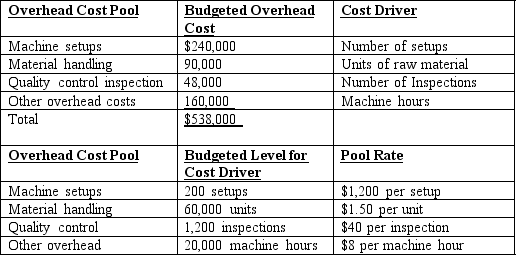 Order no. 715 has the following production requirements:
Machine setups: 7
Raw material: 11,200 units
Inspections: 16
Machine hours: 850
Required:
A. Compute the total overhead that should be assigned to order no. 715 by using activity-based costing.
B. Suppose that Norton were to use a single, predetermined overhead rate based on machine hours. Compute the rate per hour and the total overhead assigned to order no. 715.
C. Discuss the merits of an activity-based costing system in comparison with a traditional costing system.
Order no. 715 has the following production requirements:
Machine setups: 7
Raw material: 11,200 units
Inspections: 16
Machine hours: 850
Required:
A. Compute the total overhead that should be assigned to order no. 715 by using activity-based costing.
B. Suppose that Norton were to use a single, predetermined overhead rate based on machine hours. Compute the rate per hour and the total overhead assigned to order no. 715.
C. Discuss the merits of an activity-based costing system in comparison with a traditional costing system. (Essay)
4.8/5 (76)
(76) Consider the following statements:
I. Product diversity creates costing problems because diverse products tend to utilize manufacturing activities in different ways.
II. Overhead costs that are not incurred at the unit level create costing problems because such costs do not vary with traditional application bases such as direct labor hours or machine hours.
III. Product diversity typically exists when a single product (e.g., a ballpoint pen) is made in different colors.
Which of the above statements is (are) true?
(Multiple Choice)
4.9/5 (76)
(76) When using ABC, overhead costs assigned to each activity comprise an activity cost pool.
(True/False)
4.9/5 (81)
(81) Activity-based costing systems have a tendency to distort product costs.
(True/False)
5.0/5 (62)
(62) Rosen, Inc., an appliance manufacturer, is developing a new line of ovens that uses controlled-laser technology. The research and testing costs associated with the new ovens is said to arise from a:
(Multiple Choice)
4.9/5 (77)
(77) Which of the following cost drivers would best be associated with the activity of physician time in a medical clinic?
(Multiple Choice)
4.7/5 (81)
(81) 
Filters
- Essay(0)
- Multiple Choice(0)
- Short Answer(0)
- True False(0)
- Matching(0)