



 Chat with AI
Exam 5: Activity-Based Costing and Management

Exam 1: The Changing Role of Managerial Accounting in a Dynamic Business Environment85 Questions
Exam 2: Basic Cost Management Concepts115 Questions
Exam 3: Product Costing and Cost Accumulation in a Batch Production Environment95 Questions
Exam 4: Process Costing and Hybrid Product-Costing Systems88 Questions
Exam 5: Activity-Based Costing and Management103 Questions
Exam 6: Activity Analysis, Cost Behavior, and Cost Estimation90 Questions
Exam 7: Cost-Volume-Profit Analysis109 Questions
Exam 8: Variable Costing and the Costs of Quality and Sustainability74 Questions
Exam 9: Financial Planning and Analysis: the Master Budget112 Questions
Exam 10: Standard Costing and Analysis of Direct Costs97 Questions
Exam 11: Flexible Budgeting and Analysis of Overhead Costs89 Questions
Exam 12: Responsibility Accounting, Operational Performance Measures, and the Balanced Scorecard89 Questions
Exam 13: Investment Centers and Transfer Pricing101 Questions
Exam 14: Decision Making: Relevant Costs and Benefits96 Questions
Exam 15: Target Costing and Cost Analysis for Pricing Decisions107 Questions
Exam 16: Capital Expenditure Decisions120 Questions
Exam 17: Allocation of Support Activity Costs and Joint Costs81 Questions
Exam 18: The Sarbanes-Oxley Act, Internal Controls, and Management Accounting20 Questions
Exam 19: Compound Interest and the Concept of Present Value27 Questions
Exam 20: Inventory Management20 Questions
Select questions type


Use the following information to answer the following Questions
St. Vincent’s, Inc., currently uses traditional costing procedures, applying $800,000 of overhead to products Beta and Zeta on the basis of direct labor hours. The company is considering a shift to activity-based costing and the creation of individual cost pools that will use direct labor hours (DLH), production setups (SU), and number of parts components (PC) as cost drivers. Data on the cost pools and respective driver volumes follow.
 -The overhead cost allocated to Beta by using activity-based costing procedures would be:
 (Multiple Choice)
4.7/5  (70)
(70) Private Corporation manufactures two types of transponders-no. 156 and no. 157-and applies manufacturing overhead to all units at the rate of $76.50 per machine hour. Production information follows.
 The controller, who is studying the use of activity-based costing, has determined that the firm's overhead can be identified with three activities: manufacturing setups, machine processing, and product shipping. Data on the number of setups, machine hours worked, and outgoing shipments, the activities' three respective cost drivers, follow.
 The firm's total overhead of $3,060,000 is subdivided as follows: manufacturing setups, $260,000; machine processing, $2,400,000; and product shipping, $400,000.
Required:
A. Compute the pool rates that would be used for manufacturing setups, machine processing, and product shipping in an activity-based costing system.
B. Assuming use of activity-based costing, compute the unit overhead costs of product nos. 156 and 157 if the expected manufacturing volume is attained.
C. Assuming use of activity-based costing, compute the total cost per unit of product no. 156.
D. If the company's selling price is based heavily on cost, would a switch to activity-based costing from the current traditional system result in a price increase or decrease for product no. 156? Show computations.
The controller, who is studying the use of activity-based costing, has determined that the firm's overhead can be identified with three activities: manufacturing setups, machine processing, and product shipping. Data on the number of setups, machine hours worked, and outgoing shipments, the activities' three respective cost drivers, follow.
The firm's total overhead of $3,060,000 is subdivided as follows: manufacturing setups, $260,000; machine processing, $2,400,000; and product shipping, $400,000.
Required:
A. Compute the pool rates that would be used for manufacturing setups, machine processing, and product shipping in an activity-based costing system.
B. Assuming use of activity-based costing, compute the unit overhead costs of product nos. 156 and 157 if the expected manufacturing volume is attained.
C. Assuming use of activity-based costing, compute the total cost per unit of product no. 156.
D. If the company's selling price is based heavily on cost, would a switch to activity-based costing from the current traditional system result in a price increase or decrease for product no. 156? Show computations. (Essay)
4.9/5 (69)
(69) Use the following information to answer the following Questions
Barnett Products manufactures three types of remote-control devices: Economy, Standard, and Deluxe. The company, which uses activity-based costing, has identified five activities (and related cost drivers). Each activity, its budgeted cost, and related cost driver is identified below.
 -What is Barnett's pool rate for the material-handling activity?
 (Multiple Choice)
4.7/5 (73)
(73) An example of a customer-value-added activity is final painting and polishing of the product.
(True/False)
4.8/5 (102)
(102) A product's cost is the sum of its direct-material cost, its direct-labor cost, and its overhead cost, which is the accumulation of all the resource costs driven to the product by the various cost drivers selected for the ABC system.
(True/False)
4.8/5 (76)
(76) A bill of activities is a complete listing of the activities identified and used in the ABC analysis.
(True/False)
4.8/5 (67)
(67) Sampler, Inc., which sells books to college bookstores and individuals, uses activity-based costing and activity-based management. The following information is available for the company's three cost pools:
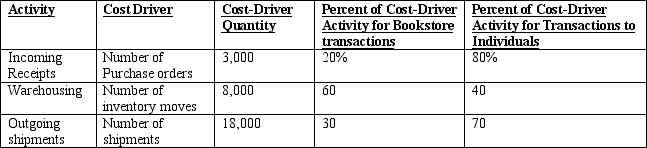 Bookstore sales totaled $8,400,000, and sales to individuals amounted to $2,400,000. Costs for the three activities were: Incoming receipts, $450,000; warehousing, $520,000; and outgoing shipments, $630,000. A review of the company's activities found various inefficiencies with respect to the warehousing of textbooks (acquired for eventual sale to bookstores) and outgoing shipments to individuals. These inefficiencies resulted in an extra 500 moves and 400 shipments, respectively.
Required:
A. What is a non-value-added activity?
B. How much did non-value-added activities cost Sampler this past year?
C. Which of the two markets-sales to bookstores or sales to individuals-resulted in lower overall costs for incoming receipts, warehousing, and outgoing shipments? Evaluate these costs in both absolute dollars and as a percentage of sales. In addition, present a possible explanation for your results. Note: Exclude costs that arose from inefficient operations.
Bookstore sales totaled $8,400,000, and sales to individuals amounted to $2,400,000. Costs for the three activities were: Incoming receipts, $450,000; warehousing, $520,000; and outgoing shipments, $630,000. A review of the company's activities found various inefficiencies with respect to the warehousing of textbooks (acquired for eventual sale to bookstores) and outgoing shipments to individuals. These inefficiencies resulted in an extra 500 moves and 400 shipments, respectively.
Required:
A. What is a non-value-added activity?
B. How much did non-value-added activities cost Sampler this past year?
C. Which of the two markets-sales to bookstores or sales to individuals-resulted in lower overall costs for incoming receipts, warehousing, and outgoing shipments? Evaluate these costs in both absolute dollars and as a percentage of sales. In addition, present a possible explanation for your results. Note: Exclude costs that arose from inefficient operations. (Essay)
4.9/5 (89)
(89) The division of activities into unit-level, batch-level, product-sustaining level, and facility-level categories is commonly known as a cost:
(Multiple Choice)
4.8/5 (75)
(75) Pound Industries' customer service department follows up on customer complaints by telephone inquiry. During a recent period, the department initiated 7,000 calls and incurred costs of $203,000. If 2,940 of these calls were for the company's wholesale operation (the remainder were for the retail division), costs allocated to the retail division should amount to:
(Multiple Choice)
4.8/5 (82)
(82) Use the following information to answer the following Questions
Barnett Products manufactures three types of remote-control devices: Economy, Standard, and Deluxe. The company, which uses activity-based costing, has identified five activities (and related cost drivers). Each activity, its budgeted cost, and related cost driver is identified below.
-Under Barnett's activity-based costing system, what is the per-unit overhead cost of Economy?
-Under Barnett's activity-based costing system, what is the per-unit overhead cost of Economy? (Multiple Choice)
4.8/5 (89)
(89) Which of the following is not a broad, cost classification category typically used in activity-based costing?
(Multiple Choice)
4.8/5 (89)
(89) Which of the following best explains the main advantages of time-driven-activity-based costing for services over the use of conventional ABC?
(Multiple Choice)
4.7/5 (85)
(85) Generally speaking, companies prefer doing business with customers who:
(Multiple Choice)
4.9/5 (85)
(85) Washburn Corporation produces flat-screen computer monitors. Consider the following selected costs that arose during the current year:
1. Direct materials used: $3,640,000
2. Plant rent, utilities, and taxes: $1,229,000
3. New technology design engineering: $2,040,000
4. Materials receiving: $318,000
5. Manufacturing-run/set-up charges: $115,000
6. Equipment depreciation: $92,000
7. General management salaries: $1,564,000
Required:
A. Briefly distinguish between batch-level and facility-level activities.
B. Determine the cost of the firm's unit-level, batch-level, product-sustaining, and facility-level activities.
(Essay)
5.0/5 (69)
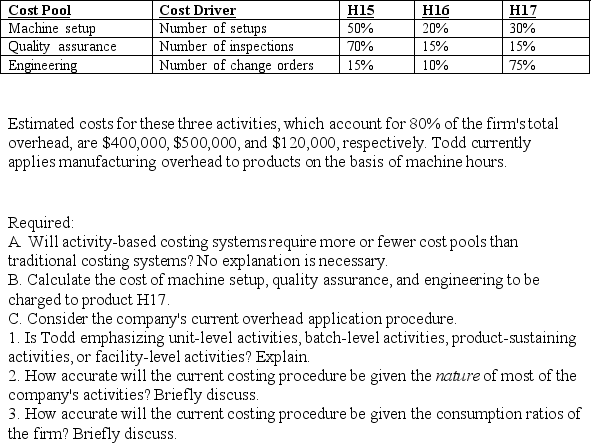
(69) Todd Manufacturing, contemplating the adoption of an activity-based costing system, has established three activity-cost pools: machine setup, quality assurance, and engineering. These cost pools, the appropriate cost driver, and the percentage of each cost driver consumed by the company's products (H15, H16, and H17) follow.
(Essay)
4.8/5 (95)
(95) Non-value-added activities are the events that trigger activities and linkages among activities.
(True/False)
4.7/5 (98)
(98) Generally speaking, companies prefer doing business with customers who order small quantities rather than large quantities.
(True/False)
5.0/5 (85)
(85) Magnolia Industries combines all manufacturing overhead into a single cost pool and allocates this overhead to products by using machine hours. Activity-based costing would likely show that with Magnolia's current procedures that:
(Multiple Choice)
4.7/5 (82)
(82) 
Filters
- Essay(0)
- Multiple Choice(0)
- Short Answer(0)
- True False(0)
- Matching(0)