



 Chat with AI
Exam 22: Electromagnetic Waves

Exam 1: Introduction, Measurement, Estimating29 Questions
Exam 2: Describing Motion: Kinematics in One Dimension527 Questions
Exam 3: Kinematics in Two Dimensions; Vectors183 Questions
Exam 4: Dynamics: Newtons Laws of Motion146 Questions
Exam 5: Circular Motion; Gravitation105 Questions
Exam 6: Work and Energy153 Questions
Exam 7: Linear Momentum139 Questions
Exam 8: Rotational Motion148 Questions
Exam 9: Static Equilibrium; Elasticity and Fracture83 Questions
Exam 10: Fluids98 Questions
Exam 11: Oscillations and Waves114 Questions
Exam 12: Sound21 Questions
Exam 13: Temperature and Kinetic Theory87 Questions
Exam 14: Heat88 Questions
Exam 15: The Laws of Thermodynamics78 Questions
Exam 16: Electric Charge and Electric Field99 Questions
Exam 17: Electric Potential107 Questions
Exam 18: Electric Currents96 Questions
Exam 19: Dc Circuits384 Questions
Exam 20: Magnetism164 Questions
Exam 21: Electromagnetic Induction and Faradays Law60 Questions
Exam 22: Electromagnetic Waves167 Questions
Exam 23: Light: Geometric Optics144 Questions
Exam 24: The Wave Nature of Light58 Questions
Exam 25: Optical Instruments156 Questions
Exam 26: The Special Theory of Relativity126 Questions
Exam 27: Early Quantum Theory and Models of the Atom192 Questions
Exam 28: Quantum Mechanics of Atoms74 Questions
Exam 29: Molecules and Solids26 Questions
Exam 30: Nuclear Physics and Radioactivity153 Questions
Exam 31: Nuclear Energy; Effects and Uses of Radiation36 Questions
Exam 32: Elementary Particles19 Questions
Exam 33: Astrophysics and Cosmology25 Questions
Select questions type


A concave spherical mirror has a focal length of magnitude 20 cm. An object is placed 10 cm in front of the mirror on the mirror's axis. Where is the image located?
(Multiple Choice)
4.8/5  (85)
(85) Which of the following terms describe lenses that are thinner at the center than at the edges? (There could be more than one correct choice.)
(Multiple Choice)
4.7/5 (71)
(71) A 1.4-cm tall flower is 4.0 cm from a spherical concave mirror. If the image of the flower is 4.0 cm tall, how far is the image from the mirror?
(Multiple Choice)
4.9/5 (77)
(77) The index of refraction of a certain glass is measured to be 1.5. What is the speed of light in that glass?
(Multiple Choice)
5.0/5 (83)
(83) A 3.0-cm tall statue is 48 cm in front of a convex lens having a focal length of magnitude
20 cm.
(a) Is the image of the statue real or virtual?
(b) How far is the image from the lens?
(c) Is the image upright or inverted?
(d) How tall is the image?
(Short Answer)
4.9/5 (71)
(71) An object is in front of a concave spherical mirror, and its image is 4.0 cm behind the mirror. If the focal length of the mirror has a magnitude of 5.0 cm, where is the object?
(Multiple Choice)
5.0/5 (75)
(75) When a person stands 40 cm in front of a cosmetic (concave) spherical mirror, the upright image is twice the size of the object. What is the focal length of the mirror?
(Multiple Choice)
5.0/5 (82)
(82) An object is placed 10 cm from a convex lens with a focal length of magnitude 20 cm. What is the magnification?
(Multiple Choice)
4.8/5 (83)
(83) A beam of light in air enters a glass slab with an index of refraction of at an angle of incidence of . What is the angle of refraction?
(Multiple Choice)
4.9/5 (74)
(74) The figure (which is exaggerated somewhat for clarity) illustrates a thin lens. This lens is made of a material with an index of refraction of 1.48, and has radii of magnitudes 6.0 cm and 4.0 cm. What
Is the focal length of the lens? 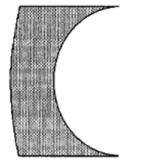
(Multiple Choice)
4.9/5 (83)
(83) Suppose you place an object in front of a concave mirror. Which of the following statements must be true? (There could be more than one correct choice.)
(Multiple Choice)
4.7/5 (66)
(66) Which of the following terms describe lenses that are thicker at the center than at the edges? (There could be more than one correct choice.)
(Multiple Choice)
4.9/5 (80)
(80) Suppose you wanted to start a fire using a mirror to focus sunlight. Which of the following statements is most accurate?
(Multiple Choice)
4.8/5 (82)
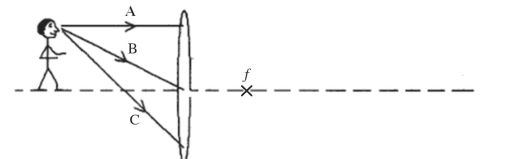
(82) A thin lens projects an image of a man as shown in the figure. Rays marked A, B, and C travel to the lens from the man's ear. Draw the paths of these three rays after they have passed through the lens. Note that is parallel to the principal axis, B goes through the center of the lens, C goes through the focal point on the left, and the point marked is the focal point on the right of the lens.
(Short Answer)
4.7/5 (89)
(89) The critical angle for a substance in air is measured at . If light enters this substance from air at with the normal, at what angle with the normal will it continue to travel?
(Multiple Choice)
4.8/5 (81)
(81) An optic fiber is made of clear plastic with an index of refraction of . For what range of angles of incidence with the lateral surface of the fiber will light remain inside the plastic "guide" if it is surrounded by air?
(Multiple Choice)
4.9/5 (81)
(81) Light enters glass from air. The angle of refraction will be
(Multiple Choice)
4.9/5 (72)
(72) Light enters air from water. The angle of refraction will be
(Multiple Choice)
4.7/5 (80)
(80) Which one of the following numbers is the correct magnification produced by a plane mirror?
(Multiple Choice)
5.0/5 (76)
(76) An object that is 4.00 cm tall is placed 18.0 cm in front of a concave mirror having a focal length of 20.0 cm. What is the location of its image in relation to the mirror and what are its characteristics?
(Multiple Choice)
4.9/5 (68)
(68) 
Filters
- Essay(0)
- Multiple Choice(0)
- Short Answer(0)
- True False(0)
- Matching(0)