



 Chat with AI
Exam 22: Electromagnetic Waves

Exam 1: Introduction, Measurement, Estimating29 Questions
Exam 2: Describing Motion: Kinematics in One Dimension527 Questions
Exam 3: Kinematics in Two Dimensions; Vectors183 Questions
Exam 4: Dynamics: Newtons Laws of Motion146 Questions
Exam 5: Circular Motion; Gravitation105 Questions
Exam 6: Work and Energy153 Questions
Exam 7: Linear Momentum139 Questions
Exam 8: Rotational Motion148 Questions
Exam 9: Static Equilibrium; Elasticity and Fracture83 Questions
Exam 10: Fluids98 Questions
Exam 11: Oscillations and Waves114 Questions
Exam 12: Sound21 Questions
Exam 13: Temperature and Kinetic Theory87 Questions
Exam 14: Heat88 Questions
Exam 15: The Laws of Thermodynamics78 Questions
Exam 16: Electric Charge and Electric Field99 Questions
Exam 17: Electric Potential107 Questions
Exam 18: Electric Currents96 Questions
Exam 19: Dc Circuits384 Questions
Exam 20: Magnetism164 Questions
Exam 21: Electromagnetic Induction and Faradays Law60 Questions
Exam 22: Electromagnetic Waves167 Questions
Exam 23: Light: Geometric Optics144 Questions
Exam 24: The Wave Nature of Light58 Questions
Exam 25: Optical Instruments156 Questions
Exam 26: The Special Theory of Relativity126 Questions
Exam 27: Early Quantum Theory and Models of the Atom192 Questions
Exam 28: Quantum Mechanics of Atoms74 Questions
Exam 29: Molecules and Solids26 Questions
Exam 30: Nuclear Physics and Radioactivity153 Questions
Exam 31: Nuclear Energy; Effects and Uses of Radiation36 Questions
Exam 32: Elementary Particles19 Questions
Exam 33: Astrophysics and Cosmology25 Questions
Select questions type


An object is placed 60 cm from a convex lens with a focal length of magnitude 10 cm. What is the magnification?
(Multiple Choice)
4.7/5  (95)
(95) David stands 2.5 m in front of a plane mirror.
(a) How far from David is his image in the mirror?
(b) If David moves away from the mirror at 1.5 m/s, how fast are David and his image
moving apart from each other?
(c) If David is 180 cm tall, how tall is his image in the mirror?
(Short Answer)
4.8/5 (88)
(88) How far from a lens having a focal length of must the object be placed if it is to form a virtual image that is times the size of the object?
(Multiple Choice)
4.9/5 (68)
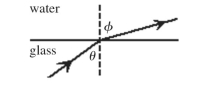
(68) A light ray in glass arrives at the glass-water interface at an angle of with the normal. The refracted ray in water makes an angle with the normal, as shown in the figure. The index of refraction of water is . The angle of incidence is now changed to . What is the new angle of refraction in the water?
(Multiple Choice)
4.9/5 (80)
(80) A convex spherical mirror has a focal length of magnitude 20 cm. If an object is placed 10 cm in front of the mirror on the mirror's axis, where is the image located?
(Multiple Choice)
4.8/5 (71)
(71) If the magnification of a mirror or lens is negative, it means that
(Multiple Choice)
4.7/5 (82)
(82) The speed of light in a certain material is measured to be . What is the index of refraction of this material?
(Multiple Choice)
4.9/5 (78)
(78) An object that is 3.4 mm tall is placed 25 cm from the vertex of a convex spherical mirror.
The radius of curvature of the mirror has magnitude 73 cm.
(a) How far is the image from the vertex of the mirror?
(b) What is the height of the image?
(Short Answer)
5.0/5 (73)
(73) An object that is 2.0 cm tall is placed at the center of curvature in front of a concave mirror. How tall is its image?
(Multiple Choice)
4.8/5 (84)
(84) An image is 4.0 mm in front of a converging lens with focal length of magnitude 5.0 mm. Where is the object for this image?
(Multiple Choice)
4.7/5 (72)
(72) A double-convex lens is formed from a piece of plastic with an index of refraction of 1.70. The radius of the front surface has magnitude 20 cm, and the radius of the back surface has magnitude
30 cm. What is the focal length of this lens?
(Multiple Choice)
4.8/5 (83)
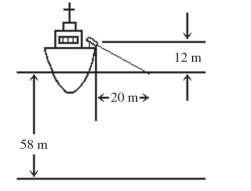
(83) As shown in the figure, a laser positioned on a ship is used to communicate with a small research submarine resting on the bottom of a lake. The laser is positioned above the surface of the water, and it strikes the water from the side of the ship. The water is deep and has an index of refraction of . How far horizontally is the submarine from the side of the ship?
(Assume all numbers are accurate to three significant figures.)
(Multiple Choice)
4.9/5 (60)
(60) A double-convex lens made of glass having a refractive index of 1.50 has a radius of magnitude 40 cm on the front side and one of magnitude 30 cm on the back side. What is the focal length of this
Lens?
(Multiple Choice)
4.9/5 (82)
(82) When a flower petal is 4.0 cm in front of a converging lens, the inverted image is half the height of the petal. What is the focal length of this lens?
(Multiple Choice)
4.8/5 (90)
(90) A narrow light beam in vacuum contains light of two wavelengths, and . It strikes a flat piece of glass at an angle of incidence of . The index of refraction of the glass is at and at . Determine the angle between the two wavelengths as the light travels in the glass.
(Short Answer)
4.8/5 (76)
(76) An amateur astronomer grinds a double convex lens whose surfaces have radii of curvature of magnitudes 40 cm and 60 cm. The glass has an index of refraction of 1.54. What is the focal length
Of this lens when used in the night air?
(Multiple Choice)
4.9/5 (87)
(87) A ray of light in glass strikes a water-glass interface at an angle of incidence equal to one-half the critical angle for that interface. The index of refraction for water is , and for the glass it is What angle does the refracted ray in the water make with the normal?
(Multiple Choice)
4.7/5 (72)
(72) An object is placed near a concave mirror having a radius of curvature of magnitude . How far should you place the object from the mirror so that the lateral magnification produced by the mirror will be ?
(Multiple Choice)
4.9/5 (79)
(79) When an object is 12 cm in front of a concave spherical mirror, the image is formed 3.0 cm in front of the mirror. What is the focal length of the mirror?
(Multiple Choice)
4.8/5 (85)
(85) 
Filters
- Essay(0)
- Multiple Choice(0)
- Short Answer(0)
- True False(0)
- Matching(0)