



 Chat with AI
Exam 22: Electromagnetic Waves

Exam 1: Introduction, Measurement, Estimating29 Questions
Exam 2: Describing Motion: Kinematics in One Dimension527 Questions
Exam 3: Kinematics in Two Dimensions; Vectors183 Questions
Exam 4: Dynamics: Newtons Laws of Motion146 Questions
Exam 5: Circular Motion; Gravitation105 Questions
Exam 6: Work and Energy153 Questions
Exam 7: Linear Momentum139 Questions
Exam 8: Rotational Motion148 Questions
Exam 9: Static Equilibrium; Elasticity and Fracture83 Questions
Exam 10: Fluids98 Questions
Exam 11: Oscillations and Waves114 Questions
Exam 12: Sound21 Questions
Exam 13: Temperature and Kinetic Theory87 Questions
Exam 14: Heat88 Questions
Exam 15: The Laws of Thermodynamics78 Questions
Exam 16: Electric Charge and Electric Field99 Questions
Exam 17: Electric Potential107 Questions
Exam 18: Electric Currents96 Questions
Exam 19: Dc Circuits384 Questions
Exam 20: Magnetism164 Questions
Exam 21: Electromagnetic Induction and Faradays Law60 Questions
Exam 22: Electromagnetic Waves167 Questions
Exam 23: Light: Geometric Optics144 Questions
Exam 24: The Wave Nature of Light58 Questions
Exam 25: Optical Instruments156 Questions
Exam 26: The Special Theory of Relativity126 Questions
Exam 27: Early Quantum Theory and Models of the Atom192 Questions
Exam 28: Quantum Mechanics of Atoms74 Questions
Exam 29: Molecules and Solids26 Questions
Exam 30: Nuclear Physics and Radioactivity153 Questions
Exam 31: Nuclear Energy; Effects and Uses of Radiation36 Questions
Exam 32: Elementary Particles19 Questions
Exam 33: Astrophysics and Cosmology25 Questions
Select questions type


A plano-convex lens is to have a focal length of magnitude 40 cm, and it is made of glass of index of refraction 1.65. What radius of curvature is required?
(Multiple Choice)
4.8/5  (75)
(75) A concave spherical mirror with a radius of curvature of 20 cm creates a real image 30 cm from the mirror. How far is the object from the mirror?
(Multiple Choice)
4.8/5 (78)
(78) A converging lens with the same curvature on both faces and a focal length of 25 cm is to
be made from crown glass having a refractive index of 1.52. What radius of curvature is
required for each face?
(Short Answer)
4.9/5 (76)
(76) A laser beam strikes a plane mirror's reflecting surface with an angle of incidence of What is the angle between the incident ray and the reflected ray?
(Multiple Choice)
4.8/5 (71)
(71) Light enters a substance from air at to the normal. It continues within the substance at to the normal. What is the critical angle for this substance when it is surrounded by air?
(Multiple Choice)
4.8/5 (88)
(88) A beam of light that is parallel to the principal axis strikes a convex mirror. What happens to the reflected beam of light?
(Multiple Choice)
4.9/5 (77)
(77) An object that is 10.0 cm tall is placed 37.0 cm in front of a concave mirror of focal length 18.5 cm. How tall is the image?
(Multiple Choice)
4.8/5 (80)
(80) A glass plate with an index of refraction is is immersed in an oil having a refractive index of . The surface of the glass is inclined at an angle of with the vertical. A horizontal light ray in the glass strikes the interface. What is the angle that the refracted ray, in the oil, makes with the horizontal?
(Multiple Choice)
4.9/5 (73)
(73) Lucite has an index of refraction of . What is its critical angle if it is in air?
(Multiple Choice)
5.0/5 (88)
(88) A cell phone that is tall is placed in front of a convex mirror. The image of the phone is tall and is located from a mirror. What is the mirror's focal length?
(Multiple Choice)
4.8/5 (91)
(91) Light having a speed in vacuum of enters a liquid of refractive index . In this liquid, its speed will be
(Multiple Choice)
4.9/5 (94)
(94) Which of the following statements about spherical mirrors is correct? (There could be more than one correct choice.)
(Multiple Choice)
4.8/5 (85)
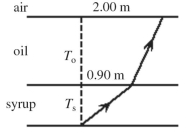
(85) A tank holds a layer of oil, of thickness , that floats on a layer of syrup of thickness , as shown in the figure. Both liquids are clear and do not mix together. A light ray, originating at the bottom of the tank at point , crosses the oil-syrup interface at a point from the axis. The ray continues and arrives at the oil-air interface, to the right of and at the critical angle. What is the index of refraction of the oil?
(Multiple Choice)
4.9/5 (86)
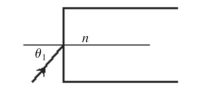
(86) During the investigation of a new type of optical fiber having an index of refraction ), a laser beam is aimed at the flat end of a straight fiber, as shown in the figure. What is the maximum angle of incidence if the beam is not to escape from the sides of the fiber if it is surrounded by air?
(Multiple Choice)
4.9/5 (79)
(79) The curved surface of a 50-cm focal length plano-convex lens has a radius of curvature of
30 cm. What is the refractive index of the glass?
(Short Answer)
4.7/5 (84)
(84) A 14-mm tall postage stamp is 4.0 mm from a converging lens. If the image of the stamp is 4.0 mm tall, how far is it from the lens?
(Multiple Choice)
4.8/5 (83)
(83) A double-concave lens has equal radii of curvature of magnitudes 15.1 cm. An object placed 14.2 cm from the lens forms a virtual image 5.00 cm from the lens. What is the index of refraction
Of the lens material?
(Multiple Choice)
4.8/5 (65)
(65) A certain camera uses a double-convex lens made of glass with an index of refraction of
1.60. This lens has a radius of curvature of magnitude 12 cm for the first surface and one of
magnitude 24 cm for the second surface. What is the focal length of this lens?
(Short Answer)
4.8/5 (79)
(79) A cup that is tall is in front of a concave lens. The image of the cup is tall and from the lens. What is the focal length of the lens?
(Multiple Choice)
4.9/5 (88)
(88) An object is placed 50 cm in front of a concave mirror with a focal length of 25 cm. What is the magnification produced by the mirror?
(Multiple Choice)
4.8/5 (78)
(78) 
Filters
- Essay(0)
- Multiple Choice(0)
- Short Answer(0)
- True False(0)
- Matching(0)