



 Chat with AI
Exam 22: Electromagnetic Waves

Exam 1: Introduction, Measurement, Estimating29 Questions
Exam 2: Describing Motion: Kinematics in One Dimension527 Questions
Exam 3: Kinematics in Two Dimensions; Vectors183 Questions
Exam 4: Dynamics: Newtons Laws of Motion146 Questions
Exam 5: Circular Motion; Gravitation105 Questions
Exam 6: Work and Energy153 Questions
Exam 7: Linear Momentum139 Questions
Exam 8: Rotational Motion148 Questions
Exam 9: Static Equilibrium; Elasticity and Fracture83 Questions
Exam 10: Fluids98 Questions
Exam 11: Oscillations and Waves114 Questions
Exam 12: Sound21 Questions
Exam 13: Temperature and Kinetic Theory87 Questions
Exam 14: Heat88 Questions
Exam 15: The Laws of Thermodynamics78 Questions
Exam 16: Electric Charge and Electric Field99 Questions
Exam 17: Electric Potential107 Questions
Exam 18: Electric Currents96 Questions
Exam 19: Dc Circuits384 Questions
Exam 20: Magnetism164 Questions
Exam 21: Electromagnetic Induction and Faradays Law60 Questions
Exam 22: Electromagnetic Waves167 Questions
Exam 23: Light: Geometric Optics144 Questions
Exam 24: The Wave Nature of Light58 Questions
Exam 25: Optical Instruments156 Questions
Exam 26: The Special Theory of Relativity126 Questions
Exam 27: Early Quantum Theory and Models of the Atom192 Questions
Exam 28: Quantum Mechanics of Atoms74 Questions
Exam 29: Molecules and Solids26 Questions
Exam 30: Nuclear Physics and Radioactivity153 Questions
Exam 31: Nuclear Energy; Effects and Uses of Radiation36 Questions
Exam 32: Elementary Particles19 Questions
Exam 33: Astrophysics and Cosmology25 Questions
Select questions type


A plant that is 4.1 cm tall is 10.3 cm from a converging lens. You observe that the image of this plant is virtual and 6.2 cm tall. What is the focal length of the lens?
(Multiple Choice)
5.0/5  (75)
(75) The critical angle for a beam of light passing from water into air is 48.8°. This means that all light rays with an angle of incidence in the water that is greater than 48.8° will be
(Multiple Choice)
4.8/5 (85)
(85) A thin double-convex lens is intended to focus the image of an object onto a screen so that the image is life-sized on the screen. The lens has equal-magnitude radii of and a refractive index of 1.6.
(a) What is the distance from the image to the screen?
(b) What is the total distance between the object and the image?
(Multiple Choice)
4.7/5 (95)
(95) If the index of refraction of a material is 2, this means that light travels
(Multiple Choice)
4.9/5 (79)
(79) An object is placed 21 cm from a concave lens having a focal length of magnitude 25 cm. What is the magnification?
(Multiple Choice)
4.8/5 (80)
(80) You may have seen ambulances on the street with the letters of the word AMBULANCE written on the front of them, in such a way as to appear correctly when viewed in your car's rear-view
Mirror. (See the figure.) How do the letters appear when you look directly at the ambulance (not
Through the mirror)? a) WดกาซNวE
b)
c) ECNALUBMA
d)
e) ヨวИA」บดMA
(Multiple Choice)
4.8/5 (85)
(85) A scuba diver is beneath the surface of a still pond of water. At what angle relative to the normal at the surface must the diver shine a beam of light toward the surface in order for a person on a distant bank to be able to see it? The index of refraction for water is .
(Multiple Choice)
5.0/5 (83)
(83) An object is placed 15 cm from a spherical concave mirror with a focal length of magnitude 20 cm. If the object is 4.0 cm tall, how tall is the image?
(Multiple Choice)
4.9/5 (73)
(73) A ray of light (ray ) in air strikes a flat piece of glass at an angle of with respect to the normal, as shown in the figure. The index of refraction of the glass is . What is the angle between the reflected ray (ray ) and refracted ray (ray ) rays?
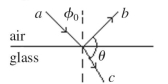
(Short Answer)
4.9/5 (77)
(77) An object is placed on the left side of a thin lens, and the image of this object is formed on the left side of the lens. Which of the following statements must be true? (There could be more than one
Correct choice.)
(Multiple Choice)
4.8/5 (67)
(67) A 4.0-cm tall object is placed 60 cm in front of a converging lens of focal length of magnitude 30 cm. What are the nature and location of the image?
(Multiple Choice)
4.8/5 (77)
(77) A plastic cube is immersed in water having an index of refraction of . A laser beam in the plastic strikes the interface at an angle of with the normal in the plastic. In the water, this beam makes an angle of with the normal. What is the speed of light in the plastic cube?
(Short Answer)
4.8/5 (74)
(74) A beam of light, traveling in air, strikes a plate of transparent material at an angle of incidence of . It is observed that the reflected and refracted beams form an angle of . What is the index of refraction of this material?
(Multiple Choice)
4.9/5 (66)
(66) When an object is placed 118 cm from a thin diverging lens, its image is found to be 59 cm
from the lens. The lens is removed, and replaced by a thin converging lens whose focal
length has the same magnitude as the diverging lens. This second lens is at the original
position of the first lens. Where is the image of the object now?
(Short Answer)
4.9/5 (87)
(87) When an object is 12 cm in front of a concave mirror, the image is 3.0 cm in front of the mirror? What is the focal length of the mirror?
(Multiple Choice)
4.9/5 (85)
(85) A convex lens has focal length . If an object is placed at a distance between and from the lens on the principal axis, the image is located at a distance from the lens
(Multiple Choice)
4.8/5 (78)
(78) A drawing is placed in front of a thin lens. If a virtual image forms at a distance of from the lens, on the same side as the drawing, what is the focal length of the lens?
(Multiple Choice)
4.8/5 (75)
(75) A light beam has speed in vacuum and speed in a certain plastic. The index of refraction of this plastic is
(Multiple Choice)
4.9/5 (97)
(97) 
Filters
- Essay(0)
- Multiple Choice(0)
- Short Answer(0)
- True False(0)
- Matching(0)