



 Chat with AI
Exam 22: Electromagnetic Waves

Exam 1: Introduction, Measurement, Estimating29 Questions
Exam 2: Describing Motion: Kinematics in One Dimension527 Questions
Exam 3: Kinematics in Two Dimensions; Vectors183 Questions
Exam 4: Dynamics: Newtons Laws of Motion146 Questions
Exam 5: Circular Motion; Gravitation105 Questions
Exam 6: Work and Energy153 Questions
Exam 7: Linear Momentum139 Questions
Exam 8: Rotational Motion148 Questions
Exam 9: Static Equilibrium; Elasticity and Fracture83 Questions
Exam 10: Fluids98 Questions
Exam 11: Oscillations and Waves114 Questions
Exam 12: Sound21 Questions
Exam 13: Temperature and Kinetic Theory87 Questions
Exam 14: Heat88 Questions
Exam 15: The Laws of Thermodynamics78 Questions
Exam 16: Electric Charge and Electric Field99 Questions
Exam 17: Electric Potential107 Questions
Exam 18: Electric Currents96 Questions
Exam 19: Dc Circuits384 Questions
Exam 20: Magnetism164 Questions
Exam 21: Electromagnetic Induction and Faradays Law60 Questions
Exam 22: Electromagnetic Waves167 Questions
Exam 23: Light: Geometric Optics144 Questions
Exam 24: The Wave Nature of Light58 Questions
Exam 25: Optical Instruments156 Questions
Exam 26: The Special Theory of Relativity126 Questions
Exam 27: Early Quantum Theory and Models of the Atom192 Questions
Exam 28: Quantum Mechanics of Atoms74 Questions
Exam 29: Molecules and Solids26 Questions
Exam 30: Nuclear Physics and Radioactivity153 Questions
Exam 31: Nuclear Energy; Effects and Uses of Radiation36 Questions
Exam 32: Elementary Particles19 Questions
Exam 33: Astrophysics and Cosmology25 Questions
Select questions type


A light ray in glass arrives at the glass-water interface an an angle of with the normal. The refracted ray in water makes an angle angle with the normal, as shown in the figure. The index of refraction of water is . The angle of incidence is now changed to . What is the new angle of refraction in the water?
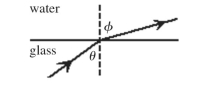
(Multiple Choice)
4.8/5  (71)
(71) A 4.0-cm-tall object is placed 50.0 cm from a diverging lens having a focal length of magnitude 25.0 cm. What is the nature and location of the image?
(Multiple Choice)
4.7/5 (86)
(86) A beam of light traveling in air strikes a slab of transparent material. The incident beam makes an angle of with the normal, and the refracted beam make an angle of with the normal. What is the speed of light in the transparent material?
(Multiple Choice)
4.8/5 (94)
(94) A slide projector is set up with its lens 6.0 m from the screen. The projected image on the
screen is 1.5 m square for a slide (the object) that is 2.5 cm square.
(a) How far is the slide from the lens?
(b) What is the focal length of the projector lens?
(Short Answer)
4.9/5 (83)
(83) An oil layer that is 5.0 cm thick is spread smoothly and evenly over the surface of water on a windless day. A light ray from the air above enters the oil at 45° with the normal and then goes
Into the water. What is the angle of refraction of this ray in the water? The index of refraction for
The oil is 1.15, and for water it is 1.33.
(Multiple Choice)
4.9/5 (75)
(75) A seed is 15 mm in front of a converging lens, and the image of the seed is 4.0 mm behind the lens. What is the focal length of the lens?
(Multiple Choice)
4.9/5 (69)
(69) An object is 5.7 cm from a spherical concave mirror. If the image is 4.7 cm tall and 10 cm from the mirror, how tall is the object?
(Multiple Choice)
4.9/5 (87)
(87) If a object is placed between a convex lens and its focal point, the image formed is
(Multiple Choice)
4.8/5 (74)
(74) Two plane mirrors make an angle of with each other. A light ray enters the system and is reflected once off of each mirror. Through what angle is the ray turned?
(Multiple Choice)
4.9/5 (76)
(76) An object is 50 cm from a concave mirror of radius of curvature of magnitude 60 cm. How far is the image from the mirror?
(Multiple Choice)
4.7/5 (78)
(78) A coin is 12 cm in front of a converging lens with focal length of magnitude 4.0 cm. Where is the image?
(Multiple Choice)
4.9/5 (76)
(76) If an object is placed at the center of curvature of concave mirror, the image formed by the mirror is located
(Multiple Choice)
4.8/5 (75)
(75) A light beam is traveling inside a glass block that has an index of refraction of 1.46. As this light arrives at the surface of the block, it makes an angle of with the normal. At what angle with the normal in the air will it leave the block?
(Multiple Choice)
4.8/5 (76)
(76) A thick slab of plastic lies at the bottom of a tank filled with water having an index of refraction of 1.33. A narrow laser beam is shone directly downward through the water on the plastic. You then gradually rotate the laser, thereby increasing the angle with respect to the normal that it strikes the plastic. You carefully note that at the instant the beam makes an angle of with the normal in the water, no light enters the plastic, but it did enter for angles smaller than that. What is the speed of light in the plastic slab? )
(Short Answer)
5.0/5 (86)
(86) The focal length of a concave mirror has a magnitude of 20 cm. What is its radius of curvature?
(Multiple Choice)
4.7/5 (83)
(83) A cell phone is placed 40 cm in front of a converging lens with a focal length of magnitude 20 cm. How far is the image of this phone from the lens?
(Multiple Choice)
4.9/5 (81)
(81) A person's face is 30 cm in front of a concave spherical shaving mirror. If the image is an erect image that is 1.5 times as large as the object, what is the focal length mirror?
(Multiple Choice)
4.8/5 (77)
(77) 
Filters
- Essay(0)
- Multiple Choice(0)
- Short Answer(0)
- True False(0)
- Matching(0)