



 Chat with AI
Exam 2: The Basic Concepts of Set Theory

Exam 1: The Art of Problem Solving190 Questions
Exam 2: The Basic Concepts of Set Theory316 Questions
Exam 3: Introduction to Logic315 Questions
Exam 4: Numeration Systems245 Questions
Exam 5: Number Theory171 Questions
Exam 6: The Real Numbers and Their Representations401 Questions
Exam 7: The Basic Concepts of Algebra273 Questions
Exam 8: Graphs, Functions, and Systems of Equations and Inequalities136 Questions
Exam 9: Geometry182 Questions
Exam 10: Counting Methods213 Questions
Exam 11: Probability140 Questions
Exam 12: Statistics152 Questions
Exam 13: Personal Financial Management260 Questions
Exam 14: Trigonometry Formerly234 Questions
Exam 15: Graph Theory110 Questions
Exam 16: Voting and Apportionment99 Questions
Select questions type


Let U = {1, 2, 4, 5, a, b, c, d, e}. Find the complement of the set.
-P = {a, b, d, e, 1, 2, 4, 5}
(Multiple Choice)
4.7/5  (74)
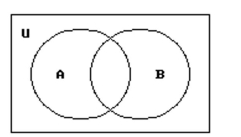
(74) For the given sets, construct a Venn diagram and place the elements in the proper region.
- Let U=\{b,d,j,i,m,n,t\} A=\{d,j,i,n\} B=\{b,d,j,t\}
(Multiple Choice)
4.8/5 (79)
(79) The lists below show five agricultural crops in Alabama, Arkansas, and Louisiana.
soybeans (s) soybeans (s) soybeans (s) peanuts (p) rice (r) sugarcane (n) corn (c) cotton (t) rice (r) hay (h) hay (h) corn (c) wheat (w) wheat (w) cotton (t)
Let U be the smallest possible universal set that includes all of the crops listed, and let A, K and L be the sets of five crops
in Alabama, Arkansas, and Louisiana, respectively. Find each of the following sets.
-The set of crops in either A' or L or both
(Multiple Choice)
4.7/5 (83)
(83) Find the indicated cardinal number.
-Find given that and .
(Multiple Choice)
4.9/5 (77)
(77) The lists below show five agricultural crops in Alabama, Arkansas, and Louisiana.
soybeans (s) soybeans (s) soybeans (s) peanuts (p) rice (r) sugarcane (n) corn (c) cotton (t) rice (r) hay (h) hay (h) corn (c) wheat (w) wheat (w) cotton (t)
Let U be the smallest possible universal set that includes all of the crops listed, and let A, K and L be the sets of five crops in Alabama, Arkansas, and Louisiana, respectively. Find each of the following sets.
-
(Multiple Choice)
4.8/5 (64)
(64) Decide whether or not it is possible to set up a one-to-one correspondence between the elements of the sets.
-{1, 2, 3, 4, ...} and {0, 1, 2, 3, 4}
(Multiple Choice)
4.9/5 (91)
(91) Decide whether the given statement is always true or not always true.
-
(Multiple Choice)
4.9/5 (69)
(69) List the elements in the set . Let
=\{,,,,,,,,,\} =\{,,,,\} =\{,,,\} =\{,,,,\}
-
(Multiple Choice)
4.9/5 (90)
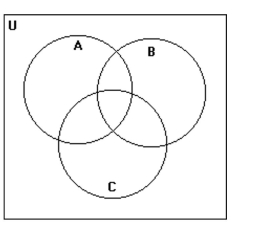
(90) For the given sets, construct a Venn diagram and place the elements in the proper region.
- =\{2,4,6,8,10,12\} =\{2,6,10\} =\{2,4,8\} =\{2,8,10,12\}
(Multiple Choice)
4.8/5 (76)
(76) Determine whether the sets are equal, equivalent, both, or neither.
- is a whole number and is an integer
(Multiple Choice)
4.9/5 (73)
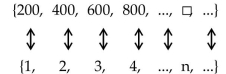
(73) A one-to-one correspondence between the set of counting numbers and the given set has been established. Find an expression for the nth term of the given set that corresponds to the counting number n.
-
(Multiple Choice)
4.8/5 (82)
(82) Write true or false for the following statement. Let
A=\{3,5,7,9,11,13\} B=\{3,5,9,11\} C=\{5,9,13\}
-
(True/False)
4.9/5 (84)
(84) 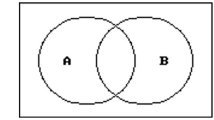
Find the cardinal number of the set.
-The numbers in the Venn Diagram below represent cardinalities. 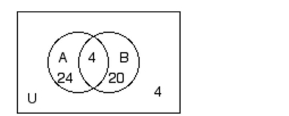 Find .
 (Multiple Choice)
4.9/5 (81)
(81) Solve the problem.
-A survey of 134 college students was done to find out what elective courses they were taking. Let A = the set of those taking art, the set of those taking basketweaving, and the set of those taking canoeing. The study revealed the following information.
n(A)=45 n(A\capB)=12 n(B)=55 n(A\capC)=15 n(C)=40 n(B\capC)=23 n(A\capB\capC)=2
How many students were not taking any of these electives?
(Multiple Choice)
4.9/5 (80)
(80) Determine whether the statement is true or false.
Let
B=\{5,6,7,8\} C=\{5,8\} D=\{2,5,8\} U=\{1,2,3,4,5,6,7,8\}
-
(True/False)
4.8/5 (76)
(76) Find the indicated cardinal number.
-Find given that and .
(Multiple Choice)
4.7/5 (94)
(94) 
Filters
- Essay(0)
- Multiple Choice(0)
- Short Answer(0)
- True False(0)
- Matching(0)