Exam 3: Graphs and Functions

arrow
  • Select Tags
search iconSearch Question
flashcardsStudy Flashcards
  • Select Tags

Write an equation for the line described. Give your answer in slope-intercept form. - m=−7\mathrm { m } = - 7 , through (−4,2)( - 4,2 )

(Multiple Choice)
5.0/5
(84)

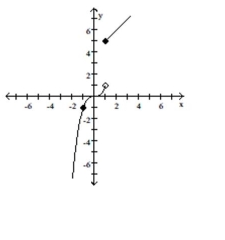
Give a rule for the piecewise-defined function. Then give the domain and range. -Give a rule for the piecewise-defined function. Then give the domain and range. -
(Multiple Choice)
4.9/5
(76)

Describe how the graph of the equation relates to the graph of y y=x3y = \sqrt [ 3 ] { x } . - f(x)=−(x−6)2−2f(x)=-(x-6)^{2}-2  Describe how the graph of the equation relates to the graph of y  y = \sqrt [ 3 ] { x }  . - f(x)=-(x-6)^{2}-2

(Multiple Choice)
4.9/5
(75)

Graph the linear function and give the domain and the range. If the function is a constant function, identify it as such. - f(x)=14xf(x)=\frac{1}{4} x  Graph the linear function and give the domain and the range. If the function is a constant function, identify it as such. - f(x)=\frac{1}{4} x
(Multiple Choice)
4.8/5
(73)

Give the domain and range of the relation. -Find g(a+1)g ( a + 1 ) when g(x)=4x+3g ( x ) = 4 x + 3

(Multiple Choice)
4.8/5
(90)

Find the slope of the line and sketch the graph. - 2x−3y=−32 x - 3 y = - 3  Find the slope of the line and sketch the graph. - 2 x - 3 y = - 3

(Multiple Choice)
4.8/5
(72)

Graph the line and give the domain and the range. - y+4=0y+4=0  Graph the line and give the domain and the range. - y+4=0

(Multiple Choice)
4.9/5
(66)

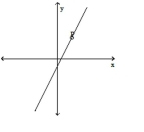
Determine the intervals of the domain over which the function is continuous. -P(2, 3) Determine the intervals of the domain over which the function is continuous. -P(2, 3)
(Multiple Choice)
4.7/5
(77)

For the pair of functions, find the indicated sum, difference, product, or quotient. - f(x)=3x+5,g(x)=9x−16f ( x ) = \sqrt { 3 x + 5 } , g ( x ) = \sqrt { 9 x - 16 } Find (fg)(x)( f g ) ( x ) .

(Multiple Choice)
4.7/5
(76)

Find the coordinates of the other endpoint of the segment, given its midpoint and one endpoint. -midpoint (−8,−9)( - 8 , - 9 ) , endpoint (−10,−5)( - 10 , - 5 )

(Multiple Choice)
4.8/5
(85)

Graph the equation by plotting points. - y=(x+1)3y=(x+1)^{3}  Graph the equation by plotting points. - y=(x+1)^{3}

(Multiple Choice)
4.8/5
(63)

Graph the point symmetric to the given point. -  Plot the point (−4,7), then plot the point that is symmetric to (−4,7) with respect to the y-axis. \text { Plot the point } ( - 4,7 ) \text {, then plot the point that is symmetric to } ( - 4,7 ) \text { with respect to the } y \text {-axis. }  Graph the point symmetric to the given point. - \text { Plot the point } ( - 4,7 ) \text {, then plot the point that is symmetric to } ( - 4,7 ) \text { with respect to the } y \text {-axis. }

(Multiple Choice)
4.8/5
(70)

Decide whether the relation defines a function. - y=3x−3y = \frac { 3 } { x - 3 }

(Multiple Choice)
4.9/5
(82)

Describe how the graph of the equation relates to the graph of y y=x3y = \sqrt [ 3 ] { x } . - f(x)=13∣−x∣f ( x ) = \frac { 1 } { 3 } | - x |  Describe how the graph of the equation relates to the graph of y  y = \sqrt [ 3 ] { x }  . - f ( x ) = \frac { 1 } { 3 } | - x |

(Multiple Choice)
4.9/5
(76)

Determine whether the three points are collinear. -Which graphs of functions increase over the whole of their domain?

(Multiple Choice)
4.8/5
(66)

Graph the linear function and give the domain and the range. If the function is a constant function, identify it as such. - f(x)=14x+6f(x)=\frac{1}{4} x+6  Graph the linear function and give the domain and the range. If the function is a constant function, identify it as such. - f(x)=\frac{1}{4} x+6
(Multiple Choice)
4.9/5
(77)

Find the specified domain. -Find the domain of (f+g)(x)( f + g ) ( x ) when f(x)=3x+9f ( x ) = 3 x + 9 and g(x)=2x−8g ( x ) = \frac { 2 } { x - 8 }

(Multiple Choice)
4.7/5
(77)

Compute and simplify the difference quotient f(x+h)−f(x)h,h≠0\frac { f ( x + h ) - f ( x ) } { h } , h \neq 0 - f(x)=2x2+7xf ( x ) = 2 x ^ { 2 } + 7 x

(Multiple Choice)
4.7/5
(70)

Find the center and radius of the circle. - x2+y2+4x−16y−13=0x ^ { 2 } + y ^ { 2 } + 4 x - 16 y - 13 = 0

(Multiple Choice)
5.0/5
(68)

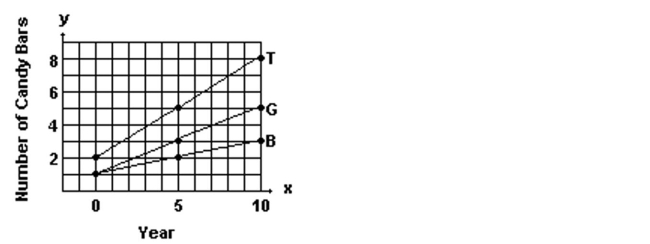
A new chocolate company is estimating how many candy bars per week college students will consume of their line of products. The graph shows the probable number of candy bars students (age 18-22) will consume from year 0 to year 10. B(x) gives the number of candy bars for boys, G(x) gives the number of candy bars for girls, and T(x) gives the total number for both groups. Use the graph to answer the question.  A new chocolate company is estimating how many candy bars per week college students will consume of their line of products. The graph shows the probable number of candy bars students (age 18-22) will consume from year 0 to year 10. B(x) gives the number of candy bars for boys, G(x) gives the number of candy bars for girls, and T(x) gives the total number for both groups. Use the graph to answer the question.   -The radius  \mathrm { r }  of a circle of known area  \mathrm { A }  is given by  \mathrm { r } = \sqrt { \mathrm { A } / \pi } , where  \pi \approx 3.1416 . Find the radius and circumference of a circle with an area of  48.71 \mathrm { sq } \mathrm { ft } . (Round results to two decimal places.) -The radius r\mathrm { r } of a circle of known area A\mathrm { A } is given by r=A/π\mathrm { r } = \sqrt { \mathrm { A } / \pi } , where π≈3.1416\pi \approx 3.1416 . Find the radius and circumference of a circle with an area of 48.71sqft48.71 \mathrm { sq } \mathrm { ft } . (Round results to two decimal places.)
(Multiple Choice)
4.9/5
(79)
Showing 261 - 280 of 531
close modal

Filters

  • Essay(0)
  • Multiple Choice(0)
  • Short Answer(0)
  • True False(0)
  • Matching(0)