



 Chat with AI
Exam 11: Liabilities: Bonds Payable

Exam 1: Introduction to Accounting and Business243 Questions
Exam 2: Analyzing Transactions234 Questions
Exam 3: The Adjusting Process225 Questions
Exam 4: The Accounting Cycle211 Questions
Exam 5: Accounting for Retail Businesses273 Questions
Exam 6: Inventories236 Questions
Exam 7: Internal Control and Cash197 Questions
Exam 8: Receivables210 Questions
Exam 9: Long-Term Assets: Fixed and Intangible243 Questions
Exam 10: Liabilities: Current, Installment Notes, and Contingencies199 Questions
Exam 11: Liabilities: Bonds Payable172 Questions
Exam 12: Corporations: Organization, Stock Transactions, and Dividends221 Questions
Exam 13: Statement of Cash Flows193 Questions
Exam 14: Financial Statement Analysis206 Questions
Exam 15: Introduction to Managerial Accounting244 Questions
Exam 16: Job Order Costing212 Questions
Exam 17: Process Cost Systems196 Questions
Exam 18: Activity-Based Costing109 Questions
Exam 19: Support Department and Joint Cost Allocation172 Questions
Exam 20: Cost-Volume-Profit Analysis247 Questions
Exam 21: Variable Costing for Management Analysis136 Questions
Exam 22: Budgeting197 Questions
Exam 23: Evaluating Variances From Standard Costs172 Questions
Exam 24: Evaluating Decentralized Operations210 Questions
Exam 25: Differential Analysis and Product Pricing157 Questions
Exam 26: Capital Investment Analysis191 Questions
Exam 27: Lean Manufacturing and Activity Analysis134 Questions
Exam 28: The Balanced Scorecard and Corporate Social Responsibility170 Questions
Exam 29: Investments137 Questions
Select questions type


Match each description below to the appropriate term (a-g).
-Allows the bond holder to exchange bond for shares of stock
A)carrying amount
B)face value
C)callable bond
D)indenture
E)term bond
F)convertible bond
G)serial bond
(Short Answer)
4.9/5  (77)
(77) Using the following table, what is the present value of $15,000 to be received in 10 years, if the market rate is 5% compounded annually? 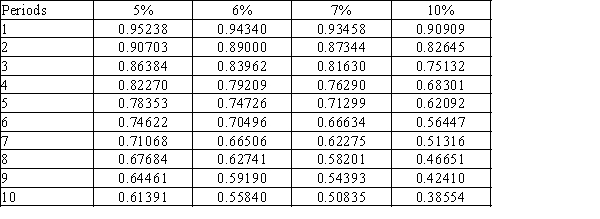
(Essay)
4.9/5 (85)
(85) Any unamortized premium should be reported on the balance sheet of the issuing corporation as
(Multiple Choice)
4.9/5 (93)
(93) The present value of the periodic bond interest payments is the value today of the amount of interest to be received at the end of each interest period.
(True/False)
4.8/5 (89)
(89) Dylan Corporation issues for cash $2,000,000 of 8%, 15-year bonds, interest payable annually, at a time when the market rate of interest is 9%. The straight-line method is adopted for the amortization of bond discount or premium. Which of the following statements is true?
(Multiple Choice)
4.8/5 (85)
(85) The present value of an annuity is the sum of the present values of each cash flow.
(True/False)
4.8/5 (68)
(68) Bonds are sold at face value when the contract rate is equal to the market rate of interest.
(True/False)
4.7/5 (77)
(77) The Merchant Company issued 10-year bonds on January 1. The 15% bonds have a face value of $100,000 and pay interest every January 1 and July 1. The bonds were sold for $117,205 based on the market interest rate of 12%. Merchant uses the effective interest method to amortize bond discounts and premiums. On July 1 of the first year, Merchant should record interest expense (round to the nearest dollar) of
(Multiple Choice)
4.8/5 (94)
(94) Both callable and noncallable bonds can be purchased by the issuing corporation in the open market.
(True/False)
4.8/5 (75)
(75) A corporation often issues callable bonds to protect itself against significant declines in future interest rates.
(True/False)
4.9/5 (84)
(84) When the effective interest method is used, the amortization of the bond premium
(Multiple Choice)
4.9/5 (72)
(72) Match each description below to the appropriate term (a-g).
-The principal of the bond issue is paid back in installments
A)carrying amount
B)face value
C)callable bond
D)indenture
E)term bond
F)convertible bond
G)serial bond
(Short Answer)
4.8/5 (74)
(74) 
Filters
- Essay(0)
- Multiple Choice(0)
- Short Answer(0)
- True False(0)
- Matching(0)