



 Chat with AI
Exam 11: Liabilities: Bonds Payable

Exam 1: Introduction to Accounting and Business243 Questions
Exam 2: Analyzing Transactions234 Questions
Exam 3: The Adjusting Process225 Questions
Exam 4: The Accounting Cycle211 Questions
Exam 5: Accounting for Retail Businesses273 Questions
Exam 6: Inventories236 Questions
Exam 7: Internal Control and Cash197 Questions
Exam 8: Receivables210 Questions
Exam 9: Long-Term Assets: Fixed and Intangible243 Questions
Exam 10: Liabilities: Current, Installment Notes, and Contingencies199 Questions
Exam 11: Liabilities: Bonds Payable172 Questions
Exam 12: Corporations: Organization, Stock Transactions, and Dividends221 Questions
Exam 13: Statement of Cash Flows193 Questions
Exam 14: Financial Statement Analysis206 Questions
Exam 15: Introduction to Managerial Accounting244 Questions
Exam 16: Job Order Costing212 Questions
Exam 17: Process Cost Systems196 Questions
Exam 18: Activity-Based Costing109 Questions
Exam 19: Support Department and Joint Cost Allocation172 Questions
Exam 20: Cost-Volume-Profit Analysis247 Questions
Exam 21: Variable Costing for Management Analysis136 Questions
Exam 22: Budgeting197 Questions
Exam 23: Evaluating Variances From Standard Costs172 Questions
Exam 24: Evaluating Decentralized Operations210 Questions
Exam 25: Differential Analysis and Product Pricing157 Questions
Exam 26: Capital Investment Analysis191 Questions
Exam 27: Lean Manufacturing and Activity Analysis134 Questions
Exam 28: The Balanced Scorecard and Corporate Social Responsibility170 Questions
Exam 29: Investments137 Questions
Select questions type


The adjusting entry to record the amortization of a discount on bonds payable is
(Multiple Choice)
4.8/5  (76)
(76) When a portion of a bond issue is redeemed, a related proportion of the unamortized premium or discount must be written off.
(True/False)
4.8/5 (67)
(67) The face value of a term bond is payable at a single specific date in the future.
(True/False)
4.8/5 (76)
(76) The total interest expense over the entire life of a bond is equal to the sum of the interest payments plus the total discount or minus the total premium related to the bond.
(True/False)
4.8/5 (76)
(76) Marmalice Co. issued $4,000,000 of five-year, 10 percent bonds, with interest payable semiannually, at a market (effective) interest rate of 11 percent. Determine the present value of the bonds payable using the present value tables. Round to the nearest dollar.
Present value of an annuity of $1 at compound interest: 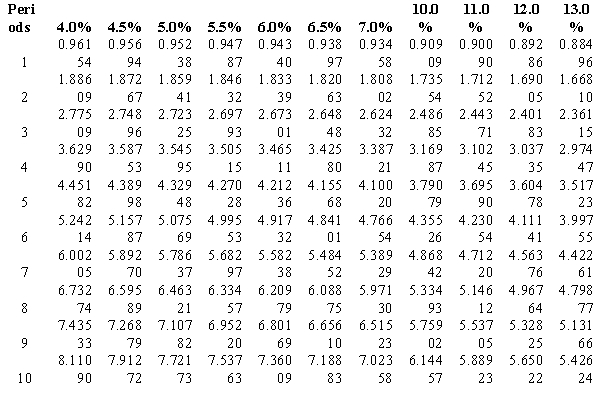 Present value of a $1 at compound interest:
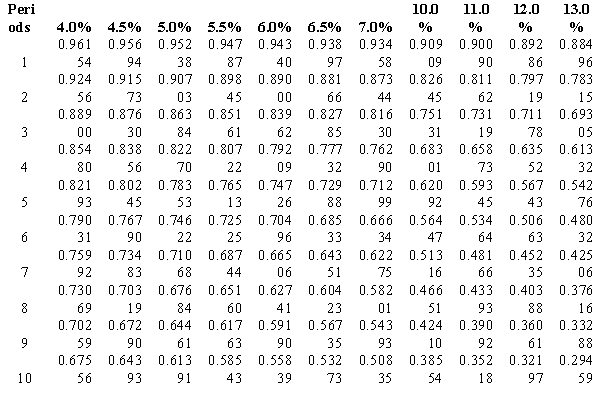
Present value of a $1 at compound interest: (Essay)
4.7/5 (69)
(69) On the first day of the fiscal year, Lisbon Co. issued $1,000,000 of 10-year, 7% bonds for $1,050,000, with interest payable semiannually. Orange Inc. purchased the bonds on the issue date for the issue price. Prepare entries to record the following transactions for the current fiscal year.(a)Issuance of the bonds.(b)Second semiannual interest payment.(c)Amortization of bond premium for the first year, using the straight-line method of amortization.
(Essay)
4.8/5 (73)
(73) A bond is usually divided into a number of individual bonds of $500 each.
(True/False)
4.8/5 (89)
(89) If $2,000,000 of 10% bonds are issued at 97, the amount of cash received from the sale is
(Multiple Choice)
4.9/5 (65)
(65) The present value of $60,000 to be received in one year, at 6% compounded annually, is _____ (rounded to nearest dollar). Use the following table, if needed. 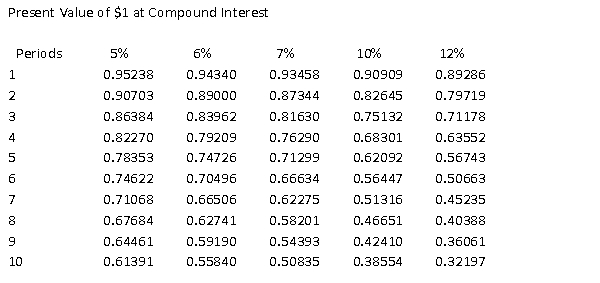
(Multiple Choice)
4.8/5 (86)
(86) On January 1, Year 1, Kennard Co. issued $2,000,000, 5%, 10-year bonds, with interest payable on June 30 and December 31 to yield 6%. Use the following format and round figures to nearest dollar. The bonds were issued for $1,851,234.
(a) Prepare an amortization schedule for Year 1 and Year 2 using the effective interest rate method.Date Interest Paid Interest Expense Amortization Bond Carrying Amount
(b) Show how this bond would be reported on the balance sheet at December 31, Year 2.
(Essay)
4.8/5 (65)
(65) Luke Corp. issued $2,000,000 of 20-year, 9% callable bonds on July 1, Year 1, with interest payable on June 30 and December 31. The fiscal year of the company is the calendar year. What is the entry to record the payment of interest on December 31 in the year the bonds were issued? 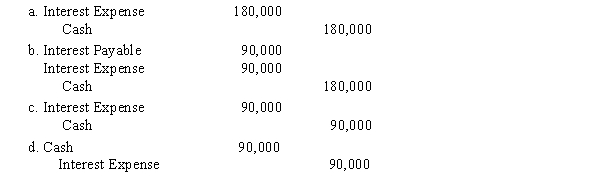
(Short Answer)
4.8/5 (79)
(79) The Levi Company issued $200,000 of 12% bonds on January 1 of the current year at face value. The bonds pay interest semiannually on January 1 and July 1. The bonds are dated January 1, and mature in five years, on January 1. The total interest expense related to these bonds for the current year ending on December 31 is
(Multiple Choice)
4.8/5 (85)
(85) Present entries to record the selected transactions described below:
(a)Issued $2,750,000 of 10-year, 8% bonds at 97.(b)Amortized bond discount for a full year, using the straight-line method.(c)Called bonds at 98. Assume the bonds were carried at $2,692,250 at the time of the redemption.
(Essay)
4.8/5 (82)
(82) When the market rate of interest was 12%, Halprin Corporation issued $1,000,000, 11%, 10-year bonds that pay interest annually. The selling price of this bond issue was _____. Use the following table, if needed. 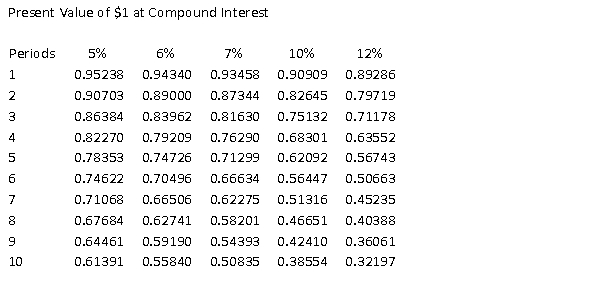
(Multiple Choice)
4.8/5 (76)
(76) On the first day of the current fiscal year, $1,500,000 of 10-year, 8% bonds, with interest payable semiannually, were sold for $1,225,000. Present entries to record the following transactions for the current fiscal year:
(a)Issuance of the bonds.(b)First semiannual interest payment (record as separate entry from discount amortization).(c)Amortization of bond discount for the year, using the straight-line method of amortization.
(Essay)
4.8/5 (84)
(84) Using the following table, what is the present value of $40,000 to be received in 5 years, if the market rate is 7% compounded annually? 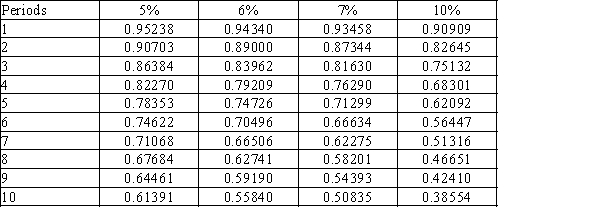
(Essay)
4.9/5 (94)
(94) Match each description below to the appropriate term (a-g).
-The value of a bond stated on the bond certificate
A)carrying amount
B)face value
C)callable bond
D)indenture
E)term bond
F)convertible bond
G)serial bond
(Short Answer)
4.8/5 (87)
(87) If the bondholder has the right to exchange a bond for shares of common stock, the bond is called a convertible bond.
(True/False)
4.8/5 (79)
(79) The carrying amount of the bonds is defined as the face value of the bonds plus any unamortized discount or less any unamortized premium.
(True/False)
4.8/5 (87)
(87) 
Filters
- Essay(0)
- Multiple Choice(0)
- Short Answer(0)
- True False(0)
- Matching(0)