



 Chat with AI
Exam 11: Liabilities: Bonds Payable

Exam 1: Introduction to Accounting and Business243 Questions
Exam 2: Analyzing Transactions234 Questions
Exam 3: The Adjusting Process225 Questions
Exam 4: The Accounting Cycle211 Questions
Exam 5: Accounting for Retail Businesses273 Questions
Exam 6: Inventories236 Questions
Exam 7: Internal Control and Cash197 Questions
Exam 8: Receivables210 Questions
Exam 9: Long-Term Assets: Fixed and Intangible243 Questions
Exam 10: Liabilities: Current, Installment Notes, and Contingencies199 Questions
Exam 11: Liabilities: Bonds Payable172 Questions
Exam 12: Corporations: Organization, Stock Transactions, and Dividends221 Questions
Exam 13: Statement of Cash Flows193 Questions
Exam 14: Financial Statement Analysis206 Questions
Exam 15: Introduction to Managerial Accounting244 Questions
Exam 16: Job Order Costing212 Questions
Exam 17: Process Cost Systems196 Questions
Exam 18: Activity-Based Costing109 Questions
Exam 19: Support Department and Joint Cost Allocation172 Questions
Exam 20: Cost-Volume-Profit Analysis247 Questions
Exam 21: Variable Costing for Management Analysis136 Questions
Exam 22: Budgeting197 Questions
Exam 23: Evaluating Variances From Standard Costs172 Questions
Exam 24: Evaluating Decentralized Operations210 Questions
Exam 25: Differential Analysis and Product Pricing157 Questions
Exam 26: Capital Investment Analysis191 Questions
Exam 27: Lean Manufacturing and Activity Analysis134 Questions
Exam 28: The Balanced Scorecard and Corporate Social Responsibility170 Questions
Exam 29: Investments137 Questions
Select questions type


When the market rate of interest is less than the contract rate for a bond, the bond will sell for a premium.
(True/False)
4.9/5  (89)
(89) On the first day of the fiscal year, a company issues a $1,000,000, 7%, 5-year bond that pays semiannual interest of $35,000 ($1,000,000 × 7% × 1/2), receiving cash of $884,171. Journalize the first interest payment and the amortization of the related bond discount using the straight-line method. Round answers to the nearest dollar.
(Essay)
4.8/5 (79)
(79) The present value of $5,000 to be received in 4 years at a market rate of interest of 6% compounded annually is $3,636.30. Use the following table, if needed. 
(True/False)
4.7/5 (79)
(79) The journal entry a company records for the interest payment and amortization of bond premium is
(Multiple Choice)
4.8/5 (80)
(80) Match each description below to the appropriate term (a-g).
-On the first day of the fiscal year, a company issues a $1,000,000, 7%, 5-year bond that pays semiannual interest of $35,000 ($1,000,000 × 7% × 1/2), receiving cash of $884,171. Journalize the entry to record the issuance of the bonds.
A)carrying amount
B)face value
C)callable bond
D)indenture
E)term bond
F)convertible bond
G)serial bond
(Essay)
4.8/5 (92)
(92) The times interest earned ratio is calculated by dividing Bonds Payable by Interest Expense.
(True/False)
4.7/5 (78)
(78) A $500,000 bond issue on which there is an unamortized discount of $20,000 is redeemed for $475,000. Journalize the redemption of the bonds.
(Essay)
4.8/5 (74)
(74) Match each description below to the appropriate term (a-g).
-The face amount of each bond
A)contract rate
B)effective rate
C)bond discount
D)bond premium
E)bond
F)bond indenture
G)principal
(Short Answer)
4.9/5 (68)
(68) The journal entry a company records for the interest payment and amortization of bond discount is
(Multiple Choice)
4.9/5 (71)
(71) If the market rate of interest is 10%, a $10,000, 12%, 10-year bond that pays interest semiannually would sell at an amount
(Multiple Choice)
4.8/5 (95)
(95) Match each description below to the appropriate term (a-g).
-The contract between bond issuer and bond purchaser
A)contract rate
B)effective rate
C)bond discount
D)bond premium
E)bond
F)bond indenture
G)principal
(Short Answer)
4.9/5 (84)
(84) If the straight-line method of amortization of discount on bonds payable is used, the amount of yearly interest expense will increase as the bonds approach maturity.
(True/False)
4.8/5 (90)
(90) On the first day of the fiscal year, a company issues a $500,000, 8%, 10-year bond that pays semiannual interest of $20,000 ($500,000 × 8% × 1/2), receiving cash of $530,000. Journalize the entry to record the issuance of the bonds.
(Essay)
4.9/5 (79)
(79) The effective interest rate method produces a constant dollar amount of interest expense to be reported each interest period.
(True/False)
4.9/5 (82)
(82) Snickett Corp. issued $5,000,000, five-year bonds on the first day of its fiscal year. The bonds have a stated rate of 11% and an effective (market) rate of 9%. Interest payments are made semiannually. Compute the following:
(a) The amount of cash proceeds from the sale of the bonds. Use the present value table and round to the nearest dollar.(b) The amount of premium to be amortized for the first semiannual interest payment period, using the interest method. Round to the nearest dollar.(c) The amount of premium to be amortized for the second semiannual interest payment period, using the interest method. Round to the nearest dollar.(d) The amount of the bond interest expense for the first year.
Present value of an annuity of $1 at compound interest: 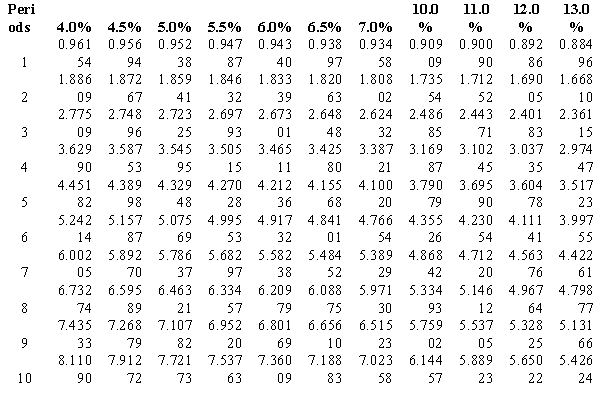 Present value of a $1 at compound interest:
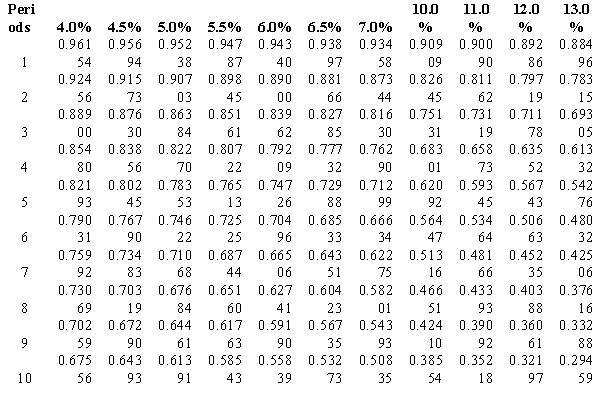
Present value of a $1 at compound interest: (Essay)
4.9/5 (88)
(88) When the effective interest rate method of amortization is used, the amount of interest expense for a given period is calculated by multiplying the face rate of interest by the bond's carrying value at the beginning of the given period.
(True/False)
4.9/5 (80)
(80) On the first day of the fiscal year, Lisbon Co. issued $1,000,000 of 10-year, 7% bonds for $1,050,000, with interest payable semiannually. Orange Inc. purchased the bonds on the issue date for the issue price. The journal entry to record the amortization of the premium (by the straight-line method) for the year by Lisbon Co. includes a debit to
(Multiple Choice)
4.8/5 (81)
(81) If $500,000 of 10-year bonds, with interest payable semiannually are sold for $494,040 based on (1) the present value of $500,000 due in 20 periods at 5% plus (2) the present value of twenty $25,000 payments at 5%, the nominal or contract rate and the market rate of interest for the bonds are both 10%.
(True/False)
5.0/5 (65)
(65) When the corporation issuing the bonds has the right to redeem the bonds prior to the maturity, the bonds are
(Multiple Choice)
4.9/5 (81)
(81) 
Filters
- Essay(0)
- Multiple Choice(0)
- Short Answer(0)
- True False(0)
- Matching(0)