



 Chat with AI
Exam 20: Income Inequality and Poverty

Exam 1: Ten Principles of Economics220 Questions
Exam 2: Thinking Like an Economist284 Questions
Exam 3: Interdependence and the Gains From Trade192 Questions
Exam 4: The Market Forces of Supply and Demand277 Questions
Exam 5: Elasticity and Its Application222 Questions
Exam 6: Supply, Demand, and Government Policies321 Questions
Exam 7: Consumers, Producers, and the Efficiency of Markets218 Questions
Exam 8: Applications: The Costs of Taxation203 Questions
Exam 9: Application: International Trade214 Questions
Exam 10: Externalities204 Questions
Exam 11: Public Goods and Common Resources182 Questions
Exam 12: The Design of the Tax System225 Questions
Exam 13: The Costs of Production261 Questions
Exam 14: Firms in Competitive Markets243 Questions
Exam 15: Monopoly231 Questions
Exam 16: Monopolistic Competition246 Questions
Exam 17: Oligopoly204 Questions
Exam 18: The Markets for the Factors of Production232 Questions
Exam 19: Earnings and Discrimination230 Questions
Exam 20: Income Inequality and Poverty194 Questions
Exam 21: The Theory of Consumer Choice209 Questions
Exam 22: Frontiers in Microeconomics185 Questions
Exam 23: Measuring a Nations Income231 Questions
Exam 24: Measuring the Cost of Living214 Questions
Exam 25: Production and Growth187 Questions
Exam 26: Saving, Investment, and the Financial System225 Questions
Exam 27: Tools of Finance198 Questions
Exam 28: Unemployment and Its Natural Rate361 Questions
Exam 29: The Monetary System210 Questions
Exam 30: Money Growth and Inflation201 Questions
Exam 31: Open-Economy Macroeconomics: Basic Concepts194 Questions
Exam 32: A Macroeconomic Theory of the Open Economy188 Questions
Exam 33: Aggregate Demand and Aggregate Supply189 Questions
Exam 34: The Influence of Monetary and Fiscal Policy on Aggregate Demand207 Questions
Exam 35: The Short-Run Tradeoff Between Inflation and Unemployment223 Questions
Exam 36: Six Debates Over Macroeconomic Policy154 Questions
Select questions type


Utilitarians believe that the proper goal of the government is to maximize the sum of the utilities of everyone in society.
(True/False)
5.0/5  (72)
(72) Which of the three political philosophies discussed in the textbook, if any, view the total income of society as a shared resource that a social planner can freely redistribute to achieve some social goal?
(Short Answer)
4.9/5 (83)
(83) In the US, is it more likely that someone will become a millionaire by making money on his/her own or by inheriting a fortune?
(Short Answer)
4.9/5 (91)
(91) In 2017, the top 5 percent of U.S. families earn approximately how much income per year?
(Multiple Choice)
4.7/5 (69)
(69) The poverty line is an absolute standard and is based on the cost of providing an adequate diet.
(True/False)
4.7/5 (74)
(74) Most economists believe that a family bases its spending decisions on its transitory income.
(True/False)
4.8/5 (79)
(79) In 2011 the top 20% of income earners accounted for over 80% of all income received by United States' families.
(True/False)
4.8/5 (84)
(84) One existing government program that works much like a negative income tax is the Earned Income Tax Credit.
(True/False)
4.8/5 (65)
(65) Figure 20-3
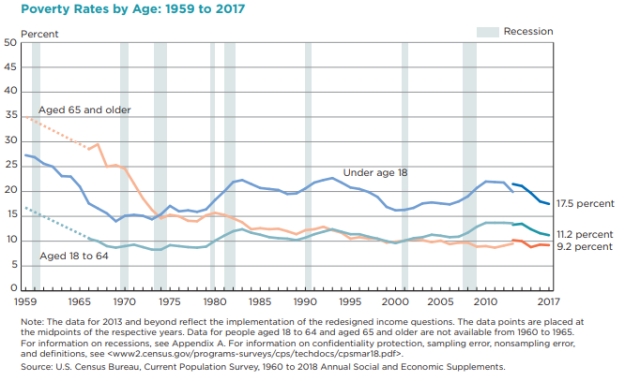
-Refer to Figure 20-3. In 2017, the percent of children under age 18 in poverty is
-Refer to Figure 20-3. In 2017, the percent of children under age 18 in poverty is (Multiple Choice)
4.8/5 (74)
(74) A follower of liberalism would not support a redistribution of income but rather would focus on equalizing opportunities.
(True/False)
4.8/5 (74)
(74) Since 1970, has the distribution of income in the US become more equal, less equal, or remained unchanged?
(Short Answer)
4.8/5 (88)
(88) Table 20-7
Distribution of Income in Imagination
Number of Families Income Range Average Income 23,500 less than \ 18,000 \ 15,890 42,410 between \ 18,000 and \ 36,000 \ 27,450 57,330 between \ 36,000 and \ 54,000 \ 46,220 63,490 between \ 54,000 and \ 72,000 \ 65,000 24,770 between \ 72,000 and \ 90,000 \ 80,790 23,500 more than \ 90,000 \ 118,750
-Refer to Table 20-7. The Human Development Report computes a measure of inequality by dividing the income of the richest 10% of the population by the income of the poorest 10%. If the value for this measure of inequality in the US is 15.9 and the value for India is 8.6, how does Imagination compare to these two nations?
(Essay)
4.9/5 (82)
(82) If a father earns 20% above his generation's average income, his son will most likely earn what percent above his generation's average income? What does this statistic indicate?
(Essay)
5.0/5 (70)
(70) Approximately what fraction of total income in the US economy comes from labor earnings?
(Short Answer)
4.9/5 (71)
(71) The table below reflects the levels of total utility received from income for each of four members of a society.
Income Peter Paul Mary Jane \ 1 15 32 20 16 \ 2 29 61 38 30 \ 3 42 87 54 42 \ 4 54 110 54 52 \ 5 65 130 68 60 \ 7 75 147 80 66 \ 8 84 161 90 70 \ 2 92 172 98 72
a.Assume that the society has the following income distribution:
Peter $3
Paul $7
Mary $5
Jane $3
Is it possible for the government to increase total aggregate utility by redistributing income among members of society? Explain your answer.
b.Assume that the government has $19 to allocate among the four members of society.(Assume that no one has any income to start with.) If the government is interested in distributing income in a way that maximizes aggregate total utility, how should it distribute the $19 of income?
c.Does the table above describe a situation characterized by diminishing marginal utility? Explain your answer.
(Essay)
4.9/5 (75)
(75) Figure 20-1
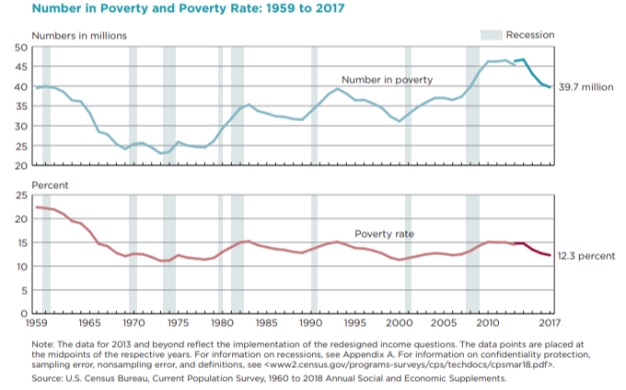
-Refer to Figure 20-1. The absolute number of people in poverty
-Refer to Figure 20-1. The absolute number of people in poverty (Multiple Choice)
4.7/5 (81)
(81) Scenario 20-1
The government is proposing switching from a progressive tax system in which families pay 15% of the first $50,000 earned, 25% of the next $50,000 earned, and 35% of any income over $100,000 to a tax system in which every family pays 20% of their income minus $20,000.
-Refer to Scenario 20-1. Which group would be most in favor of the switch from the current progressive tax policy to the new policy?
(Multiple Choice)
4.8/5 (91)
(91) If the government decided that each family needs a minimum income of $25,000 and promised to make up the difference between whatever a family earned and $25,000, which of the following is correct?
(Multiple Choice)
4.8/5 (82)
(82) 
Filters
- Essay(0)
- Multiple Choice(0)
- Short Answer(0)
- True False(0)
- Matching(0)