



 Chat with AI
Exam 20: Income Inequality and Poverty

Exam 1: Ten Principles of Economics220 Questions
Exam 2: Thinking Like an Economist284 Questions
Exam 3: Interdependence and the Gains From Trade192 Questions
Exam 4: The Market Forces of Supply and Demand277 Questions
Exam 5: Elasticity and Its Application222 Questions
Exam 6: Supply, Demand, and Government Policies321 Questions
Exam 7: Consumers, Producers, and the Efficiency of Markets218 Questions
Exam 8: Applications: The Costs of Taxation203 Questions
Exam 9: Application: International Trade214 Questions
Exam 10: Externalities204 Questions
Exam 11: Public Goods and Common Resources182 Questions
Exam 12: The Design of the Tax System225 Questions
Exam 13: The Costs of Production261 Questions
Exam 14: Firms in Competitive Markets243 Questions
Exam 15: Monopoly231 Questions
Exam 16: Monopolistic Competition246 Questions
Exam 17: Oligopoly204 Questions
Exam 18: The Markets for the Factors of Production232 Questions
Exam 19: Earnings and Discrimination230 Questions
Exam 20: Income Inequality and Poverty194 Questions
Exam 21: The Theory of Consumer Choice209 Questions
Exam 22: Frontiers in Microeconomics185 Questions
Exam 23: Measuring a Nations Income231 Questions
Exam 24: Measuring the Cost of Living214 Questions
Exam 25: Production and Growth187 Questions
Exam 26: Saving, Investment, and the Financial System225 Questions
Exam 27: Tools of Finance198 Questions
Exam 28: Unemployment and Its Natural Rate361 Questions
Exam 29: The Monetary System210 Questions
Exam 30: Money Growth and Inflation201 Questions
Exam 31: Open-Economy Macroeconomics: Basic Concepts194 Questions
Exam 32: A Macroeconomic Theory of the Open Economy188 Questions
Exam 33: Aggregate Demand and Aggregate Supply189 Questions
Exam 34: The Influence of Monetary and Fiscal Policy on Aggregate Demand207 Questions
Exam 35: The Short-Run Tradeoff Between Inflation and Unemployment223 Questions
Exam 36: Six Debates Over Macroeconomic Policy154 Questions
Select questions type


Scenario 20-4
Suppose the government implemented a negative income tax and used the following formula to compute a family's tax liability:
Taxes owed = (1/4 of income) - $14,000
-Refer to Scenario 20-4. A family earning $40,000 before taxes will owe tax.
(True/False)
4.9/5  (77)
(77) Figure 20-4
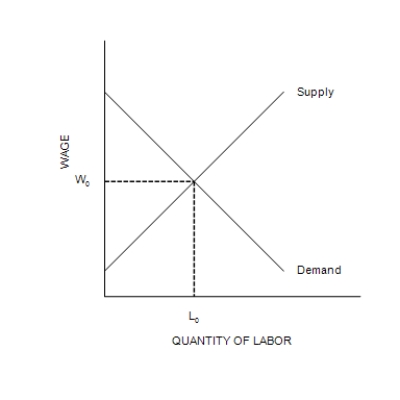 -Refer to Figure 20-4. If the government imposes a minimum wage above W0, it is likely to
 (Multiple Choice)
4.9/5 (93)
(93) Table 20-8
Income Inequality in the United States
The values in the table reflect the percentages of pre-tax-and transfer income.
Source: US Census Bureau
Year Bottom Fifth Second Fifth Middle Fifth Fourth Fifth Top Fifth Top 5\% 3.3\% 8.5\% 14.6\% 23.4\% 50.2\% 21.3\% 3.4 8.6 14.6 23.0 50.4 22.2 3.6 8.9 14.8 23.0 49.8 22.1 3.7 9.1 15.2 23.3 48.7 21.0 3.8 9.6 15.9 24.0 46.6 18.5 3.9 9.8 16.2 24.4 45.6 17.6 4.2 10.2 16.8 24.7 44.1 16.5
-Refer to Table 20-8. In 2010, what percentage of total income in the US did the bottom 20% of families have?
(Short Answer)
4.7/5 (71)
(71) Based on data from 2017, the top quintile of all families received approximately what percent of all income in the United States?
(Multiple Choice)
4.9/5 (66)
(66) In the United States in 2011, the bottom fifth of the income distribution had incomes below $27,218.
(True/False)
4.9/5 (77)
(77) Which of the three political philosophies discussed in the textbook, if any, think the government should not take from some individuals and give to others to achieve any particular distribution of income?
(Short Answer)
4.9/5 (88)
(88) Scenario 20-3
Suppose the government implemented a negative income tax and used the following formula to compute a family's tax liability:
Taxes owed = (1/4 of income) − $16,000
-Refer to Scenario 20-3. A family earning $46,000 before taxes would have how much after-tax income?
(Multiple Choice)
4.9/5 (70)
(70) A government's policy of redistributing income makes the income distribution
(Multiple Choice)
4.9/5 (78)
(78) With a minimum wage law, the workers who remain employed benefit from a .
(Short Answer)
4.9/5 (88)
(88) Government vouchers to purchase food, also known as food stamps, are an example of
(Multiple Choice)
4.8/5 (72)
(72) Of the following groups, which group is most likely to live in poverty - children, elderly, married-couple families, female household with no spouse present?
(Short Answer)
4.9/5 (82)
(82) The maximin criterion is the idea that the government should aim to maximize the well-being of the worst-off person in society.
(True/False)
4.8/5 (75)
(75) Libertarians believe that the government should enforce individual rights to ensure that all people have the same opportunities to use their talents to achieve success.
(True/False)
4.8/5 (64)
(64) One existing government program that works much like a negative income tax is Medicaid.
(True/False)
4.7/5 (86)
(86) 
Filters
- Essay(0)
- Multiple Choice(0)
- Short Answer(0)
- True False(0)
- Matching(0)