



 Chat with AI
Exam 26: Saving, Investment, and the Financial System

Exam 1: Ten Principles of Economics220 Questions
Exam 2: Thinking Like an Economist284 Questions
Exam 3: Interdependence and the Gains From Trade192 Questions
Exam 4: The Market Forces of Supply and Demand277 Questions
Exam 5: Elasticity and Its Application222 Questions
Exam 6: Supply, Demand, and Government Policies321 Questions
Exam 7: Consumers, Producers, and the Efficiency of Markets218 Questions
Exam 8: Applications: The Costs of Taxation203 Questions
Exam 9: Application: International Trade214 Questions
Exam 10: Externalities204 Questions
Exam 11: Public Goods and Common Resources182 Questions
Exam 12: The Design of the Tax System225 Questions
Exam 13: The Costs of Production261 Questions
Exam 14: Firms in Competitive Markets243 Questions
Exam 15: Monopoly231 Questions
Exam 16: Monopolistic Competition246 Questions
Exam 17: Oligopoly204 Questions
Exam 18: The Markets for the Factors of Production232 Questions
Exam 19: Earnings and Discrimination230 Questions
Exam 20: Income Inequality and Poverty194 Questions
Exam 21: The Theory of Consumer Choice209 Questions
Exam 22: Frontiers in Microeconomics185 Questions
Exam 23: Measuring a Nations Income231 Questions
Exam 24: Measuring the Cost of Living214 Questions
Exam 25: Production and Growth187 Questions
Exam 26: Saving, Investment, and the Financial System225 Questions
Exam 27: Tools of Finance198 Questions
Exam 28: Unemployment and Its Natural Rate361 Questions
Exam 29: The Monetary System210 Questions
Exam 30: Money Growth and Inflation201 Questions
Exam 31: Open-Economy Macroeconomics: Basic Concepts194 Questions
Exam 32: A Macroeconomic Theory of the Open Economy188 Questions
Exam 33: Aggregate Demand and Aggregate Supply189 Questions
Exam 34: The Influence of Monetary and Fiscal Policy on Aggregate Demand207 Questions
Exam 35: The Short-Run Tradeoff Between Inflation and Unemployment223 Questions
Exam 36: Six Debates Over Macroeconomic Policy154 Questions
Select questions type


In a closed economy, if Y, C, and T remained the same, a decrease in G would
(Multiple Choice)
4.8/5  (92)
(92) A decrease in taxes on interest income would increase the interest rate.
(True/False)
4.8/5 (93)
(93) When tax code changes reduce saving incentives, the interest rate will _____ and investment will _____.
(Short Answer)
4.8/5 (78)
(78) Concerns about the bankruptcy of an appliance manufacturer diminish after a new CEO is appointed and some of the company's less productive factories are sold. What type of risk for bondholders falls? What happens to the interest rate on this company's bonds?
(Short Answer)
4.9/5 (69)
(69) The income that households have left after paying their taxes and paying for their consumption is known as _____.
(Short Answer)
4.8/5 (87)
(87) To state that national saving is equal to investment, for a closed economy, is to state an accounting identity.
(True/False)
4.9/5 (93)
(93) Suppose the Move It! exercise chain has revenues of $45 million, accounting costs of $15 million, and currently has issued 10 million shares of stocks selling at $90 each. Compute the price-earning ratio. Show your work. Is this ratio relatively high or low? What might an increase in the price-earnings ratio indicate?
(Essay)
4.9/5 (80)
(80) Figure 26-2
The figure depicts a supply-of-loanable-funds curve and two demand-for-loanable-funds curves. 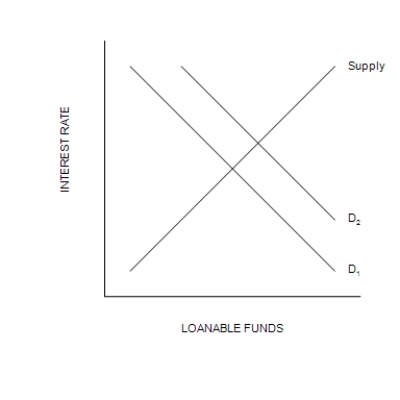 -Refer to Figure 26-2. Which of the following events would shift the demand curve from D1 to D2?
 (Multiple Choice)
4.9/5 (88)
(88) In a closed economy, what does the difference between the tax revenue and government purchases, (T − G), represent?
(Multiple Choice)
4.9/5 (82)
(82) A higher interest rate makes _____ less attractive. Therefore the quantity of loanable funds demanded decreases.
(Short Answer)
4.8/5 (104)
(104) A restaurant chain announces declining revenues. What's the name of the type of risk that this news raises for holders of this chain's bonds? What does this news to do the interest rate on this chain's bonds?
(Short Answer)
4.8/5 (82)
(82) Generally, if people begin to expect a company to have higher future profits, the price of the company's stock will begin to decrease.
(True/False)
4.7/5 (85)
(85) When a firm wants to borrow directly from the public to finance the purchase of new equipment, it does so by selling shares of stock.
(True/False)
4.9/5 (85)
(85) If people become less optimistic about the future earnings of Hyde Park Jazz Studio, then the price of the company's stock will fall.
(True/False)
4.9/5 (71)
(71) Two of the economy's most important financial intermediaries are
(Multiple Choice)
4.7/5 (73)
(73) The term loanable funds refers to all income that is not used for consumption.
(True/False)
4.9/5 (71)
(71) 
Filters
- Essay(0)
- Multiple Choice(0)
- Short Answer(0)
- True False(0)
- Matching(0)