



 Chat with AI
Exam 26: Saving, Investment, and the Financial System

Exam 1: Ten Principles of Economics220 Questions
Exam 2: Thinking Like an Economist284 Questions
Exam 3: Interdependence and the Gains From Trade192 Questions
Exam 4: The Market Forces of Supply and Demand277 Questions
Exam 5: Elasticity and Its Application222 Questions
Exam 6: Supply, Demand, and Government Policies321 Questions
Exam 7: Consumers, Producers, and the Efficiency of Markets218 Questions
Exam 8: Applications: The Costs of Taxation203 Questions
Exam 9: Application: International Trade214 Questions
Exam 10: Externalities204 Questions
Exam 11: Public Goods and Common Resources182 Questions
Exam 12: The Design of the Tax System225 Questions
Exam 13: The Costs of Production261 Questions
Exam 14: Firms in Competitive Markets243 Questions
Exam 15: Monopoly231 Questions
Exam 16: Monopolistic Competition246 Questions
Exam 17: Oligopoly204 Questions
Exam 18: The Markets for the Factors of Production232 Questions
Exam 19: Earnings and Discrimination230 Questions
Exam 20: Income Inequality and Poverty194 Questions
Exam 21: The Theory of Consumer Choice209 Questions
Exam 22: Frontiers in Microeconomics185 Questions
Exam 23: Measuring a Nations Income231 Questions
Exam 24: Measuring the Cost of Living214 Questions
Exam 25: Production and Growth187 Questions
Exam 26: Saving, Investment, and the Financial System225 Questions
Exam 27: Tools of Finance198 Questions
Exam 28: Unemployment and Its Natural Rate361 Questions
Exam 29: The Monetary System210 Questions
Exam 30: Money Growth and Inflation201 Questions
Exam 31: Open-Economy Macroeconomics: Basic Concepts194 Questions
Exam 32: A Macroeconomic Theory of the Open Economy188 Questions
Exam 33: Aggregate Demand and Aggregate Supply189 Questions
Exam 34: The Influence of Monetary and Fiscal Policy on Aggregate Demand207 Questions
Exam 35: The Short-Run Tradeoff Between Inflation and Unemployment223 Questions
Exam 36: Six Debates Over Macroeconomic Policy154 Questions
Select questions type


In a closed economy, investment must be equal to private saving.
(True/False)
4.8/5  (81)
(81) In a closed economy, if Y and T remained the same, but G rose and C fell but by less than the rise in G, what would happen to public and national saving?
(Multiple Choice)
4.8/5 (54)
(54) Financial markets are important for bringing equilibrium to the loanable funds market, but do not affect the efficient allocation of scarce resources in the long-run.
(True/False)
4.8/5 (71)
(71) Figure 26-1
The figure depicts a demand-for-loanable-funds curve and two supply-of-loanable-funds curves. 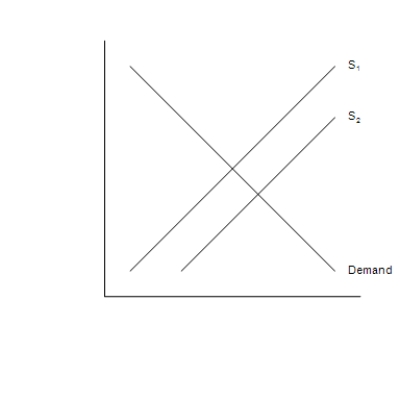 -Refer to Figure 26-1. Which of the following events would shift the supply curve from S1 to S2?
 (Multiple Choice)
4.7/5 (80)
(80) By definition, government purchases and taxes are zero for a closed economy.
(True/False)
5.0/5 (80)
(80) For a closed economy, GDP is $37 trillion, consumption is $10 trillion, taxes are $2.0 trillion and the government runs a surplus of $3 trillion. What are private saving and national saving?
(Multiple Choice)
4.8/5 (80)
(80) All financial intermediaries are financial institutions, but not all financial institutions are financial intermediaries.
(True/False)
4.9/5 (83)
(83) Refer to Scenario 26-1. This economy's government is running a budget
(Multiple Choice)
5.0/5 (99)
(99) If the tax rate fell, holding municipal bonds would be less desirable so the interest rates on them would fall.
(True/False)
4.9/5 (82)
(82) Joan uses some of her income to buy mutual fund shares. A macroeconomist refers to Joan's purchase as investment.
(True/False)
5.0/5 (60)
(60) Using a graph representing the market for loanable funds, show and explain what happens to interest rates and investment if the government budget goes from a deficit to a surplus.
(Essay)
5.0/5 (77)
(77) The country of Cedarland does not trade with any other country. Its GDP is $17 billion. Its government purchases $5 billion worth of goods and services each year and collects $6 billion in taxes. Private saving in Cedarland is $5 billion. For Cedarland, investment is
(Multiple Choice)
4.9/5 (79)
(79) Cole, a financial advisor, has told his clients the following things. Which of his statements is not correct?
(Multiple Choice)
4.8/5 (73)
(73) In a closed economy private saving is $500 billion and the government budget deficit is $100 billion. What is investment?
(Short Answer)
4.8/5 (65)
(65) When the U.S. government is in debt during a given year, it follows that its budget is in deficit for that year.
(True/False)
4.9/5 (66)
(66) An increase in the government's budget surplus means public saving is
(Multiple Choice)
4.9/5 (78)
(78) On which of these bonds is the prospect of default most likely?
(Multiple Choice)
4.8/5 (69)
(69) Bond A and Bond B have identical characteristics except that Bond A has a higher interest rate. Which bond has a higher credit risk?
(Short Answer)
4.9/5 (67)
(67) 
Filters
- Essay(0)
- Multiple Choice(0)
- Short Answer(0)
- True False(0)
- Matching(0)