



 Chat with AI
Exam 26: Saving, Investment, and the Financial System

Exam 1: Ten Principles of Economics220 Questions
Exam 2: Thinking Like an Economist284 Questions
Exam 3: Interdependence and the Gains From Trade192 Questions
Exam 4: The Market Forces of Supply and Demand277 Questions
Exam 5: Elasticity and Its Application222 Questions
Exam 6: Supply, Demand, and Government Policies321 Questions
Exam 7: Consumers, Producers, and the Efficiency of Markets218 Questions
Exam 8: Applications: The Costs of Taxation203 Questions
Exam 9: Application: International Trade214 Questions
Exam 10: Externalities204 Questions
Exam 11: Public Goods and Common Resources182 Questions
Exam 12: The Design of the Tax System225 Questions
Exam 13: The Costs of Production261 Questions
Exam 14: Firms in Competitive Markets243 Questions
Exam 15: Monopoly231 Questions
Exam 16: Monopolistic Competition246 Questions
Exam 17: Oligopoly204 Questions
Exam 18: The Markets for the Factors of Production232 Questions
Exam 19: Earnings and Discrimination230 Questions
Exam 20: Income Inequality and Poverty194 Questions
Exam 21: The Theory of Consumer Choice209 Questions
Exam 22: Frontiers in Microeconomics185 Questions
Exam 23: Measuring a Nations Income231 Questions
Exam 24: Measuring the Cost of Living214 Questions
Exam 25: Production and Growth187 Questions
Exam 26: Saving, Investment, and the Financial System225 Questions
Exam 27: Tools of Finance198 Questions
Exam 28: Unemployment and Its Natural Rate361 Questions
Exam 29: The Monetary System210 Questions
Exam 30: Money Growth and Inflation201 Questions
Exam 31: Open-Economy Macroeconomics: Basic Concepts194 Questions
Exam 32: A Macroeconomic Theory of the Open Economy188 Questions
Exam 33: Aggregate Demand and Aggregate Supply189 Questions
Exam 34: The Influence of Monetary and Fiscal Policy on Aggregate Demand207 Questions
Exam 35: The Short-Run Tradeoff Between Inflation and Unemployment223 Questions
Exam 36: Six Debates Over Macroeconomic Policy154 Questions
Select questions type


Explain why the demand for loanable funds slopes downward and why the supply of loanable funds slopes upward.
(Essay)
4.9/5  (74)
(74) The ratio of government debt to GDP was higher during the Reagan presidency than at any previous time in U.S. history.
(True/False)
4.7/5 (83)
(83) Suppose that you are a broker and people tell you the following about themselves. What sort of bond would you recommend to each? Defend your choices.
a."I am in a high federal income tax bracket and I don't want to take very much risk."
b."I want a high return and I am willing to take a lot of risk to get it."
c."I want a decent return and I have enough deductions that I don't value tax breaks highly."
(Essay)
4.8/5 (81)
(81) At the broadest level, the financial system moves the economy's scarce resources from
(Multiple Choice)
4.7/5 (74)
(74) The financial system coordinates investment and saving, which are important determinants of long-run real GDP.
(True/False)
4.8/5 (79)
(79) Which of the following bonds has the highest interest rate?
(Multiple Choice)
4.9/5 (80)
(80) On a graph that depicts the market for loanable funds, the nominal interest rate is measured along the vertical axis.
(True/False)
4.7/5 (87)
(87) Institutions that help to match one person's saving with another person's investment are collectively called the
(Multiple Choice)
4.9/5 (83)
(83) Managed mutual funds perform better on average than index funds because stock prices are usually a good predictor of a company's true value.
(True/False)
4.9/5 (77)
(77) Figure 26-4
This figure shows the loanable funds market for a closed economy. 
-Refer to Figure 26-4. Starting at point A, the enactment of an investment tax credit would likely cause the quantity of loanable funds traded to
-Refer to Figure 26-4. Starting at point A, the enactment of an investment tax credit would likely cause the quantity of loanable funds traded to (Multiple Choice)
4.8/5 (64)
(64) An increase in the demand for loanable funds increases the equilibrium interest rate and decreases the equilibrium level of saving.
(True/False)
5.0/5 (89)
(89) Owners of bonds that were issued by the federal government are not required to pay federal income tax on the interest income.
(True/False)
5.0/5 (75)
(75) Robert buys bonds. Rachel buys a new truck for her landscaping business. Identify both as savers, investors, both, or neither.
(Short Answer)
4.9/5 (86)
(86) Figure 26-1
The figure depicts a demand-for-loanable-funds curve and two supply-of-loanable-funds curves. 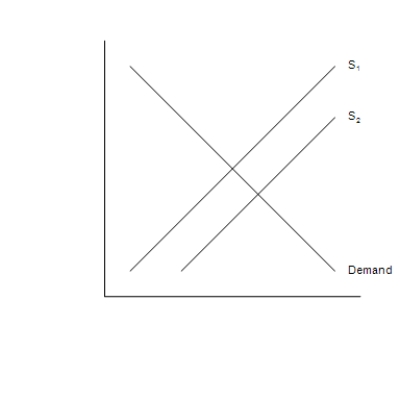 -Refer to Figure 26-1. What is measured along the vertical axis of the graph?
 (Multiple Choice)
4.7/5 (80)
(80) The term loanable funds refers to all income that is not used for consumption or government expenditures.
(True/False)
4.8/5 (87)
(87) 
Filters
- Essay(0)
- Multiple Choice(0)
- Short Answer(0)
- True False(0)
- Matching(0)