



 Chat with AI
Exam 35: The Short-Run Tradeoff Between Inflation and Unemployment

Exam 1: Ten Principles of Economics220 Questions
Exam 2: Thinking Like an Economist284 Questions
Exam 3: Interdependence and the Gains From Trade192 Questions
Exam 4: The Market Forces of Supply and Demand277 Questions
Exam 5: Elasticity and Its Application222 Questions
Exam 6: Supply, Demand, and Government Policies321 Questions
Exam 7: Consumers, Producers, and the Efficiency of Markets218 Questions
Exam 8: Applications: The Costs of Taxation203 Questions
Exam 9: Application: International Trade214 Questions
Exam 10: Externalities204 Questions
Exam 11: Public Goods and Common Resources182 Questions
Exam 12: The Design of the Tax System225 Questions
Exam 13: The Costs of Production261 Questions
Exam 14: Firms in Competitive Markets243 Questions
Exam 15: Monopoly231 Questions
Exam 16: Monopolistic Competition246 Questions
Exam 17: Oligopoly204 Questions
Exam 18: The Markets for the Factors of Production232 Questions
Exam 19: Earnings and Discrimination230 Questions
Exam 20: Income Inequality and Poverty194 Questions
Exam 21: The Theory of Consumer Choice209 Questions
Exam 22: Frontiers in Microeconomics185 Questions
Exam 23: Measuring a Nations Income231 Questions
Exam 24: Measuring the Cost of Living214 Questions
Exam 25: Production and Growth187 Questions
Exam 26: Saving, Investment, and the Financial System225 Questions
Exam 27: Tools of Finance198 Questions
Exam 28: Unemployment and Its Natural Rate361 Questions
Exam 29: The Monetary System210 Questions
Exam 30: Money Growth and Inflation201 Questions
Exam 31: Open-Economy Macroeconomics: Basic Concepts194 Questions
Exam 32: A Macroeconomic Theory of the Open Economy188 Questions
Exam 33: Aggregate Demand and Aggregate Supply189 Questions
Exam 34: The Influence of Monetary and Fiscal Policy on Aggregate Demand207 Questions
Exam 35: The Short-Run Tradeoff Between Inflation and Unemployment223 Questions
Exam 36: Six Debates Over Macroeconomic Policy154 Questions
Select questions type


A central bank can reduce inflation by reducing money supply growth, but it necessarily does so at the cost of permanently raising the unemployment rate.
(True/False)
4.8/5  (86)
(86) What evidence does the Volcker disinflation provide concerning the importance of inflation expectations to the costs of disinflation?
(Essay)
4.9/5 (78)
(78) Just as the aggregate-demand curve slopes downward only in the short run, the trade-off between inflation and unemployment holds only in the long run.
(True/False)
4.9/5 (84)
(84) Other things the same, if there is an increase in the money supply growth rate that is larger than expected, then in the short run
(Multiple Choice)
4.8/5 (67)
(67) An increase in inflation expectations shifts the short-run Phillips curve right and has no effect on the long-run Phillips curve.
(True/False)
4.8/5 (69)
(69) The government of Blenova considers two policies. Policy A would shift AD right by 500 units while policy B would shift AD right by 300 units. According to the short-run Phillips curve, policy A will lead
(Multiple Choice)
4.8/5 (84)
(84) If there were a favorable supply shock and the central bank wanted to offset the change in the unemployment rate, what would it do?
(Essay)
4.8/5 (94)
(94) Does a more steeply sloped Phillips curve make the sacrifice ratio smaller or larger than otherwise?
(Essay)
4.7/5 (76)
(76) A policy change that reduces the natural rate of unemployment shifts both the long-run aggregate-supply curve and the long-run Phillips curve left.
(True/False)
4.8/5 (82)
(82) If people correctly anticipate that inflation will fall by 1%, then
(Multiple Choice)
4.8/5 (90)
(90) The analysis of Friedman and Phelps argues that an expected change in inflation has no impact on the unemployment rate.
(True/False)
4.7/5 (55)
(55) If expected inflation falls but actual inflation remains the same, what happens to the unemployment rate? Defend your answer.
(Essay)
4.9/5 (89)
(89) If prices and wages adjusted rapidly and producers could quickly distinguish the difference between a change in the price level and a change in the relative price of their products, then an increase in the money supply growth rate would have at most a very short-lived affect on unemployment.
(True/False)
4.9/5 (82)
(82) Figure 35-1 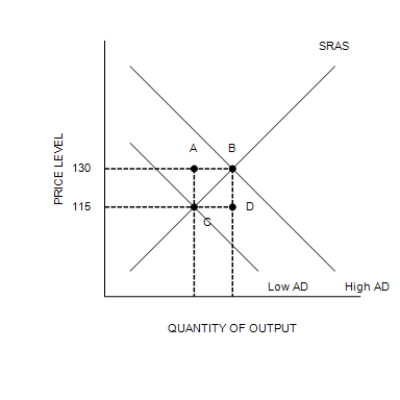
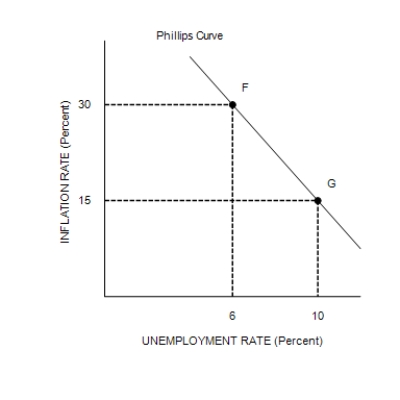
-Refer to Figure 35-1. Suppose points F and G on the right-hand graph represent two possible outcomes for an imaginary economy in the year 2020, and those two points correspond to points B and C, respectively, on the left-hand graph. Then it is apparent that the price index equaled
-Refer to Figure 35-1. Suppose points F and G on the right-hand graph represent two possible outcomes for an imaginary economy in the year 2020, and those two points correspond to points B and C, respectively, on the left-hand graph. Then it is apparent that the price index equaled (Multiple Choice)
4.8/5 (86)
(86) U.S. monetary policy in the early 1980s reduced the inflation rate by more than half.
(True/False)
4.8/5 (80)
(80) Figure 35-5 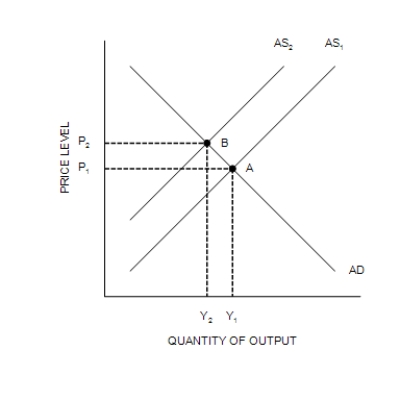
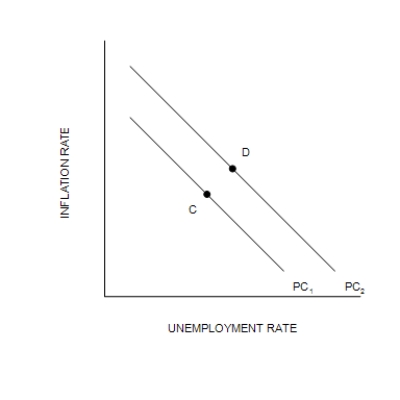 -Refer to Figure 35-5. A significant increase in the world price of oil could explain
 (Multiple Choice)
4.9/5 (82)
(82) According to the long-run Phillips curve, in the long run monetary policy influences
(Multiple Choice)
5.0/5 (83)
(83) In 1980, the combination of inflation and unemployment the U.S. was experiencing
(Multiple Choice)
4.9/5 (92)
(92) If the Fed reduces inflation by 2 percentage points and this results in a 6 percentage-point increase in unemployment, then the sacrifice ratio is equal to 3.
(True/False)
4.7/5 (87)
(87) 
Filters
- Essay(0)
- Multiple Choice(0)
- Short Answer(0)
- True False(0)
- Matching(0)