



 Chat with AI
Exam 35: The Short-Run Tradeoff Between Inflation and Unemployment

Exam 1: Ten Principles of Economics220 Questions
Exam 2: Thinking Like an Economist284 Questions
Exam 3: Interdependence and the Gains From Trade192 Questions
Exam 4: The Market Forces of Supply and Demand277 Questions
Exam 5: Elasticity and Its Application222 Questions
Exam 6: Supply, Demand, and Government Policies321 Questions
Exam 7: Consumers, Producers, and the Efficiency of Markets218 Questions
Exam 8: Applications: The Costs of Taxation203 Questions
Exam 9: Application: International Trade214 Questions
Exam 10: Externalities204 Questions
Exam 11: Public Goods and Common Resources182 Questions
Exam 12: The Design of the Tax System225 Questions
Exam 13: The Costs of Production261 Questions
Exam 14: Firms in Competitive Markets243 Questions
Exam 15: Monopoly231 Questions
Exam 16: Monopolistic Competition246 Questions
Exam 17: Oligopoly204 Questions
Exam 18: The Markets for the Factors of Production232 Questions
Exam 19: Earnings and Discrimination230 Questions
Exam 20: Income Inequality and Poverty194 Questions
Exam 21: The Theory of Consumer Choice209 Questions
Exam 22: Frontiers in Microeconomics185 Questions
Exam 23: Measuring a Nations Income231 Questions
Exam 24: Measuring the Cost of Living214 Questions
Exam 25: Production and Growth187 Questions
Exam 26: Saving, Investment, and the Financial System225 Questions
Exam 27: Tools of Finance198 Questions
Exam 28: Unemployment and Its Natural Rate361 Questions
Exam 29: The Monetary System210 Questions
Exam 30: Money Growth and Inflation201 Questions
Exam 31: Open-Economy Macroeconomics: Basic Concepts194 Questions
Exam 32: A Macroeconomic Theory of the Open Economy188 Questions
Exam 33: Aggregate Demand and Aggregate Supply189 Questions
Exam 34: The Influence of Monetary and Fiscal Policy on Aggregate Demand207 Questions
Exam 35: The Short-Run Tradeoff Between Inflation and Unemployment223 Questions
Exam 36: Six Debates Over Macroeconomic Policy154 Questions
Select questions type


Suppose that a small economy that produces mostly agricultural goods experiences a year with exceptionally poor conditions for growing crops. The poor weather would
(Multiple Choice)
4.8/5  (86)
(86) What does an unexpected decrease in the growth rate of the money supply do to inflation and unemployment in the short-run? What does it do to inflation and unemployment in the long run?
(Essay)
4.9/5 (82)
(82) How would a decrease in the natural rate of unemployment affect the long-run Phillips curve?
(Multiple Choice)
4.8/5 (97)
(97) Scenario 35-1
Suppose that in the first half of June 2022, the effects of a housing and financial crisis and an increase in world prices of oil and foodstuffs were affecting the economy.
-Refer to Scenario 35-1. The short-run effects of the housing and financial crisis are shown by
(Multiple Choice)
4.8/5 (85)
(85) Suppose that the money supply increases. In the short run, this increases prices according to
(Multiple Choice)
4.8/5 (64)
(64) Fiscal policy cannot be used to move the economy along the short-run Phillips curve.
(True/False)
4.9/5 (73)
(73) If consumer confidence rises and inflation expectations remain unchanged, what happens to inflation and unemployment? Defend your answer.
(Essay)
4.8/5 (85)
(85) Scenario 35-1
Suppose that in the first half of June 2022, the effects of a housing and financial crisis and an increase in world prices of oil and foodstuffs were affecting the economy.
-Refer to Scenario 35-1. The short-run effects of rising world commodity prices are shown by
(Multiple Choice)
4.9/5 (94)
(94) If expected inflation increases, the short-run Phillips curve will shift to the left so that inflation will be higher at any given unemployment rate.
(True/False)
4.9/5 (70)
(70) Figure 35-1 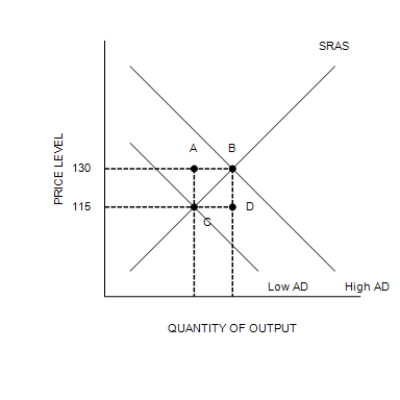
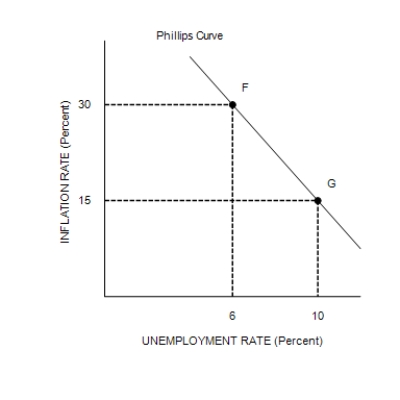
-Refer to Figure 35-1. Assuming the price level in the previous year was 100, point F on the right-hand graph corresponds to
-Refer to Figure 35-1. Assuming the price level in the previous year was 100, point F on the right-hand graph corresponds to (Multiple Choice)
4.7/5 (67)
(67) Suppose a recession in Europe reduces U.S. net exports at every price level. Which of the following would you expect to occur in the U.S. as a result of this change?
(Multiple Choice)
4.7/5 (87)
(87) Samuelson and Solow reasoned that when aggregate demand was high, unemployment was
(Multiple Choice)
4.9/5 (71)
(71) Sticky wages leads to a positive relationship between the actual price level and the quantity of output supplied in
(Multiple Choice)
4.8/5 (100)
(100) How is a decrease in the natural rate of unemployment shown in the Phillips curve diagram? Does this decrease change the inflation rate?
(Essay)
4.8/5 (76)
(76) Scenario 35-1
Suppose that in the first half of June 2022, the effects of a housing and financial crisis and an increase in world prices of oil and foodstuffs were affecting the economy.
-Refer to Scenario 35-1. The effects of the housing and financial crises could be shown by shifting
(Multiple Choice)
4.8/5 (84)
(84) Assume the analysis of Friedman and Phelps is correct, so that the following equation is valid:
Unemployment rate = Natural rate of unemployment − a × (Αctual inflation − x).
In this equation,
(Multiple Choice)
4.7/5 (83)
(83) How are the effects of a favorable supply shock shown in the Phillips curve diagram? If the Fed wants to return unemployment to its natural rate after the shock, what should it do?
(Essay)
4.9/5 (77)
(77) Scenario 35-2
In Flosserland, the Department of Finance is responsible for monetary policy. Flosserland has had an inflation rate of 25% for many years.
-Refer to Scenario 35-2. Suppose that the Flosserland Department of Finance undertakes a public relations campaign to convince people that it will soon change monetary policy to reduce inflation to 12.5%. If Flosserlanders believe their government then which, if any, curve(s) shift left?
(Multiple Choice)
4.9/5 (68)
(68) 
Filters
- Essay(0)
- Multiple Choice(0)
- Short Answer(0)
- True False(0)
- Matching(0)