



 Chat with AI
Exam 35: The Short-Run Tradeoff Between Inflation and Unemployment

Exam 1: Ten Principles of Economics220 Questions
Exam 2: Thinking Like an Economist284 Questions
Exam 3: Interdependence and the Gains From Trade192 Questions
Exam 4: The Market Forces of Supply and Demand277 Questions
Exam 5: Elasticity and Its Application222 Questions
Exam 6: Supply, Demand, and Government Policies321 Questions
Exam 7: Consumers, Producers, and the Efficiency of Markets218 Questions
Exam 8: Applications: The Costs of Taxation203 Questions
Exam 9: Application: International Trade214 Questions
Exam 10: Externalities204 Questions
Exam 11: Public Goods and Common Resources182 Questions
Exam 12: The Design of the Tax System225 Questions
Exam 13: The Costs of Production261 Questions
Exam 14: Firms in Competitive Markets243 Questions
Exam 15: Monopoly231 Questions
Exam 16: Monopolistic Competition246 Questions
Exam 17: Oligopoly204 Questions
Exam 18: The Markets for the Factors of Production232 Questions
Exam 19: Earnings and Discrimination230 Questions
Exam 20: Income Inequality and Poverty194 Questions
Exam 21: The Theory of Consumer Choice209 Questions
Exam 22: Frontiers in Microeconomics185 Questions
Exam 23: Measuring a Nations Income231 Questions
Exam 24: Measuring the Cost of Living214 Questions
Exam 25: Production and Growth187 Questions
Exam 26: Saving, Investment, and the Financial System225 Questions
Exam 27: Tools of Finance198 Questions
Exam 28: Unemployment and Its Natural Rate361 Questions
Exam 29: The Monetary System210 Questions
Exam 30: Money Growth and Inflation201 Questions
Exam 31: Open-Economy Macroeconomics: Basic Concepts194 Questions
Exam 32: A Macroeconomic Theory of the Open Economy188 Questions
Exam 33: Aggregate Demand and Aggregate Supply189 Questions
Exam 34: The Influence of Monetary and Fiscal Policy on Aggregate Demand207 Questions
Exam 35: The Short-Run Tradeoff Between Inflation and Unemployment223 Questions
Exam 36: Six Debates Over Macroeconomic Policy154 Questions
Select questions type


Suppose that the Fed unexpectedly pursues contractionary monetary policy. What will happen to unemployment in the short run? What will happen to unemployment in the long run? Justify your answer using the Phillips curves.
(Essay)
4.9/5  (68)
(68) If the Federal Reserve decreases the rate at which it increases the money supply, then unemployment is higher
(Multiple Choice)
4.8/5 (69)
(69) What did Friedman and Phelps predict would happen if policymakers tried to move the economy upward along the Phillips curve? Did the behavior of the economy in the late 1960s and the 1970s prove them wrong?
(Essay)
5.0/5 (80)
(80) Table 35-1
An economist working for the Central Bank of Fredonia estimates a Phillips curve for Fredonia and reports the following points on the estimated curve.
Actual Inflation Rate (Percent) Unemployment Rate (Percent) 5 4.0 4 4.5 3 5.0 2 5.5
-Refer to Table 35-1. Which of the following statements is correct?
(Multiple Choice)
4.8/5 (71)
(71) If the Fed wants to reverse the effects of an adverse supply shock on unemployment, it should
(Multiple Choice)
4.7/5 (82)
(82) Suppose the Fed decreased the growth rate of the money supply. Which of the following would be lower in the long run?
(Multiple Choice)
4.7/5 (90)
(90) A basis for the slope of the short-run Phillips curve is that when unemployment is high there are
(Multiple Choice)
4.8/5 (84)
(84) Suppose that businesses become less optimistic about the future. Assuming no change in inflation expectations, how would the effects of this shock be shown on the Phillips curve diagram and what would happen to inflation and unemployment?
(Essay)
4.9/5 (75)
(75) In 2009, Congress and President Obama approved tax cuts and increased government spending. According to the short-run Phillips curve these policies should have
(Multiple Choice)
4.8/5 (80)
(80) If the Fed raised the money supply growth by more than expected then the unemployment rate would _____ in the short run. Explain the process by which the economy moves to the long run if the Fed maintains the higher money supply growth rate.
(Essay)
5.0/5 (63)
(63) Milton Friedman argued that the Fed's control over the money supply could be used to peg
(Multiple Choice)
5.0/5 (54)
(54) According to the Phillips curve, unemployment and inflation are positively related in
(Multiple Choice)
4.9/5 (67)
(67) Which of the following would shift the long-run Phillips curve to the right?
(Multiple Choice)
4.9/5 (92)
(92) If because they expect the central bank to disinflate, people reduce their inflation expectations, then is the sacrifice ratio larger or smaller the otherwise? Defend your answer by referring to the Phillips curve.
(Essay)
4.7/5 (65)
(65) If the Fed responded to an adverse supply shock by increasing the growth rate of the money supply and maintained the higher growth rate, what would eventually happen to the short-run Phillips curve? Why?
(Essay)
4.9/5 (76)
(76) Figure 35-4 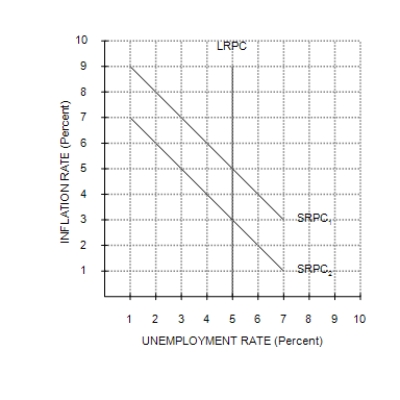 -Refer to Figure 35-4. Suppose the economy starts at 5% unemployment and 3% inflation and expected inflation remains at 3%. Which one of the following points could the economy move to in the short run if the Federal Reserve pursues a more expansionary monetary policy?
 (Multiple Choice)
4.8/5 (74)
(74) Some countries have had relatively high inflation and relatively high unemployment for long periods of time. Is this consistent with the Phillips curve? Defend your answer.
(Essay)
4.9/5 (86)
(86) Which of the following would reduce the natural rate of unemployment?
(Multiple Choice)
4.9/5 (82)
(82) If the Federal Reserve increases the growth rate of the money supply, in the long run
(Multiple Choice)
4.9/5 (76)
(76) 
Filters
- Essay(0)
- Multiple Choice(0)
- Short Answer(0)
- True False(0)
- Matching(0)