



 Chat with AI
Exam 4: Corporations: Organization and Capital Structure

Exam 1: Understanding and Working With the Federal Tax Law92 Questions
Exam 2: The Deduction for Qualified Business Income for Pass-Through Entities65 Questions
Exam 3: Corporations: Introduction and Operating Rules105 Questions
Exam 4: Corporations: Organization and Capital Structure108 Questions
Exam 5: Corporations: Earnings and Profits and Dividend Distributions129 Questions
Exam 6: Corporations: Redemptions and Liquidations117 Questions
Exam 7: Corporations: Reorganizations139 Questions
Exam 8: Consolidated Tax Returns154 Questions
Exam 9: Taxation of International Transactions128 Questions
Exam 10: Partnerships: Formation, Operations, and Basis163 Questions
Exam 11: Partnerships: Distributions, Transfer of Interests, and Terminations164 Questions
Exam 12: S Corporations121 Questions
Exam 13: Comparative Forms of Doing Business113 Questions
Exam 14: Taxes on the Financial Statements71 Questions
Exam 15: Exempt Entities129 Questions
Exam 16: Multistate Corporate Taxation184 Questions
Exam 17: Tax Practice and Ethics174 Questions
Exam 18: The Federal Gift and Estate Taxes145 Questions
Exam 19: Family Tax Planning118 Questions
Exam 20: Income Taxation of Trusts and Estates166 Questions
Select questions type


Because boot is generated under § 357b) i.e., the liability is not supported by a bona fide business purpose), the transferor shareholder will always have to recognize gain.
(True/False)
4.8/5  (75)
(75) A taxpayer transfers assets and liabilities to a corporation in return for its stock. If the liabilities exceed the basis of the assets transferred, the taxpayer will have a negative basis in the stock.
(True/False)
4.7/5 (84)
(84) Carl and Ben form Eagle Corporation. Carl transfers cash of $50,000 for 50 shares of stock of Eagle. Ben transfers proprietary information with a tax basis of zero and a fair market value of $50,000 for the remaining 50 shares in Eagle. Carl will have a tax basis of $50,000 in his stock in Eagle Corporation and Ben's basis in his stock will be zero.
(True/False)
4.8/5 (90)
(90) Kim, a real estate dealer, and others form Eagle Corporation under § 351. Kim contributes inventory land held for resale) in return for Eagle stock. The holding period for the stock includes the holding period of the inventory.
(True/False)
4.9/5 (74)
(74) For transfers falling under § 351, what are the holding period rules for stock received by the shareholder and for the assets transferred to the corporation?
(Essay)
4.9/5 (76)
(76) Penny, Miesha, and Sabrina transfer property to Owl Corporation for 75% of its stock. Nancy, their attorney, receives 25% of the stock in Owl for legal services rendered in incorporating the business. What are the tax consequences of these transactions? How should this transaction have been handled?
(Essay)
4.8/5 (86)
(86) The use of § 351 is not limited to the initial formation of a corporation, and it can apply to later transfers as well.
(True/False)
4.8/5 (65)
(65) Silver Corporation receives $1 million in cash from Madison County as an inducement to expand its operations there. Within one year, Silver spends $1.5 million to enlarge its existing plant. Silver Corporation's basis in the expansion is
$500,000.
(True/False)
4.8/5 (70)
(70) Joe and Kay form Gull Corporation. Joe transfers cash of $250,000 for 200 shares in Gull Corporation. Kay transfers property with a basis of $50,000 and fair market value of $240,000. She agrees to accept 200 shares in Gull Corporation for the property and for providing bookkeeping services to the corporation in its first year of operation. The value of Kay's services is $10,000. With respect to the transfer:
(Multiple Choice)
4.9/5 (72)
(72) To help avoid the thin capitalization problem, it is advisable to make the repayment of the debt contingent upon the corporation's earnings.
(True/False)
4.8/5 (83)
(83) Ruth transfers property worth $200,000 basis of $60,000) to Goldfinch Corporation. In return, she receives 80% of its stock worth $180,000) and a long-term note executed by Goldfinch and made payable to Ruth worth $20,000). Ruth will recognize no gain on the transfer.
(True/False)
4.7/5 (77)
(77) Tina incorporates her sole proprietorship with assets having a fair market value of $100,000 and an adjusted basis of
$110,000. Even though § 351 applies, Tina may recognize her realized loss of $10,000.
(True/False)
4.8/5 (75)
(75) Stock in Merlin Corporation is held equally by Jane, Eve, and Fred. Merlin seeks additional capital to buy a valuable tract of land that will cost $6,000,000. Jane, Eve, and Fred propose to loan Merlin $2,000,000 each, taking from Merlin a $2,000,000 10-year note with interest payable annually at five points above the prime rate. Merlin Corporation has current taxable income of $7,000,000. How are the payments on the notes treated for tax purposes?
(Essay)
4.9/5 (89)
(89) Leah transfers equipment basis of $400,000 and fair market value of $500,000) for additional stock in Crow Corporation. After the transfer, Leah owns 80% of Crow's stock. Associated with the equipment is § 1245 depreciation recapture potential of $70,000. As a result of the transfer:
(Multiple Choice)
4.9/5 (71)
(71) A long-term note is treated as "boot." Thus, Eve is taxed on the value of the note received.
(True/False)
4.8/5 (72)
(72) Adam transfers cash of $300,000 and land worth $200,000 to Camel Corporation for 100% of the stock in Camel. In the first year of operation, Camel has net taxable income of $70,000. If Camel distributes $50,000 to Adam:
(Multiple Choice)
4.8/5 (79)
(79) In a § 351 transaction, if a transferor receives consideration other than stock, the transaction can be taxable.
(True/False)
4.8/5 (77)
(77) Four individuals form Chickadee Corporation under § 351. Two of these individuals, Jane and Walt, made the following contributions: Fair Market Adjusted Basis Value From Jane-Cash \ 360,000 \ 360,000 Patent -0- 40,000 From Walt- Equipment (depreciation claimed of \ 100,000 ) 240,000 370,000 Both Jane and Walt receive stock in Chickadee Corporation equal to the value of their investments.
(Multiple Choice)
4.8/5 (80)
(80) Nancy, Guy, and Rod form Goldfinch Corporation with the following consideration.
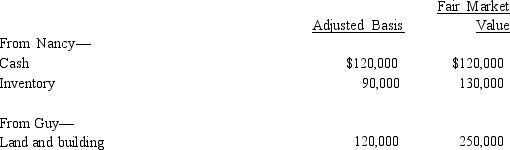 From Rod-
Legal and accounting services to incorporate
Goldfinch issues its 500 shares of stock as follows: 250 to Nancy, 200 to Guy, and 50 to Rod. In addition, Guy gets
$50,000 in cash.
a. Does Nancy, Guy, or Rod recognize gain or income)?
b. What basis does Guy have in the Goldfinch stock?
c. What basis does Goldfinch Corporation have in the inventory? In the land and building?
d. What basis does Rod have in the Goldfinch stock?
From Rod-
Legal and accounting services to incorporate
Goldfinch issues its 500 shares of stock as follows: 250 to Nancy, 200 to Guy, and 50 to Rod. In addition, Guy gets
$50,000 in cash.
a. Does Nancy, Guy, or Rod recognize gain or income)?
b. What basis does Guy have in the Goldfinch stock?
c. What basis does Goldfinch Corporation have in the inventory? In the land and building?
d. What basis does Rod have in the Goldfinch stock? (Essay)
4.8/5 (74)
(74) Rob and Yi form Bluebird Corporation with the following investments. Fair Market Adjusted Basis Value From Rob-Cash \4 00,000 \4 00,000 From Yi -Land 500,000 440,000
Each receives 50% of Bluebird's stock. In addition, Yi receives cash of $40,000. One result of these transfers is that Yi has a:
(Multiple Choice)
4.9/5 (89)
(89) 
Filters
- Essay(0)
- Multiple Choice(0)
- Short Answer(0)
- True False(0)
- Matching(0)