



 Chat with AI
Exam 14: Taxes on the Financial Statements

Exam 1: Understanding and Working With the Federal Tax Law92 Questions
Exam 2: The Deduction for Qualified Business Income for Pass-Through Entities65 Questions
Exam 3: Corporations: Introduction and Operating Rules105 Questions
Exam 4: Corporations: Organization and Capital Structure108 Questions
Exam 5: Corporations: Earnings and Profits and Dividend Distributions129 Questions
Exam 6: Corporations: Redemptions and Liquidations117 Questions
Exam 7: Corporations: Reorganizations139 Questions
Exam 8: Consolidated Tax Returns154 Questions
Exam 9: Taxation of International Transactions128 Questions
Exam 10: Partnerships: Formation, Operations, and Basis163 Questions
Exam 11: Partnerships: Distributions, Transfer of Interests, and Terminations164 Questions
Exam 12: S Corporations121 Questions
Exam 13: Comparative Forms of Doing Business113 Questions
Exam 14: Taxes on the Financial Statements71 Questions
Exam 15: Exempt Entities129 Questions
Exam 16: Multistate Corporate Taxation184 Questions
Exam 17: Tax Practice and Ethics174 Questions
Exam 18: The Federal Gift and Estate Taxes145 Questions
Exam 19: Family Tax Planning118 Questions
Exam 20: Income Taxation of Trusts and Estates166 Questions
Select questions type


Black, Inc., is a domestic corporation with the following balance sheet for book and tax purposes at the end of the year. Assume a 21% corporate tax rate and no valuation allowance. 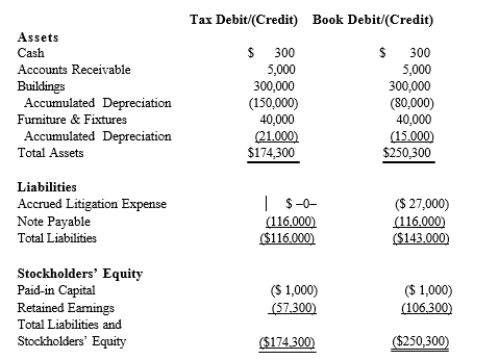 Black, Inc.'s, gross deferred tax assets and liabilities at the beginning of Black's year are as follows:
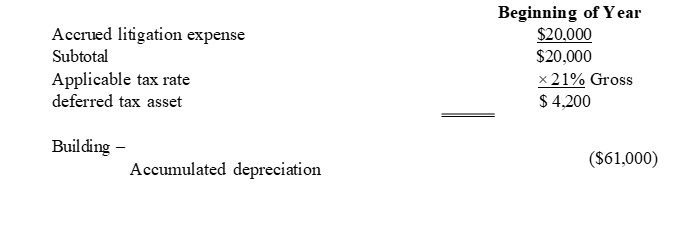
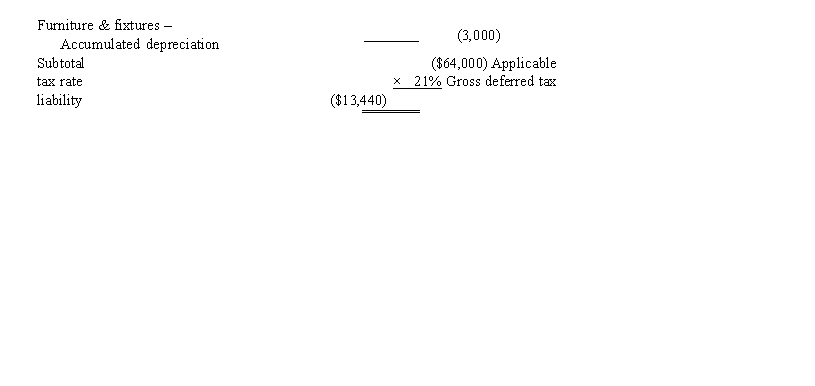 Black, Inc.'s, book income before tax is $6,000. Black records two permanent book-tax differences.
It earned $250 in tax-exempt municipal bond interest, and it incurred $500 in nondeductible business meals expense. Determine the net deferred tax asset or net deferred tax liability at year-end.
Black, Inc.'s, gross deferred tax assets and liabilities at the beginning of Black's year are as follows:
Black, Inc.'s, book income before tax is $6,000. Black records two permanent book-tax differences.
It earned $250 in tax-exempt municipal bond interest, and it incurred $500 in nondeductible business meals expense. Determine the net deferred tax asset or net deferred tax liability at year-end.
Free
(Essay)
4.7/5  (77)
(77) Correct Answer: Verified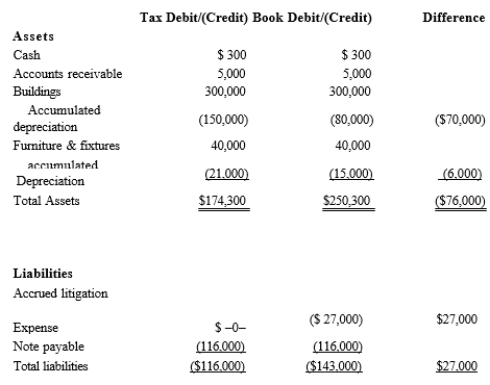
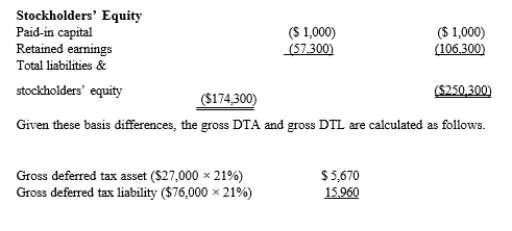 Net deferred tax liability
You are assisting LipidCo, a U.S. corporation subject to GAAP, to determine its current-year book expense for income taxes. The following represent the steps that you will take in making this computation. Put the steps into the correct order.
A. Compute the deferred tax provision.
B. Determine book income before income tax effects. C. Determine the current tax provision.
D. Determine whether a valuation allowance is required, and apply or release it. E. Identify and measure temporary book-tax differences.
F. Prepare the disclosures for the financial statement footnotes. G. Add/Subtract any permanent book-tax differences.
Free
(Short Answer)
4.8/5 (79)
(79) Correct Answer:Verified
VerifiedB. - G. - E. - C. - A. - D. - F.
Bunker, Inc., is a domestic corporation. It owns 100% of Texas, Inc., a domestic corporation; 100% of Paris, a foreign corporation and 35% of Iowa, Inc., a domestic corporation.
a. Which entities' incomes are included in Bunker's Federal consolidated income tax return?
b. How would your answer change if Bunker instead owned 15% of Iowa?
Free
(Essay)
4.8/5 (73)
(73) Correct Answer:Verified
Verifieda. Bunker includes its own taxable income and that of Texas if Bunker elects to include Texas in its consolidated group. Paris is not included because foreign corporations are not eligible to be included. Iowa's income is not included because, although domestic, Bunker's ownership percentage does not meet the 80% required level for tax consolidation.
b. If Bunker instead owns 15% of Iowa, the answer remains the same. None of Iowa's income is included in Bunker's consolidated Federal income tax return until Iowa makes an actual dividend distribution to Bunker.
Giant uses the equity method to account for the operations of its 40% owned subsidiary Little. A portion of Little's profits for the year are included in Giant's GAAP book income.
(True/False)
4.8/5 (67)
(67) Which of the following taxes are included in the total income tax expense of a corporation as reported on its GAAP financial statements?
(Multiple Choice)
4.7/5 (81)
(81) A valuation allowance expresses on the GAAP balance sheet that there exists uncertainty that the taxpayer will be able to recover a deferred tax asset.
(True/False)
4.7/5 (86)
(86) Morrisson, Inc., earns book net income before tax of $500,000. In computing its book income, Morrisson deducts $50,000 more in warranty expense for book purposes than is allowed for tax purposes. Morrisson records no other temporary or permanent book-tax differences. Assuming that the U.S. tax rate is 21% and no valuation allowance is required, what is Morrisson's current income tax expense reported on its GAAP financial statements?
(Multiple Choice)
4.8/5 (72)
(72) Clipp, Inc., earns book net income before tax of $600,000. Clipp puts into service a depreciable asset this year, and its first-year tax depreciation exceeds book depreciation by $120,000. Clipp has recorded no other temporary or permanent book-tax differences. Assuming that the U.S. tax rate is 21%, what is Clipp's deferred income tax liability reported on its GAAP financial statements?
(Multiple Choice)
4.9/5 (75)
(75) Create, Inc., a domestic corporation, owns 90% of Vinyl, Ltd., a foreign corporation and Digital, Inc., a domestic corporation. Create also owns 60% of Record, Inc., a domestic corporation. Create receives no distributions from any of these corporations. Which of these entities' net income is included in Create's Federal income tax return for the current year, assuming that Create elects to include all eligible entities in its consolidated Federal income tax return?
(Multiple Choice)
4.8/5 (86)
(86) Black, Inc., is a domestic corporation with the following balance sheet for book and tax purposes at the end of the year. Assume a 21% corporate tax rate and no valuation allowance. 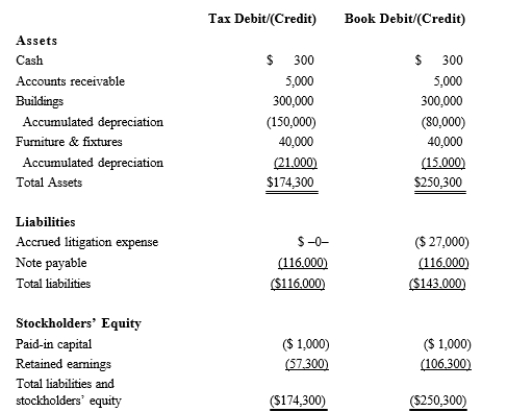 Black, Inc.'s, gross deferred tax assets and liabilities at the beginning of Black's year are as follows:
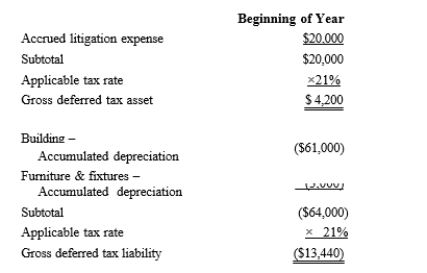 Black, Inc.'s, book income before tax is $6,000. Black records two permanent book-tax differences.
It earned $250 in tax-exempt municipal bond interest, and it incurred $500 in nondeductible business meals expense. Calculate Black's current tax expense.
Black, Inc.'s, gross deferred tax assets and liabilities at the beginning of Black's year are as follows: Black, Inc.'s, book income before tax is $6,000. Black records two permanent book-tax differences.
It earned $250 in tax-exempt municipal bond interest, and it incurred $500 in nondeductible business meals expense. Calculate Black's current tax expense. (Essay)
4.8/5 (85)
(85) A partnership owned at least 80% by a corporation is included in a consolidated group's U.S. income tax return.
(True/False)
4.7/5 (80)
(80) You are the tax adviser to a publicly traded U.S. corporation. How might you use a "benchmarking" analysis to begin your review of the entity's tax situation and planning opportunities?
(Essay)
4.9/5 (70)
(70) ASC 740 addresses how an entity should report uncertain tax positions in its financial statements.
(True/False)
4.8/5 (80)
(80) The income tax footnote to the GAAP financial statements includes a reconciliation of a corporation's hypothetical tax on book income to its book-tax expense as if it were taxed in full at the applicable U.S. income tax rates.
(True/False)
4.9/5 (93)
(93) In the rate reconciliation of GAAP tax footnotes, temporary book-tax differences are reconciled between book income as if taxed at U.S. tax rates and the actual book income tax expense.
(True/False)
4.9/5 (90)
(90) Only U.S. corporations are included in a combined GAAP financial statement.
(True/False)
4.7/5 (76)
(76) A deferred tax asset is the expected future tax benefit savings) associated with income reported in the current-year
GAAP financial statements.
(True/False)
4.7/5 (83)
(83) Kling Corporation reports a $150,000 cash tax savings from a temporary book-tax difference. This item has the same effect on Kling's current-year effective tax rate as a $150,000 cash tax savings that is a permanent book-tax difference.
(True/False)
4.8/5 (85)
(85) A corporation's taxable income almost never is the same as its GAAP financial accounting income. Explain why this occurs. Use the terms permanent and temporary book-tax differences in your answer. Give at least two examples of each type of book-tax difference.
(Essay)
4.8/5 (81)
(81) 
Filters
- Essay(0)
- Multiple Choice(0)
- Short Answer(0)
- True False(0)
- Matching(0)