



 Chat with AI
Exam 14: Taxes on the Financial Statements

Exam 1: Understanding and Working With the Federal Tax Law92 Questions
Exam 2: The Deduction for Qualified Business Income for Pass-Through Entities65 Questions
Exam 3: Corporations: Introduction and Operating Rules105 Questions
Exam 4: Corporations: Organization and Capital Structure108 Questions
Exam 5: Corporations: Earnings and Profits and Dividend Distributions129 Questions
Exam 6: Corporations: Redemptions and Liquidations117 Questions
Exam 7: Corporations: Reorganizations139 Questions
Exam 8: Consolidated Tax Returns154 Questions
Exam 9: Taxation of International Transactions128 Questions
Exam 10: Partnerships: Formation, Operations, and Basis163 Questions
Exam 11: Partnerships: Distributions, Transfer of Interests, and Terminations164 Questions
Exam 12: S Corporations121 Questions
Exam 13: Comparative Forms of Doing Business113 Questions
Exam 14: Taxes on the Financial Statements71 Questions
Exam 15: Exempt Entities129 Questions
Exam 16: Multistate Corporate Taxation184 Questions
Exam 17: Tax Practice and Ethics174 Questions
Exam 18: The Federal Gift and Estate Taxes145 Questions
Exam 19: Family Tax Planning118 Questions
Exam 20: Income Taxation of Trusts and Estates166 Questions
Select questions type


Black, Inc., is a domestic corporation with the following balance sheet for book and tax purposes at the end of the year. Assume a 21% corporate tax rate and no valuation allowance. 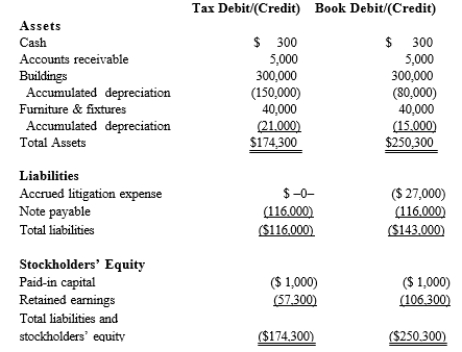 Black, Inc.'s, gross deferred tax assets and liabilities at the beginning of Black's year are listed below. Beginning of Year Accrued litigation expense \ 20,000 Subtotal \ 20,000
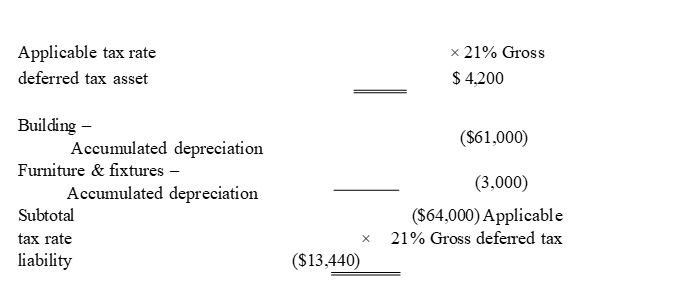 Black, Inc.'s, book income before tax is $6,000. Black records two permanent book-tax differences.
It earned $250 in tax-exempt municipal bond interest and incurred $500 in nondeductible business meals expense. Determine the change in Black's deferred tax liabilities for the current year.
Black, Inc.'s, gross deferred tax assets and liabilities at the beginning of Black's year are listed below. Beginning of Year Accrued litigation expense \ 20,000 Subtotal \ 20,000
Black, Inc.'s, book income before tax is $6,000. Black records two permanent book-tax differences.
It earned $250 in tax-exempt municipal bond interest and incurred $500 in nondeductible business meals expense. Determine the change in Black's deferred tax liabilities for the current year. (Essay)
4.9/5  (86)
(86) Which of the following items represents a temporary book-tax difference?
(Multiple Choice)
5.0/5 (76)
(76) Bryden Corporation is considering two tax planning strategies. Both would produce a $1 million tax savings. One of
the strategies would structure the plan so that the $1 million would represent a temporary book-tax difference, and the other would generate a permanent difference. In general, which plan would the Bryden CFO prefer? Which would a stock analyst reviewing the Bryden valuation prefer?
(Essay)
4.9/5 (80)
(80) South, Inc., earns book net income before tax of $400,000 in year 1. It acquires a depreciable asset in year 1, and its first-year tax depreciation exceeds book depreciation by $50,000. At the end of year 1, South's deferred tax liability account balance is $10,500. In year 2, South earns $500,000 book net income before tax, and its book depreciation exceeds tax depreciation by $20,000. South records no other temporary or permanent book-tax differences. Assuming that the U.S. tax rate is 21%, what is South's total provision for income tax expense reported on its GAAP financial statements for year 2?
(Multiple Choice)
4.8/5 (70)
(70) Phyllis, Inc., earns book net income before tax of $600,000. Phyllis puts into service a depreciable asset this year, and its first-year tax depreciation exceeds book depreciation by $120,000. Phyllis has recorded no other temporary or permanent book-tax differences. Assuming that the U.S. tax rate is 21%, what is Phyllis's total income tax expense reported on its GAAP financial statements?
(Multiple Choice)
4.9/5 (84)
(84) Never, Inc., earns book net income before tax of $500,000. In computing its book income, Never deducts $50,000 more in warranty expense for book purposes than is allowed for tax purposes. Never records no other temporary or permanent book-tax differences. Assuming that the U.S. tax rate is 21% and no valuation allowance is required, what is Never's deferred income tax asset reported on its GAAP financial statements?
(Multiple Choice)
4.9/5 (78)
(78) Black, Inc., is a domestic corporation with the following balance sheet for book and tax purposes at the end of the year. Assume a 21% corporate tax rate and no valuation allowance. Tax Debit/(Credit) Book Debit/(Credit) Assets Cash \ 300 \3 00 Accounts receivable 5,000 5,000 Buildings 300,000 300,000 Accumulated depreciation (150,000) (80,000) Furniture \& fixtures 40,000 40,000 Accumulated depreciation (21,000) (15,000) Total assets \ 174,300 \ 250,300 Liabilities Accrued litigation expense \- 0- (\ 27,000) Note payable (116,000) (116.000) Total liabilities (\ 116.000) (\ 143,000) Stockholders' Equity Paid in capital (\ 1,000) (\ 1,000) Retained earnings (57.300) (106.300) Total liabilities and stockholders' equity ( \1 74,300) ( \2 50,300) Black, Inc.'s, gross deferred tax assets and liabilities at the beginning of Black's year are as follows: 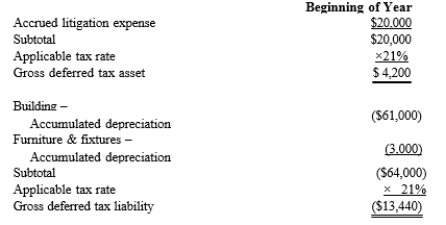 Black, Inc.'s, book income before tax is $6,000. Black records two permanent book-tax differences.
It earned $250 in tax-exempt municipal bond interest, and it incurred $500 in nondeductible business meals expense. Provide the journal entry to record Black's current tax expense.
Black, Inc.'s, book income before tax is $6,000. Black records two permanent book-tax differences.
It earned $250 in tax-exempt municipal bond interest, and it incurred $500 in nondeductible business meals expense. Provide the journal entry to record Black's current tax expense. (Essay)
4.9/5 (84)
(84) Which of the following taxes are included in the total income tax liability of a corporation reported on its Federal income tax return?
(Multiple Choice)
5.0/5 (81)
(81) Jogg, Inc., earns book net income before tax of $600,000. It puts into service a depreciable asset this year, and its first-year tax depreciation exceeds book depreciation by $120,000. Jogg has recorded no other temporary or permanent book-tax differences. Assuming that the U.S. tax rate is 21%, and that this is Jogg's first year of operations, what is Jogg's balance in its deferred tax asset and deferred tax liability accounts at year-end?
(Multiple Choice)
4.8/5 (87)
(87) JuarezCo constructs the following table in determining how to apply ASC 740-10 to its filing position for its domestic production activities deduction. Its book-tax provision for the year, including $3 million for the uncertain transfer pricing issue, is $10 million. Resulting Estimated Tax Benefit Probability of Agreement between JuarezCo and IRS Cumulative Probability of Agreement \3 million 10\% 10\% \2 million 45\% 55\% \1 .6 million 40\% 95\% \1 .1 million 5\% 100\% Under ASC 740-10, JuarezCo's book income tax expense for this item is:
(Multiple Choice)
4.9/5 (93)
(93) Black, Inc., is a domestic corporation with the following balance sheet for book and tax purposes at the end of the year. Assume a 21% corporate tax rate and no valuation allowance.
Cash \ 300 \ 300 Accounts Receivable 5,000 5,000 Buildings 300,000 300,000 Accumulated Depreciation (150,000) (80,000) Furniture \& Fixtures 40,000 40,000 Accumulated Depreciation (21.000) (15,000) Total Assets \1 74,000 \2 50,300 Liabilities Accrued Litigation Expense \- 0- (\ 27,000) Note Payable (116,000) (116,000) Total Liabilities (\ 116,000) \ 143,000) Stockholders' Equity Paid in Capital (\ 1,000) (\ 1,000) Retained Earnings (57,300) (106,300) Total Liabilities and Stockholders' Equity (\ 174,300) (\ 250,300)
Black, Inc.'s, book income before tax is $6,000. Black records two permanent book-tax differences.
It earned $250 in tax-exempt municipal bond interest, and it incurred $500 in nondeductible business meals expense. Determine the change in Black's deferred tax assets for the current year.
(Essay)
4.7/5 (78)
(78) Purple, Inc., a domestic corporation, owns 100% of Blue, Ltd., a foreign corporation and Yellow, Inc., a domestic corporation. Purple also owns 40% of Green, a domestic corporation. Purple receives no distributions from any of these corporations. Which of these entities' net income is included in Purple's GAAP income statement for current- year financial reporting purposes?
(Multiple Choice)
4.8/5 (70)
(70) South, Inc., earns book net income before tax of $400,000 in year 1. It acquires a depreciable asset in year 1, and its first-year tax depreciation exceeds book depreciation by $50,000. At the end of year 1, South's deferred tax liability account balance is $10,500. In year 2, South earns $500,000 book net income before tax, and its book depreciation exceeds tax depreciation by $20,000. South records no other temporary or permanent book-tax differences. Assuming that the U.S. tax rate is 21% in both years, what is South's balance in its deferred tax liability account at the end of year 2?
(Multiple Choice)
4.8/5 (80)
(80) The best estimate of the actual current-year income tax liability i.e., perhaps the amount of the checks that the taxpayer will write to taxing jurisdictions) is the:
(Multiple Choice)
4.8/5 (98)
(98) Black, Inc., is a domestic corporation with the following balance sheet for book and tax purposes at the end of the year. Assume a 21% corporate tax rate and no valuation allowance. 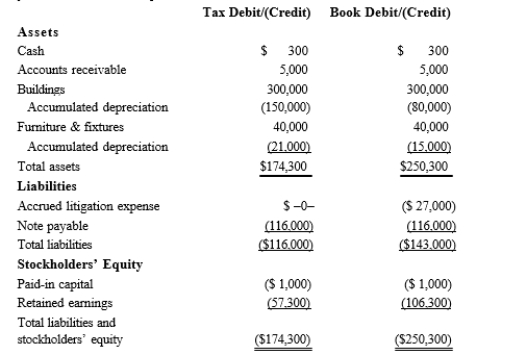 Black, Inc.'s, gross deferred tax assets and liabilities at the beginning of Black's year are as follows:
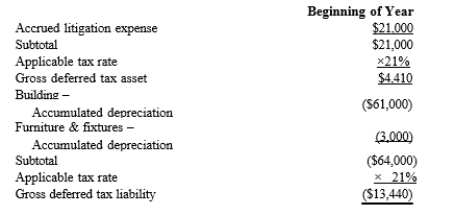 Black, Inc.'s, book income before tax is $6,000. Black records two permanent book-tax differences.
It earned $250 in tax-exempt municipal bond interest and incurred $500 in nondeductible business meals expense. Provide the income tax footnote rate reconciliation for Black, using either
dollars or percentages.
Black, Inc.'s, gross deferred tax assets and liabilities at the beginning of Black's year are as follows: Black, Inc.'s, book income before tax is $6,000. Black records two permanent book-tax differences.
It earned $250 in tax-exempt municipal bond interest and incurred $500 in nondeductible business meals expense. Provide the income tax footnote rate reconciliation for Black, using either
dollars or percentages. (Essay)
4.8/5 (85)
(85) Which of the following statements best describes considerations regarding a company's tax expense that users of GAAP financial statements may make?
(Multiple Choice)
4.9/5 (80)
(80) A deferred tax liability represents a potential future tax benefit associated with income reported in the current-year
GAAP financial statements.
(True/False)
5.0/5 (74)
(74) Schedule UTP of the Form 1120 reconciles financial statement net income after tax with a large corporation's taxable income.
(True/False)
4.8/5 (86)
(86) 
Filters
- Essay(0)
- Multiple Choice(0)
- Short Answer(0)
- True False(0)
- Matching(0)