



 Chat with AI
Exam 1: What Economics Is About

Exam 1: What Economics Is About174 Questions
Exam 2: Production Possibilities Frontier Framework156 Questions
Exam 3: Supply and Demand Theory224 Questions
Exam 4: Prices Free Controlled and Relative122 Questions
Exam 5: Supply Demand and Price Applications76 Questions
Exam 6: Macroeconomic Measurements Part I Prices and Unemployment151 Questions
Exam 7: Macroeconomic Measurements Part II Gdp and Real Gdp150 Questions
Exam 8: Aggregate Demand and Aggregate Supply204 Questions
Exam 9: Classical Macroeconomics and the Self Regulating Economy172 Questions
Exam 10: Keynesian Macroeconomics and Economic Instability a Critique of the Self Regulating Economy200 Questions
Exam 11: Fiscal Policy and the Federal Budget167 Questions
Exam 12: Money Banking and the Financial System150 Questions
Exam 13: The Federal Reserve System180 Questions
Exam 14: Money and the Economy150 Questions
Exam 15: Monetary Policy185 Questions
Exam 16: Expectations Theory and the Economy150 Questions
Exam 17: Economic Growth Resources Technology Ideas and Institutions103 Questions
Exam 18: Debates in Macroeconomics Over the Role and Effects of Government100 Questions
Exam 19: Elasticity204 Questions
Exam 20: Consumer Choice and Behavioral Economics179 Questions
Exam 21: Production and Costs245 Questions
Exam 22: Perfect Competition187 Questions
Exam 23: Monopoly195 Questions
Exam 24: Monopolistic Competition Oligopoly and Game Theory172 Questions
Exam 25: Government and Product Markets Antitrust and Regulation158 Questions
Exam 26: Factor Markets With Emphasis on the Labor Market184 Questions
Exam 27: Wages Unions and Labor138 Questions
Exam 28: The Distribution of Income and Poverty99 Questions
Exam 29: Interest Rent and Profit198 Questions
Exam 30: Market Failure Externalities Public Goods and Asymmetric Information187 Questions
Exam 31: Public Choice and Special Interest Group Politics135 Questions
Exam 32: Building Theories to Explain Everyday Life From Observations to Questions to Theories to Predictions62 Questions
Exam 33: International Trade152 Questions
Exam 34: International Finance122 Questions
Exam 35: The Economic Case for and Against Government Five Topics Considered87 Questions
Exam 36: Stocks Bonds Futures and Options110 Questions
Select questions type


Let X be the number of hours you spend studying for an exam on Wednesday afternoon and Y be your chances of winning the Wednesday night state lottery. What kind of a relationship do you most likely expect between X and Y?
(Multiple Choice)
4.7/5  (73)
(73) Macroeconomics deals with issues involving large corporations, while microeconomics exclusively deals with issues involving small businesses.
(True/False)
4.9/5 (77)
(77) A mandatory seatbelt law ends up raising the number of traffic fatalities if it lowers fatalities per accident from 0.10 to 0.07 while raising the number of accidents per period from 35,000 to any more than
(Multiple Choice)
4.9/5 (89)
(89) By looking at the different slices of a pie chart, and comparing one slice to another, it is possible to quickly estimate
(Multiple Choice)
4.7/5 (86)
(86) Exhibit 1-3

-Refer to Exhibit 1-3. According to the data provided in this table, what is the approximate slope of the line between points A and B, if these data were graphed with X on the horizontal axis and Y on the vertical axis?
-Refer to Exhibit 1-3. According to the data provided in this table, what is the approximate slope of the line between points A and B, if these data were graphed with X on the horizontal axis and Y on the vertical axis? (Multiple Choice)
4.9/5 (67)
(67) The resource termed labor consists of the physical, but not the mental, talents that people contribute to the production process.
(True/False)
4.8/5 (78)
(78) Exhibit 1-1
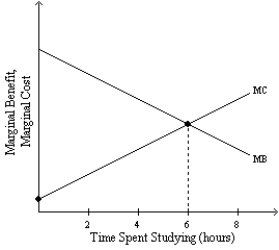 -Refer to Exhibit 1-1. If the student whose study habits are illustrated here is currently studying for the 8th hour, she should
 (Multiple Choice)
4.8/5 (83)
(83) Which of the following is a normative macroeconomics statement?
(Multiple Choice)
4.7/5 (88)
(88) If people want more cars than there are cars available, then it must be true that
(Multiple Choice)
4.8/5 (78)
(78) 
Filters
- Essay(0)
- Multiple Choice(0)
- Short Answer(0)
- True False(0)
- Matching(0)