



 Chat with AI
Exam 1: What Economics Is About

Exam 1: What Economics Is About174 Questions
Exam 2: Production Possibilities Frontier Framework156 Questions
Exam 3: Supply and Demand Theory224 Questions
Exam 4: Prices Free Controlled and Relative122 Questions
Exam 5: Supply Demand and Price Applications76 Questions
Exam 6: Macroeconomic Measurements Part I Prices and Unemployment151 Questions
Exam 7: Macroeconomic Measurements Part II Gdp and Real Gdp150 Questions
Exam 8: Aggregate Demand and Aggregate Supply204 Questions
Exam 9: Classical Macroeconomics and the Self Regulating Economy172 Questions
Exam 10: Keynesian Macroeconomics and Economic Instability a Critique of the Self Regulating Economy200 Questions
Exam 11: Fiscal Policy and the Federal Budget167 Questions
Exam 12: Money Banking and the Financial System150 Questions
Exam 13: The Federal Reserve System180 Questions
Exam 14: Money and the Economy150 Questions
Exam 15: Monetary Policy185 Questions
Exam 16: Expectations Theory and the Economy150 Questions
Exam 17: Economic Growth Resources Technology Ideas and Institutions103 Questions
Exam 18: Debates in Macroeconomics Over the Role and Effects of Government100 Questions
Exam 19: Elasticity204 Questions
Exam 20: Consumer Choice and Behavioral Economics179 Questions
Exam 21: Production and Costs245 Questions
Exam 22: Perfect Competition187 Questions
Exam 23: Monopoly195 Questions
Exam 24: Monopolistic Competition Oligopoly and Game Theory172 Questions
Exam 25: Government and Product Markets Antitrust and Regulation158 Questions
Exam 26: Factor Markets With Emphasis on the Labor Market184 Questions
Exam 27: Wages Unions and Labor138 Questions
Exam 28: The Distribution of Income and Poverty99 Questions
Exam 29: Interest Rent and Profit198 Questions
Exam 30: Market Failure Externalities Public Goods and Asymmetric Information187 Questions
Exam 31: Public Choice and Special Interest Group Politics135 Questions
Exam 32: Building Theories to Explain Everyday Life From Observations to Questions to Theories to Predictions62 Questions
Exam 33: International Trade152 Questions
Exam 34: International Finance122 Questions
Exam 35: The Economic Case for and Against Government Five Topics Considered87 Questions
Exam 36: Stocks Bonds Futures and Options110 Questions
Select questions type


"If you hadn't gone to dinner with your friends, you would have stayed home and watched television." It follows that
(Multiple Choice)
4.9/5  (80)
(80) Exhibit 1-2

-Refer to Exhibit 1-2. According to the data provided in this table, what is the slope of the line between points A and B, if these data were graphed with X on the horizontal axis and Y on the vertical axis?
-Refer to Exhibit 1-2. According to the data provided in this table, what is the slope of the line between points A and B, if these data were graphed with X on the horizontal axis and Y on the vertical axis? (Multiple Choice)
4.7/5 (70)
(70) Exhibit 1-3

-Refer to Exhibit 1-3. According to the data provided in this table, what is the approximate slope of the line between points C and D (if these data were graphed with X on the horizontal axis and Y on the vertical axis)?
-Refer to Exhibit 1-3. According to the data provided in this table, what is the approximate slope of the line between points C and D (if these data were graphed with X on the horizontal axis and Y on the vertical axis)? (Multiple Choice)
4.9/5 (87)
(87) Exhibit 1-1
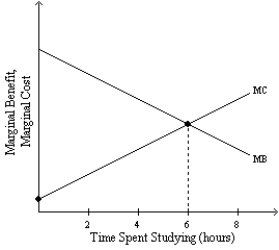 -Refer to Exhibit 1-1. The student whose study habits are illustrated in this diagram will maximize the net benefits of studying when she has studied __________ hours.
 (Multiple Choice)
4.9/5 (85)
(85) Prior to attending college, Marvin is offered a lucrative four-year contract as an actor on a daytime soap opera. Assuming that acting and attending college are Marvin's preferred alternatives and that he must choose between these two options, his opportunity cost of attending college after receiving the offer on the soap opera ________________, making him ____________ likely to attend college than before he received the offer.
(Multiple Choice)
4.9/5 (69)
(69) The branch of economics that studies the decisions of individuals and firms is called
(Multiple Choice)
5.0/5 (85)
(85) A rationing device is a method used to resolve who gets what of available goods and resources.
(True/False)
4.8/5 (83)
(83) If variable X rises as a result of variable Y falling, then X and Y have an inverse relationship.
(True/False)
4.9/5 (74)
(74) At the optimal or efficient level of an activity, the activity's marginal benefit must
(Multiple Choice)
4.9/5 (75)
(75) Which of the following issues is most unlikely to be addressed by an economist practicing positive economics?
(Multiple Choice)
4.9/5 (82)
(82) Explain how scarcity can exist in a relatively rich country such as the United States. Give examples to help support your answer.
(Essay)
4.8/5 (75)
(75) How are changes in opportunity cost predicted to affect behavior?
(Multiple Choice)
4.9/5 (81)
(81) If an economist says "the higher the price of oranges, the fewer oranges individuals will buy, ceteris paribus," this means that
(Multiple Choice)
4.9/5 (88)
(88) A theory is an abstract representation of reality. This means a theory
(Multiple Choice)
4.8/5 (83)
(83) Some economic studies have shown that mandatory seat belt laws do not lead to a reduction in traffic fatalities.
(True/False)
4.9/5 (93)
(93) Which of the following pairs of variables is most likely to be inversely related?
(Multiple Choice)
4.8/5 (85)
(85) Most states have instituted mandatory seatbelt laws to reduce traffic fatalities. An economist may point out that an unintended effect of these laws is
(Multiple Choice)
4.8/5 (75)
(75) Exhibit 1-1
-Refer to Exhibit 1-1. If the student whose study habits are illustrated here is currently studying for the 2nd hour she should
-Refer to Exhibit 1-1. If the student whose study habits are illustrated here is currently studying for the 2nd hour she should (Multiple Choice)
4.9/5 (69)
(69) 
Filters
- Essay(0)
- Multiple Choice(0)
- Short Answer(0)
- True False(0)
- Matching(0)