



 Chat with AI
Exam 3: Supply and Demand Theory

Exam 1: What Economics Is About174 Questions
Exam 2: Production Possibilities Frontier Framework156 Questions
Exam 3: Supply and Demand Theory224 Questions
Exam 4: Prices Free Controlled and Relative122 Questions
Exam 5: Supply Demand and Price Applications76 Questions
Exam 6: Macroeconomic Measurements Part I Prices and Unemployment151 Questions
Exam 7: Macroeconomic Measurements Part II Gdp and Real Gdp150 Questions
Exam 8: Aggregate Demand and Aggregate Supply204 Questions
Exam 9: Classical Macroeconomics and the Self Regulating Economy172 Questions
Exam 10: Keynesian Macroeconomics and Economic Instability a Critique of the Self Regulating Economy200 Questions
Exam 11: Fiscal Policy and the Federal Budget167 Questions
Exam 12: Money Banking and the Financial System150 Questions
Exam 13: The Federal Reserve System180 Questions
Exam 14: Money and the Economy150 Questions
Exam 15: Monetary Policy185 Questions
Exam 16: Expectations Theory and the Economy150 Questions
Exam 17: Economic Growth Resources Technology Ideas and Institutions103 Questions
Exam 18: Debates in Macroeconomics Over the Role and Effects of Government100 Questions
Exam 19: Elasticity204 Questions
Exam 20: Consumer Choice and Behavioral Economics179 Questions
Exam 21: Production and Costs245 Questions
Exam 22: Perfect Competition187 Questions
Exam 23: Monopoly195 Questions
Exam 24: Monopolistic Competition Oligopoly and Game Theory172 Questions
Exam 25: Government and Product Markets Antitrust and Regulation158 Questions
Exam 26: Factor Markets With Emphasis on the Labor Market184 Questions
Exam 27: Wages Unions and Labor138 Questions
Exam 28: The Distribution of Income and Poverty99 Questions
Exam 29: Interest Rent and Profit198 Questions
Exam 30: Market Failure Externalities Public Goods and Asymmetric Information187 Questions
Exam 31: Public Choice and Special Interest Group Politics135 Questions
Exam 32: Building Theories to Explain Everyday Life From Observations to Questions to Theories to Predictions62 Questions
Exam 33: International Trade152 Questions
Exam 34: International Finance122 Questions
Exam 35: The Economic Case for and Against Government Five Topics Considered87 Questions
Exam 36: Stocks Bonds Futures and Options110 Questions
Select questions type


Which of the following statements represents a correct and sequentially accurate economic explanation?
(Multiple Choice)
5.0/5  (88)
(88) One point on a market supply curve represents $4 and 100 units quantity supplied. If there are three suppliers, and at a price of $4 one of the suppliers supplies 23 units, then which of the following combinations of price and quantity supplied might hold for the other two suppliers?
(Multiple Choice)
4.9/5 (81)
(81) Suppose that good X is one of the more heavily subsidized industries in the United States. Suppose further that as a result of intense lobbying from health-related concerns, Congress repeals the subsidies on good X. Which of the following scenarios would likely occur?
(Multiple Choice)
4.9/5 (86)
(86) As Jamal's income rises, his demand for pizza does not change. It follows that for Jamal, pizza is a(n)
(Multiple Choice)
4.9/5 (77)
(77) The law of supply states that price and quantity supplied are
(Multiple Choice)
4.7/5 (83)
(83) If the government increased licensing requirements for beauty salons, the supply curve for salon services would shift to the left.
(True/False)
4.8/5 (78)
(78) Jerry has $50,000 in his savings account and the average new car price is $23,000. Does Jerry have a demand for a new car?
(Multiple Choice)
4.8/5 (66)
(66) When income rises for the buyers of good X, the ____________ curve for good X will shift ________________.
(Multiple Choice)
4.9/5 (78)
(78) Exhibit 3-13
-----------------------------Quantity Demanded-------------------------------------
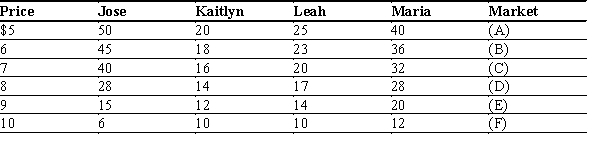 Assume that Jose, Kaitlyn, Leah, and Maria are the only buyers in this market.
-Refer to Exhibit 3-13. Fill in blanks (C) and (D) respectively with the market quantity demanded at each given price.
Assume that Jose, Kaitlyn, Leah, and Maria are the only buyers in this market.
-Refer to Exhibit 3-13. Fill in blanks (C) and (D) respectively with the market quantity demanded at each given price. (Multiple Choice)
4.8/5 (86)
(86) Exhibit 3-14
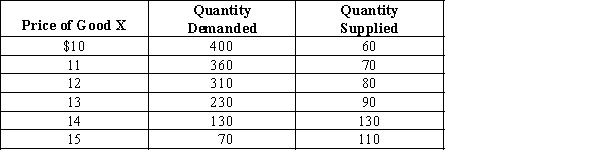 -Refer to Exhibit 3-14. At a price of $10, there is a ____________ of ____________ units of good X.
 (Multiple Choice)
4.7/5 (80)
(80) Exhibit 3-1
 -Refer to Exhibit 3-1. At a price of $6 there is a
 (Multiple Choice)
4.9/5 (88)
(88) Exhibit 3-8
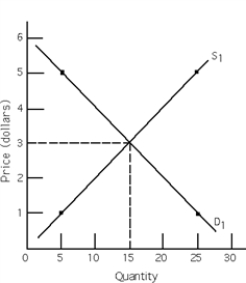 -Refer to Exhibit 3-8. Equilibrium price and quantity are ____________________, respectively.
 (Multiple Choice)
4.8/5 (96)
(96) A demand curve is the graphical representation of the law of demand.
(True/False)
4.8/5 (85)
(85) A rightward shift in the demand curve for tennis balls would most likely be caused by
(Multiple Choice)
4.9/5 (80)
(80) A(n) _______________ good is one in which as income rises or falls, there is no change in the demand for the good.
(Multiple Choice)
4.8/5 (80)
(80) In year 1 the price of good X is $10 and 100 units are bought and sold. In year 2 the price of good X is $13 and 230 units are bought and sold. What can explain this?
(Multiple Choice)
4.8/5 (72)
(72) Exhibit 3-6
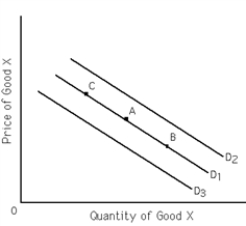 -Refer to Exhibit 3-6. If a decrease in income causes the demand for good X to shift from D1 to D2, then good X is
 (Multiple Choice)
4.7/5 (96)
(96) An increase in the price of good B resulting from a decrease in the supply of B caused an increase in the demand for good C. This indicates that goods B and C are
(Multiple Choice)
5.0/5 (72)
(72) In the supply-and-demand diagram of the market for peanut butter, the equilibrium point has moved down and to the right. What could have caused this?
(Multiple Choice)
4.9/5 (79)
(79) 
Filters
- Essay(0)
- Multiple Choice(0)
- Short Answer(0)
- True False(0)
- Matching(0)