



 Chat with AI
Exam 11: Fiscal Policy and the Federal Budget

Exam 1: What Economics Is About174 Questions
Exam 2: Production Possibilities Frontier Framework156 Questions
Exam 3: Supply and Demand Theory224 Questions
Exam 4: Prices Free Controlled and Relative122 Questions
Exam 5: Supply Demand and Price Applications76 Questions
Exam 6: Macroeconomic Measurements Part I Prices and Unemployment151 Questions
Exam 7: Macroeconomic Measurements Part II Gdp and Real Gdp150 Questions
Exam 8: Aggregate Demand and Aggregate Supply204 Questions
Exam 9: Classical Macroeconomics and the Self Regulating Economy172 Questions
Exam 10: Keynesian Macroeconomics and Economic Instability a Critique of the Self Regulating Economy200 Questions
Exam 11: Fiscal Policy and the Federal Budget167 Questions
Exam 12: Money Banking and the Financial System150 Questions
Exam 13: The Federal Reserve System180 Questions
Exam 14: Money and the Economy150 Questions
Exam 15: Monetary Policy185 Questions
Exam 16: Expectations Theory and the Economy150 Questions
Exam 17: Economic Growth Resources Technology Ideas and Institutions103 Questions
Exam 18: Debates in Macroeconomics Over the Role and Effects of Government100 Questions
Exam 19: Elasticity204 Questions
Exam 20: Consumer Choice and Behavioral Economics179 Questions
Exam 21: Production and Costs245 Questions
Exam 22: Perfect Competition187 Questions
Exam 23: Monopoly195 Questions
Exam 24: Monopolistic Competition Oligopoly and Game Theory172 Questions
Exam 25: Government and Product Markets Antitrust and Regulation158 Questions
Exam 26: Factor Markets With Emphasis on the Labor Market184 Questions
Exam 27: Wages Unions and Labor138 Questions
Exam 28: The Distribution of Income and Poverty99 Questions
Exam 29: Interest Rent and Profit198 Questions
Exam 30: Market Failure Externalities Public Goods and Asymmetric Information187 Questions
Exam 31: Public Choice and Special Interest Group Politics135 Questions
Exam 32: Building Theories to Explain Everyday Life From Observations to Questions to Theories to Predictions62 Questions
Exam 33: International Trade152 Questions
Exam 34: International Finance122 Questions
Exam 35: The Economic Case for and Against Government Five Topics Considered87 Questions
Exam 36: Stocks Bonds Futures and Options110 Questions
Select questions type


Suppose the government increases spending on public education by $700 million and individual spending on private education drops by $500 million. This is an example of
(Multiple Choice)
4.9/5  (89)
(89) Suppose the government increases spending on public education by $700 million and individual spending on private education drops by $700 million. This is an example of
(Multiple Choice)
4.9/5 (87)
(87) Which of the following is an example of automatic fiscal policy?
(Multiple Choice)
4.8/5 (87)
(87) Suppose the economy is in a recessionary gap. If government expenditures are currently $3.5 trillion and tax revenues are currently $2.9 trillion, the (total) budget deficit is _____________. Assume that economists estimate that if the economy were operating at full employment, government expenditures would be $3.2 trillion and tax revenues would be $3.1 trillion. The structural deficit must be_________________ and the cyclical deficit must be _______________.
(Multiple Choice)
5.0/5 (72)
(72) Both Jones and Smith agree that the economy is in a recessionary gap. Jones proposes a tax cut and believes that it will raise Real GDP and lower the price level. Smith agrees that a tax cut will raise Real GDP, but he argues that it will not lower the price level in the short run. It follows that
(Multiple Choice)
4.9/5 (83)
(83) If Smith believes the economy is self-regulating, then Smith
(Multiple Choice)
4.9/5 (76)
(76) Exhibit 11-5
 Assume that the farmer grows wheat and sells it to the miller, the miller turns the wheat into flour and sells it to the baker, and the baker turns the flour into bread and sells it to the final consumer.
-Refer to Exhibit 11-5 which summarizes the situation prior to the value added tax (VAT). If the government imposes a VAT rate of 10 percent, the government will receive ___________ in VAT revenue per loaf of bread sold and the final consumer will find that he has to pay _______________ more for a loaf of bread than he did prior to the VAT tax.
Assume that the farmer grows wheat and sells it to the miller, the miller turns the wheat into flour and sells it to the baker, and the baker turns the flour into bread and sells it to the final consumer.
-Refer to Exhibit 11-5 which summarizes the situation prior to the value added tax (VAT). If the government imposes a VAT rate of 10 percent, the government will receive ___________ in VAT revenue per loaf of bread sold and the final consumer will find that he has to pay _______________ more for a loaf of bread than he did prior to the VAT tax. (Multiple Choice)
4.7/5 (84)
(84) According to information provided in the textbook, the federal government could easily eliminate budget deficits by raising taxes on millionaires.
(True/False)
4.8/5 (87)
(87) The transmission lag is the period that elapses between the time fiscal policy is enacted and the time it is put into effect.
(True/False)
4.9/5 (76)
(76) The economy is in a recessionary gap. There is no crowding out and government has correctly estimated that to bring the economy into long-run equilibrium it should raise government purchases by $123 billion. If government purchases are raised by $123 billion, does it follow that the economy will be moved into long-run equilibrium?
(Multiple Choice)
4.9/5 (75)
(75) The unique feature of a progressive income tax is that the higher one's income (up to some point), the __________ one pays.
(Multiple Choice)
4.8/5 (71)
(71) Which of the following is not an example of a "lag" that diminishes the potential impact of the use of fiscal policy?
(Multiple Choice)
4.8/5 (73)
(73) To eliminate an inflationary gap, Keynesian theory indicates that government should
(Multiple Choice)
5.0/5 (86)
(86) Exhibit 11-2
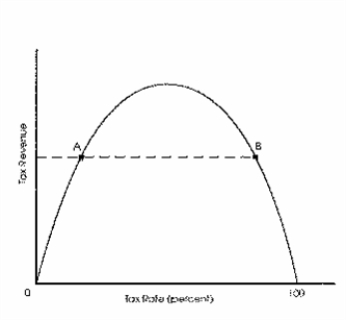 -Refer to Exhibit 11-2. At point B, if we cut tax rates slightly, tax revenues will
 (Multiple Choice)
4.9/5 (89)
(89) That part of the deficit that results from a downturn in economic activity is called the __________ deficit.
(Multiple Choice)
4.8/5 (79)
(79) List and describe three of the five different lags that can occur which may impede the effectiveness of the use of fiscal policy.
(Essay)
4.8/5 (64)
(64) 
Filters
- Essay(0)
- Multiple Choice(0)
- Short Answer(0)
- True False(0)
- Matching(0)