



 Chat with AI
Exam 11: Fiscal Policy and the Federal Budget

Exam 1: What Economics Is About174 Questions
Exam 2: Production Possibilities Frontier Framework156 Questions
Exam 3: Supply and Demand Theory224 Questions
Exam 4: Prices Free Controlled and Relative122 Questions
Exam 5: Supply Demand and Price Applications76 Questions
Exam 6: Macroeconomic Measurements Part I Prices and Unemployment151 Questions
Exam 7: Macroeconomic Measurements Part II Gdp and Real Gdp150 Questions
Exam 8: Aggregate Demand and Aggregate Supply204 Questions
Exam 9: Classical Macroeconomics and the Self Regulating Economy172 Questions
Exam 10: Keynesian Macroeconomics and Economic Instability a Critique of the Self Regulating Economy200 Questions
Exam 11: Fiscal Policy and the Federal Budget167 Questions
Exam 12: Money Banking and the Financial System150 Questions
Exam 13: The Federal Reserve System180 Questions
Exam 14: Money and the Economy150 Questions
Exam 15: Monetary Policy185 Questions
Exam 16: Expectations Theory and the Economy150 Questions
Exam 17: Economic Growth Resources Technology Ideas and Institutions103 Questions
Exam 18: Debates in Macroeconomics Over the Role and Effects of Government100 Questions
Exam 19: Elasticity204 Questions
Exam 20: Consumer Choice and Behavioral Economics179 Questions
Exam 21: Production and Costs245 Questions
Exam 22: Perfect Competition187 Questions
Exam 23: Monopoly195 Questions
Exam 24: Monopolistic Competition Oligopoly and Game Theory172 Questions
Exam 25: Government and Product Markets Antitrust and Regulation158 Questions
Exam 26: Factor Markets With Emphasis on the Labor Market184 Questions
Exam 27: Wages Unions and Labor138 Questions
Exam 28: The Distribution of Income and Poverty99 Questions
Exam 29: Interest Rent and Profit198 Questions
Exam 30: Market Failure Externalities Public Goods and Asymmetric Information187 Questions
Exam 31: Public Choice and Special Interest Group Politics135 Questions
Exam 32: Building Theories to Explain Everyday Life From Observations to Questions to Theories to Predictions62 Questions
Exam 33: International Trade152 Questions
Exam 34: International Finance122 Questions
Exam 35: The Economic Case for and Against Government Five Topics Considered87 Questions
Exam 36: Stocks Bonds Futures and Options110 Questions
Select questions type


To identify whether fiscal policy is expansionary or contractionary, one should focus on the cyclical deficit.
(True/False)
4.9/5  (75)
(75) If the structural deficit is $80 billion and the cyclical deficit is $150 billion, it follows that the __________ is __________ billion.
(Multiple Choice)
4.9/5 (80)
(80) Buchanan and Wagner assert that there is a political bias toward contractionary fiscal policy and not expansionary fiscal policy.
(True/False)
4.9/5 (86)
(86) When the economy is in a recessionary gap, Keynesian economists will often advocate expansionary policy measures. Why?
(Multiple Choice)
4.9/5 (67)
(67) Define the term budget deficit (as it applies to the federal government) and describe the difference between a cyclical deficit and a structural deficit. Provide a hypothetical numerical example to help support your answer.
(Essay)
4.7/5 (80)
(80) The answer is: "After a policy measure is implemented, it takes time to affect the economy." What is the question?
(Multiple Choice)
4.9/5 (72)
(72) Elaine's taxable income increases by $1 and her tax payment increases by $0.28. Her marginal tax rate is
(Multiple Choice)
5.0/5 (71)
(71) Explain the difference between a progressive income tax, a proportional income tax and a regressive income tax. Under which type of system is the federal income tax?
(Essay)
4.8/5 (83)
(83) Suppose government spending rises by $120 billion. It follows that if private expenditures
(Multiple Choice)
4.9/5 (71)
(71) The answer is: "Policymakers are not aware of changes in the economy as soon as they happen." What is the question?
(Multiple Choice)
5.0/5 (69)
(69) Exhibit 11-5
 Assume that the farmer grows wheat and sells it to the miller, the miller turns the wheat into flour and sells it to the baker, and the baker turns the flour into bread and sells it to the final consumer.
-Refer to Exhibit 11-5 which summarizes the situation prior to the value added tax (VAT). If the government imposes a VAT rate of 10 percent, the baker must pay ___________ in VAT tax and will need to raise the price he charges the final consumer to _______________.
Assume that the farmer grows wheat and sells it to the miller, the miller turns the wheat into flour and sells it to the baker, and the baker turns the flour into bread and sells it to the final consumer.
-Refer to Exhibit 11-5 which summarizes the situation prior to the value added tax (VAT). If the government imposes a VAT rate of 10 percent, the baker must pay ___________ in VAT tax and will need to raise the price he charges the final consumer to _______________. (Multiple Choice)
4.9/5 (81)
(81) Exhibit 11-2
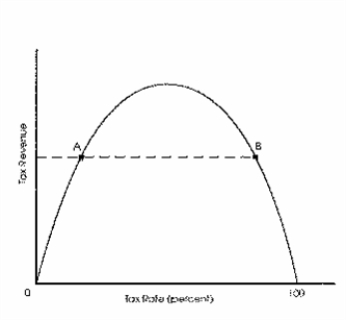 -Refer to Exhibit 11-2. At the highest point above the horizontal axis, tax revenues
 (Multiple Choice)
4.8/5 (87)
(87) Exhibit 11-4
 -Refer to Exhibit 11-4. If a person's taxable income is $90,000, how much does he pay in taxes?
 (Multiple Choice)
4.8/5 (75)
(75) Use the information provided in Exhibit 11-4. If a person's taxable income is $110,000, how much does he pay in taxes?
(Multiple Choice)
5.0/5 (73)
(73) According to the textbook (based upon 2014 data), if the bottom half of all U.S. income tax payers were allowed to stop paying the income tax entirely and the top 50% continued to pay as they do now, tax revenues to the government would drop by about
(Multiple Choice)
4.9/5 (73)
(73) Define crowding out. Give a hypothetical numerical example to show the difference between complete crowding out and incomplete crowding out. Explain how complete and incomplete crowding out could impact the effectiveness of fiscal policy.
(Essay)
4.8/5 (73)
(73) The top 1% of income earners in the U.S. (those with the highest taxable incomes) pay
(Multiple Choice)
5.0/5 (80)
(80) 
Filters
- Essay(0)
- Multiple Choice(0)
- Short Answer(0)
- True False(0)
- Matching(0)