



 Chat with AI
Exam 12: Money Banking and the Financial System

Exam 1: What Economics Is About174 Questions
Exam 2: Production Possibilities Frontier Framework156 Questions
Exam 3: Supply and Demand Theory224 Questions
Exam 4: Prices Free Controlled and Relative122 Questions
Exam 5: Supply Demand and Price Applications76 Questions
Exam 6: Macroeconomic Measurements Part I Prices and Unemployment151 Questions
Exam 7: Macroeconomic Measurements Part II Gdp and Real Gdp150 Questions
Exam 8: Aggregate Demand and Aggregate Supply204 Questions
Exam 9: Classical Macroeconomics and the Self Regulating Economy172 Questions
Exam 10: Keynesian Macroeconomics and Economic Instability a Critique of the Self Regulating Economy200 Questions
Exam 11: Fiscal Policy and the Federal Budget167 Questions
Exam 12: Money Banking and the Financial System150 Questions
Exam 13: The Federal Reserve System180 Questions
Exam 14: Money and the Economy150 Questions
Exam 15: Monetary Policy185 Questions
Exam 16: Expectations Theory and the Economy150 Questions
Exam 17: Economic Growth Resources Technology Ideas and Institutions103 Questions
Exam 18: Debates in Macroeconomics Over the Role and Effects of Government100 Questions
Exam 19: Elasticity204 Questions
Exam 20: Consumer Choice and Behavioral Economics179 Questions
Exam 21: Production and Costs245 Questions
Exam 22: Perfect Competition187 Questions
Exam 23: Monopoly195 Questions
Exam 24: Monopolistic Competition Oligopoly and Game Theory172 Questions
Exam 25: Government and Product Markets Antitrust and Regulation158 Questions
Exam 26: Factor Markets With Emphasis on the Labor Market184 Questions
Exam 27: Wages Unions and Labor138 Questions
Exam 28: The Distribution of Income and Poverty99 Questions
Exam 29: Interest Rent and Profit198 Questions
Exam 30: Market Failure Externalities Public Goods and Asymmetric Information187 Questions
Exam 31: Public Choice and Special Interest Group Politics135 Questions
Exam 32: Building Theories to Explain Everyday Life From Observations to Questions to Theories to Predictions62 Questions
Exam 33: International Trade152 Questions
Exam 34: International Finance122 Questions
Exam 35: The Economic Case for and Against Government Five Topics Considered87 Questions
Exam 36: Stocks Bonds Futures and Options110 Questions
Select questions type


If a bank's assets are $500 million and its liabilities are $380 million, then its net worth (bank capital) is ____________________. If the bank's assets then rise by 6 percent at the same time that its liabilities rise by 5 percent, the percentage change in the bank's net worth will be approximately _______________ percent.
(Multiple Choice)
4.9/5  (86)
(86) If a person uses money to buy a pair of shoes, money is functioning as
(Multiple Choice)
4.9/5 (83)
(83) Historically, which of the following goods have evolved into money?
(Multiple Choice)
4.9/5 (82)
(82) Small-denomination time deposits are part of M2, but not part of M1.
(True/False)
4.8/5 (83)
(83) The two types of asymmetric information problems are moral hazard and insolvency.
(True/False)
4.8/5 (93)
(93) To economists, credit cards are a widely accepted form of money.
(True/False)
4.9/5 (100)
(100) A bank has $132,000 in excess reserves and the required reserve ratio is 11 percent. This means the bank could have __________ in checkable deposit liabilities and __________ in (total) reserves.
(Multiple Choice)
4.9/5 (89)
(89) Bank A has checkable deposits of $10 million and total reserves of $1 million. The required reserve ratio is 9 percent. The bank has required reserves of
(Multiple Choice)
4.8/5 (69)
(69) When money is used to buy a computer, it is functioning as a
(Multiple Choice)
5.0/5 (78)
(78) Bank A has checkable deposits of $510 million and total reserves of $55.2 million. The required reserve ratio is 9 percent. The bank has excess reserves of ______________ million.
(Multiple Choice)
4.9/5 (68)
(68) Your neighbor has knowledge of economics and you would like her to share it with you. You own a car, a CD player and a new pair of running shoes. You wish to make a trade, but the neighbor does not want what you have. The problem can be stated as follows: You are not satisfying the
(Multiple Choice)
4.9/5 (82)
(82) When people in a barter economy began to accept the good that had greater acceptability than all other goods, they weren't trying to create the institution of money. They were simply trying to __________.
(Multiple Choice)
4.8/5 (74)
(74) The Chinese government has prohibited anyone in China from dealing with bitcoin exchanges.
(True/False)
4.9/5 (75)
(75)
Exhibit 12-4
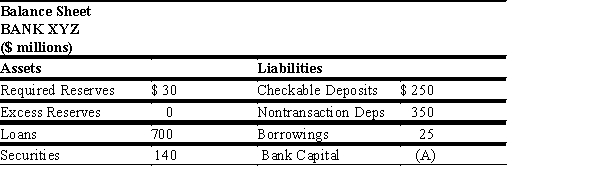
-Refer to Exhibit 12-4. What is the required reserve ratio?
-Refer to Exhibit 12-4. What is the required reserve ratio? (Multiple Choice)
4.8/5 (77)
(77) 
Filters
- Essay(0)
- Multiple Choice(0)
- Short Answer(0)
- True False(0)
- Matching(0)