



 Chat with AI
Exam 12: Money Banking and the Financial System

Exam 1: What Economics Is About174 Questions
Exam 2: Production Possibilities Frontier Framework156 Questions
Exam 3: Supply and Demand Theory224 Questions
Exam 4: Prices Free Controlled and Relative122 Questions
Exam 5: Supply Demand and Price Applications76 Questions
Exam 6: Macroeconomic Measurements Part I Prices and Unemployment151 Questions
Exam 7: Macroeconomic Measurements Part II Gdp and Real Gdp150 Questions
Exam 8: Aggregate Demand and Aggregate Supply204 Questions
Exam 9: Classical Macroeconomics and the Self Regulating Economy172 Questions
Exam 10: Keynesian Macroeconomics and Economic Instability a Critique of the Self Regulating Economy200 Questions
Exam 11: Fiscal Policy and the Federal Budget167 Questions
Exam 12: Money Banking and the Financial System150 Questions
Exam 13: The Federal Reserve System180 Questions
Exam 14: Money and the Economy150 Questions
Exam 15: Monetary Policy185 Questions
Exam 16: Expectations Theory and the Economy150 Questions
Exam 17: Economic Growth Resources Technology Ideas and Institutions103 Questions
Exam 18: Debates in Macroeconomics Over the Role and Effects of Government100 Questions
Exam 19: Elasticity204 Questions
Exam 20: Consumer Choice and Behavioral Economics179 Questions
Exam 21: Production and Costs245 Questions
Exam 22: Perfect Competition187 Questions
Exam 23: Monopoly195 Questions
Exam 24: Monopolistic Competition Oligopoly and Game Theory172 Questions
Exam 25: Government and Product Markets Antitrust and Regulation158 Questions
Exam 26: Factor Markets With Emphasis on the Labor Market184 Questions
Exam 27: Wages Unions and Labor138 Questions
Exam 28: The Distribution of Income and Poverty99 Questions
Exam 29: Interest Rent and Profit198 Questions
Exam 30: Market Failure Externalities Public Goods and Asymmetric Information187 Questions
Exam 31: Public Choice and Special Interest Group Politics135 Questions
Exam 32: Building Theories to Explain Everyday Life From Observations to Questions to Theories to Predictions62 Questions
Exam 33: International Trade152 Questions
Exam 34: International Finance122 Questions
Exam 35: The Economic Case for and Against Government Five Topics Considered87 Questions
Exam 36: Stocks Bonds Futures and Options110 Questions
Select questions type


Tenth National Bank holds $285 million in checkable deposits and $35 million in reserves. With a required reserve ratio of 11 percent, how much in excess reserves is Tenth National holding?
(Multiple Choice)
4.9/5  (85)
(85) Bank A holds $1 million in required reserves and the required reserve ratio is 9 percent. It follows that Bank A holds checkable deposit liabilities that total approximately
(Multiple Choice)
4.8/5 (79)
(79) In a barter economy, people are _________ to specialize in the production of one good or service, compared to in a money economy.
(Multiple Choice)
4.9/5 (76)
(76) If M1 is $1,200 billion, currency held outside banks is $400 billion, and traveler's checks is $10 billion, then small-denomination time deposits equal
(Multiple Choice)
4.8/5 (75)
(75) A moral hazard problem occurs before a loan is made, and the adverse selection problem occurs after a loan is made.
(True/False)
4.8/5 (91)
(91) Consider the following data: currency (held outside banks) = $354 billion, checkable deposits = $250 billion, traveler's checks = $4 billion, small-denomination time deposits = $200 billion, savings deposits = $100 billion, retail money market mutual funds = $160 billion. M1 equals __________ billion and M2 equals __________ billion.
(Multiple Choice)
4.9/5 (70)
(70) According to the textbook, L. Frank Baum, the author of The Wonderful Wizard of Oz, blamed ____________________ for the economic depression of 1893 and the related hardships faced by farmers and workers.
(Multiple Choice)
4.9/5 (88)
(88) When economists say that banks must hold a percentage of their total deposits in reserve form, what does this mean?
(Multiple Choice)
4.9/5 (70)
(70) The term federal reserve notes refers to coins minted by the U.S. Treasury.
(True/False)
4.9/5 (86)
(86) If checkable deposits in Bank A total $390 million and the required reserve ratio is 10 percent, then required reserves at Bank A equal
(Multiple Choice)
4.9/5 (80)
(80)
Exhibit 12-4
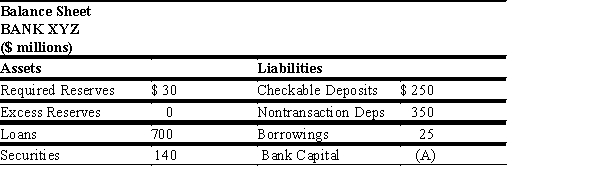
-Refer to Exhibit 12-4. How much bank capital does Bank XYZ have (i.e. what dollar amount belongs in blank (A))?
-Refer to Exhibit 12-4. How much bank capital does Bank XYZ have (i.e. what dollar amount belongs in blank (A))? (Multiple Choice)
4.8/5 (75)
(75) 
Filters
- Essay(0)
- Multiple Choice(0)
- Short Answer(0)
- True False(0)
- Matching(0)