



 Chat with AI
Exam 17: Economic Growth Resources Technology Ideas and Institutions

Exam 1: What Economics Is About174 Questions
Exam 2: Production Possibilities Frontier Framework156 Questions
Exam 3: Supply and Demand Theory224 Questions
Exam 4: Prices Free Controlled and Relative122 Questions
Exam 5: Supply Demand and Price Applications76 Questions
Exam 6: Macroeconomic Measurements Part I Prices and Unemployment151 Questions
Exam 7: Macroeconomic Measurements Part II Gdp and Real Gdp150 Questions
Exam 8: Aggregate Demand and Aggregate Supply204 Questions
Exam 9: Classical Macroeconomics and the Self Regulating Economy172 Questions
Exam 10: Keynesian Macroeconomics and Economic Instability a Critique of the Self Regulating Economy200 Questions
Exam 11: Fiscal Policy and the Federal Budget167 Questions
Exam 12: Money Banking and the Financial System150 Questions
Exam 13: The Federal Reserve System180 Questions
Exam 14: Money and the Economy150 Questions
Exam 15: Monetary Policy185 Questions
Exam 16: Expectations Theory and the Economy150 Questions
Exam 17: Economic Growth Resources Technology Ideas and Institutions103 Questions
Exam 18: Debates in Macroeconomics Over the Role and Effects of Government100 Questions
Exam 19: Elasticity204 Questions
Exam 20: Consumer Choice and Behavioral Economics179 Questions
Exam 21: Production and Costs245 Questions
Exam 22: Perfect Competition187 Questions
Exam 23: Monopoly195 Questions
Exam 24: Monopolistic Competition Oligopoly and Game Theory172 Questions
Exam 25: Government and Product Markets Antitrust and Regulation158 Questions
Exam 26: Factor Markets With Emphasis on the Labor Market184 Questions
Exam 27: Wages Unions and Labor138 Questions
Exam 28: The Distribution of Income and Poverty99 Questions
Exam 29: Interest Rent and Profit198 Questions
Exam 30: Market Failure Externalities Public Goods and Asymmetric Information187 Questions
Exam 31: Public Choice and Special Interest Group Politics135 Questions
Exam 32: Building Theories to Explain Everyday Life From Observations to Questions to Theories to Predictions62 Questions
Exam 33: International Trade152 Questions
Exam 34: International Finance122 Questions
Exam 35: The Economic Case for and Against Government Five Topics Considered87 Questions
Exam 36: Stocks Bonds Futures and Options110 Questions
Select questions type


Compare a property rights system in which people are allowed to keep one-third of the monetary rewards of their labor with a system in which they keep two-thirds. We should expect more entrepreneurship under the __________ system and faster real economic growth under the __________ system.
(Multiple Choice)
5.0/5  (75)
(75) In the production function Real GDP = T (L, K), the T stands for tax coefficient.
(True/False)
4.8/5 (86)
(86) Exhibit 17-3
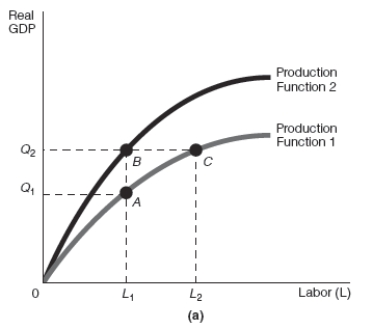
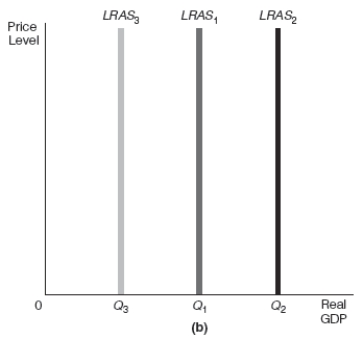 -Refer to Exhibit 17-3 Assume that the starting point on the production function is point A. After an increase in the quantity of labor, there would be a ______________________ which would shift the LRAS curve from LRAS1 to _______________ resulting in _______________..
 (Multiple Choice)
4.8/5 (69)
(69) Absolute real economic growth is an increase in __________ from one period to the next.
(Multiple Choice)
4.8/5 (63)
(63) Per-capita real economic growth refers to an increase from one period to the next in
(Multiple Choice)
4.8/5 (83)
(83) Higher income taxes cause a ____________shift of the labor supply curve, which then produces__________ Real GDP.
(Multiple Choice)
4.9/5 (88)
(88) Exhibit 17-2

 -Refer to Exhibit 17-2. Assume that the starting point is always point 1. Which of the production function graphs shown, (a) or (b), represents an increase in the quantity of labor, and which represents an increase in the quantity of capital, respectively?
 (Multiple Choice)
4.8/5 (87)
(87) In the production function Real GDP = T (L, K), the T represents the _____________ coefficient, the L represents ________________ and the K represents _______________.
(Multiple Choice)
4.7/5 (81)
(81) Exhibit 17-5
Applying the concept of a production function to your learning, assume that the amount of learning you acquire can be summarized by the following equation (and that your motivation to learn and the quality of instruction are both rated on a scale from 1 to 10):
Amount of learning acquired = 0.2(number of books read) + 0.25(hours spent studying) + 0.15(quality of instruction) + 0.4(motivation to learn)
-Refer to Exhibit 17-5. Based on the equation given in this exhibit, if your motivation to learn rises from 7 to 9, by how much will the amount of learning acquired rise as a result?
(Multiple Choice)
4.9/5 (84)
(84) Exhibit 17-1
Production Function
Real GDP = T (L, K), such that Real GDP = T(L + K)
Assume that the technology coefficient is equal to 0.40.
-Refer to Exhibit 17-1. If there are 4 units of capital and 6 units of labor, ________ units of output (Real GDP) will be produced.
(Multiple Choice)
4.9/5 (81)
(81) Real GDP in a small country is worth $40 billion. The population of the country is 1.666,000. What is the country's approximate per capita Real GDP?
(Multiple Choice)
5.0/5 (75)
(75) Production functions used in economic growth theory are always limited to two inputs: labor and capital.
(True/False)
4.8/5 (77)
(77) Property rights are a tangible factor in producing economic growth.
(True/False)
4.8/5 (84)
(84) If an economy's steady annual growth rate falls from 3.5 percent to 2.5 percent, this adds __________ years to the time it takes for the economy to double in size.
(Multiple Choice)
4.8/5 (83)
(83) According to Paul Romer, one way to produce more ideas and knowledge is by
(Multiple Choice)
4.8/5 (75)
(75) An economy growing at a steady rate of 2.6 percent per year doubles in size approximately every __________ years.
(Multiple Choice)
5.0/5 (92)
(92) In 1961, President Kennedy committed the United States to a manned lunar mission by the end of the decade. Few thought it could actually be done, but of course it did, with five months to spare. This story illustrates the __________ growth theory argument that technological change __________.
(Multiple Choice)
4.9/5 (73)
(73) Exhibit 17-5
Applying the concept of a production function to your learning, assume that the amount of learning you acquire can be summarized by the following equation (and that your motivation to learn and the quality of instruction are both rated on a scale from 1 to 10):
Amount of learning acquired = 0.2(number of books read) + 0.25(hours spent studying) + 0.15(quality of instruction) + 0.4(motivation to learn)
-Refer to Exhibit 17-5. Based on the equation given in this exhibit, if you read 2 books, study for 3 hours, have an instructor whose quality of instruction is ranked as 4, and your motivation to learn is ranked as 7, what is the amount of learning that you will acquire?
(Multiple Choice)
4.8/5 (82)
(82) If the annual growth rate in Real GDP is 4 percent, then it will take 25 years for the economy to double in size.
(True/False)
5.0/5 (72)
(72) 
Filters
- Essay(0)
- Multiple Choice(0)
- Short Answer(0)
- True False(0)
- Matching(0)