



 Chat with AI
Exam 33: International Trade

Exam 1: What Economics Is About174 Questions
Exam 2: Production Possibilities Frontier Framework156 Questions
Exam 3: Supply and Demand Theory224 Questions
Exam 4: Prices Free Controlled and Relative122 Questions
Exam 5: Supply Demand and Price Applications76 Questions
Exam 6: Macroeconomic Measurements Part I Prices and Unemployment151 Questions
Exam 7: Macroeconomic Measurements Part II Gdp and Real Gdp150 Questions
Exam 8: Aggregate Demand and Aggregate Supply204 Questions
Exam 9: Classical Macroeconomics and the Self Regulating Economy172 Questions
Exam 10: Keynesian Macroeconomics and Economic Instability a Critique of the Self Regulating Economy200 Questions
Exam 11: Fiscal Policy and the Federal Budget167 Questions
Exam 12: Money Banking and the Financial System150 Questions
Exam 13: The Federal Reserve System180 Questions
Exam 14: Money and the Economy150 Questions
Exam 15: Monetary Policy185 Questions
Exam 16: Expectations Theory and the Economy150 Questions
Exam 17: Economic Growth Resources Technology Ideas and Institutions103 Questions
Exam 18: Debates in Macroeconomics Over the Role and Effects of Government100 Questions
Exam 19: Elasticity204 Questions
Exam 20: Consumer Choice and Behavioral Economics179 Questions
Exam 21: Production and Costs245 Questions
Exam 22: Perfect Competition187 Questions
Exam 23: Monopoly195 Questions
Exam 24: Monopolistic Competition Oligopoly and Game Theory172 Questions
Exam 25: Government and Product Markets Antitrust and Regulation158 Questions
Exam 26: Factor Markets With Emphasis on the Labor Market184 Questions
Exam 27: Wages Unions and Labor138 Questions
Exam 28: The Distribution of Income and Poverty99 Questions
Exam 29: Interest Rent and Profit198 Questions
Exam 30: Market Failure Externalities Public Goods and Asymmetric Information187 Questions
Exam 31: Public Choice and Special Interest Group Politics135 Questions
Exam 32: Building Theories to Explain Everyday Life From Observations to Questions to Theories to Predictions62 Questions
Exam 33: International Trade152 Questions
Exam 34: International Finance122 Questions
Exam 35: The Economic Case for and Against Government Five Topics Considered87 Questions
Exam 36: Stocks Bonds Futures and Options110 Questions
Select questions type


Suppose that a tariff is imposed on imported cheese. This will have the effect of __________ the quantity consumed of cheese, __________ consumers' surplus, and __________ the government's tariff revenues.
(Multiple Choice)
4.9/5  (92)
(92) Exhibit 33-7
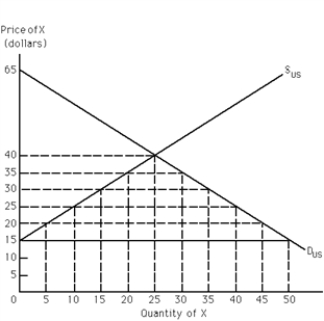 -Refer to Exhibit 33-7. Assume that the current price of good X is $25 (which includes a $10 tariff on imports of good X). The government collects tariff revenue on good X in the amount of
 (Multiple Choice)
5.0/5 (87)
(87) Explain why the government is often more responsive to producer interests than to consumer interests when it comes to the imposition of tariffs and quotas.
(Essay)
4.7/5 (70)
(70) Exhibit 33-3
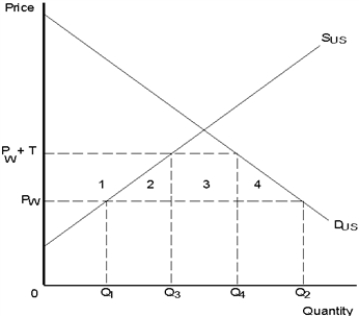 -Refer to Exhibit 33-3. The world price is PW. If a tariff is imposed, the price rises to PW + T. Because of the tariff, producers' surplus is __________ by an amount equal to the area of __________.
 (Multiple Choice)
4.9/5 (72)
(72) One country has a comparative advantage over another country in the production of a good if it
(Multiple Choice)
4.8/5 (85)
(85) Exhibit 33-6
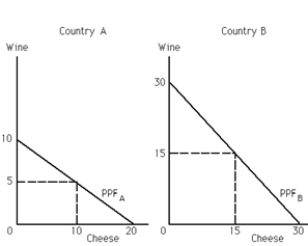 -Refer to Exhibit 33-6. The opportunity cost of 1 unit of cheese in terms of units of wine is __________ for country A.
 (Multiple Choice)
4.8/5 (62)
(62) Exhibit 33-1
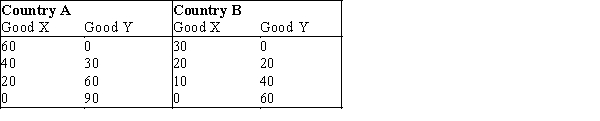
-Refer to Exhibit 33-1. If country A is to specialize in the production of one of the two goods (and then trade that good with Country B), which good should it be and why? If Country B is to specialize in the production of one of the two goods (and then trade that good to with Country A), which good should it be and why?
-Refer to Exhibit 33-1. If country A is to specialize in the production of one of the two goods (and then trade that good with Country B), which good should it be and why? If Country B is to specialize in the production of one of the two goods (and then trade that good to with Country A), which good should it be and why? (Multiple Choice)
4.7/5 (67)
(67) List and describe three arguments that help to explain why nations sometimes restrict trade. Does everyone agree with these arguments?
(Essay)
4.8/5 (86)
(86) Exhibit 33-2
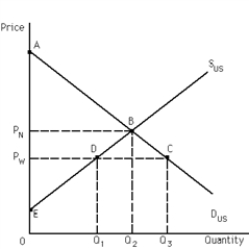 -Refer to Exhibit 33-2. The U.S. demand and supply for a good are shown. Under a policy of free trade, where imports are permitted, the world price is PW. If there is a policy change such that imports are prohibited, the price becomes PN, consumers' surplus equals __________ and producers' surplus equals __________.
 (Multiple Choice)
4.8/5 (84)
(84) Exhibit 33-5
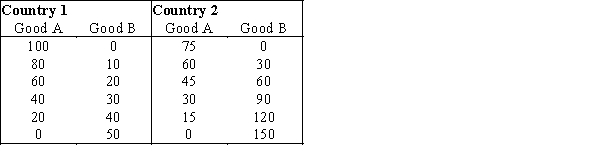 -Refer to Exhibit 33-5. The opportunity cost of one unit of good A is __________ for country 1 and __________ for country 2.
 (Multiple Choice)
5.0/5 (80)
(80) Exhibit 33-9
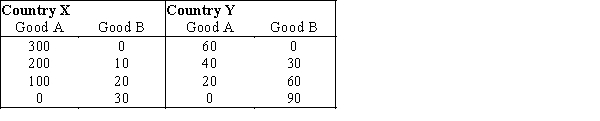 -Refer to Exhibit 33-9. In the no specialization-no trade case, suppose country X produces and consumes 100 units of good A and 20 units of good B. Country Y produces and consumes 20 units of good A and 60 units of good B. If the two countries specialize and trade, and the actual amounts traded are 125 units of good A for 25 units of good B, how many more units of good A will country X consume by specializing and trading?
 (Multiple Choice)
4.8/5 (89)
(89) It is necessary for government officials to analyze cost data to determine what their country should specialize in producing.
(True/False)
4.7/5 (88)
(88) A country has a (an) __________ in the production of a good it produces at lower opportunity cost than another country.
(Multiple Choice)
4.8/5 (75)
(75) When countries engage in specialization and international trade, every individual person in those countries will gain.
(True/False)
4.9/5 (79)
(79) 
Filters
- Essay(0)
- Multiple Choice(0)
- Short Answer(0)
- True False(0)
- Matching(0)