



 Chat with AI
Exam 33: International Trade

Exam 1: What Economics Is About174 Questions
Exam 2: Production Possibilities Frontier Framework156 Questions
Exam 3: Supply and Demand Theory224 Questions
Exam 4: Prices Free Controlled and Relative122 Questions
Exam 5: Supply Demand and Price Applications76 Questions
Exam 6: Macroeconomic Measurements Part I Prices and Unemployment151 Questions
Exam 7: Macroeconomic Measurements Part II Gdp and Real Gdp150 Questions
Exam 8: Aggregate Demand and Aggregate Supply204 Questions
Exam 9: Classical Macroeconomics and the Self Regulating Economy172 Questions
Exam 10: Keynesian Macroeconomics and Economic Instability a Critique of the Self Regulating Economy200 Questions
Exam 11: Fiscal Policy and the Federal Budget167 Questions
Exam 12: Money Banking and the Financial System150 Questions
Exam 13: The Federal Reserve System180 Questions
Exam 14: Money and the Economy150 Questions
Exam 15: Monetary Policy185 Questions
Exam 16: Expectations Theory and the Economy150 Questions
Exam 17: Economic Growth Resources Technology Ideas and Institutions103 Questions
Exam 18: Debates in Macroeconomics Over the Role and Effects of Government100 Questions
Exam 19: Elasticity204 Questions
Exam 20: Consumer Choice and Behavioral Economics179 Questions
Exam 21: Production and Costs245 Questions
Exam 22: Perfect Competition187 Questions
Exam 23: Monopoly195 Questions
Exam 24: Monopolistic Competition Oligopoly and Game Theory172 Questions
Exam 25: Government and Product Markets Antitrust and Regulation158 Questions
Exam 26: Factor Markets With Emphasis on the Labor Market184 Questions
Exam 27: Wages Unions and Labor138 Questions
Exam 28: The Distribution of Income and Poverty99 Questions
Exam 29: Interest Rent and Profit198 Questions
Exam 30: Market Failure Externalities Public Goods and Asymmetric Information187 Questions
Exam 31: Public Choice and Special Interest Group Politics135 Questions
Exam 32: Building Theories to Explain Everyday Life From Observations to Questions to Theories to Predictions62 Questions
Exam 33: International Trade152 Questions
Exam 34: International Finance122 Questions
Exam 35: The Economic Case for and Against Government Five Topics Considered87 Questions
Exam 36: Stocks Bonds Futures and Options110 Questions
Select questions type


Exhibit 33-1
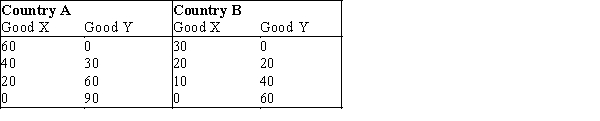
-Refer to Exhibit 33-1. Country B is the lower opportunity cost producer of
-Refer to Exhibit 33-1. Country B is the lower opportunity cost producer of (Multiple Choice)
4.8/5  (76)
(76) A quota on imported avocadoes ______________ the price of avocadoes, _____________ consumers' surplus for avocado buyers, _______________ producers' surplus of avocado growers and __________________ tariff revenue. Because the loss to _____________ is more than the gain to ___________________, there is a net loss to society.
(Multiple Choice)
4.8/5 (84)
(84) Exhibit 33-10
 -Refer to Exhibit 33-10. Who has the comparative advantage when it comes to mowing lawns?
 (Multiple Choice)
4.8/5 (75)
(75) Exhibit 33-6
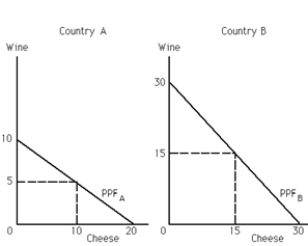 -Refer to Exhibit 33-6. Which of the following terms of trade would both countries agree on?
 (Multiple Choice)
4.9/5 (79)
(79) Exhibit 33-3
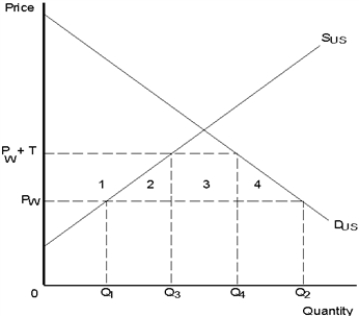 -Refer to Exhibit 33-3. The world price is PW. If a tariff is imposed, the price rises to PW + T. Because of the tariff, government collects tariff revenues equal to the area of
 (Multiple Choice)
4.9/5 (82)
(82) Exhibit 33-1
-Refer to Exhibit 33-1. The opportunity cost of one unit of Y in country A is
-Refer to Exhibit 33-1. The opportunity cost of one unit of Y in country A is (Multiple Choice)
4.9/5 (68)
(68) Which of the following conditions makes it most likely for a quota to be imposed?
(Multiple Choice)
4.9/5 (69)
(69) Alexander Hamilton used the infant-industry argument to support trade restrictions.
(True/False)
4.8/5 (78)
(78) Exhibit 33-9
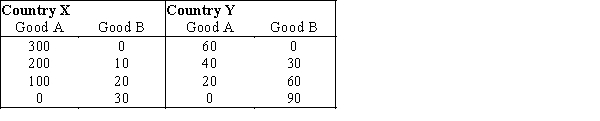 -Refer to Exhibit 33-9. For country Y, the opportunity cost of producing one unit of good A is __________ unit(s) of good B.
 (Multiple Choice)
4.8/5 (71)
(71) If a U.S. company operates within a competitive environment and chooses to offshore part of its production process, the resulting change in the firm's costs should shift the ______________ curve for its product ___________________, thus _____________ the price of the product being produced.
(Multiple Choice)
4.9/5 (74)
(74) Exhibit 33-6
-Refer to Exhibit 33-6. The opportunity cost of 1 unit of cheese in terms of units of wine is __________ for country B.
-Refer to Exhibit 33-6. The opportunity cost of 1 unit of cheese in terms of units of wine is __________ for country B. (Multiple Choice)
4.8/5 (67)
(67) The answer is: "The difference between the price buyers pay for a good and the maximum or highest price they would have paid for the good." This is the definition for
(Multiple Choice)
4.8/5 (83)
(83) Smith argues that American producers cannot compete with foreign producers because wages are lower in foreign countries than in the United States. Smith is
(Multiple Choice)
4.9/5 (77)
(77) Dumping occurs when a firm sells goods abroad at a price below their cost and below the price charged in their domestic market.
(True/False)
4.8/5 (74)
(74) As a result of a quota, both consumers' surplus and producers' surplus fall.
(True/False)
4.9/5 (83)
(83) A tariff is imposed on strawberries. The tariff will ___________ the price of strawberries in the domestic market, _____________ the quantity of strawberries imported in the domestic market, and ____________ consumers' surplus.
(Multiple Choice)
5.0/5 (72)
(72) Consumers receive more consumers' surplus when tariffs exist than when they do not exist.
(True/False)
4.9/5 (93)
(93) 
Filters
- Essay(0)
- Multiple Choice(0)
- Short Answer(0)
- True False(0)
- Matching(0)