



 Chat with AI
Exam 22: Accounting for Changes and Errors

Exam 1: The Demand for and Supply of Financial Accounting Information85 Questions
Exam 2: Financial Reporting: Its Conceptual Framework83 Questions
Exam 3: Review of a Company S Accounting System148 Questions
Exam 4: The Balance Sheet and the Statement of Shareholders Equity127 Questions
Exam 5: The Income Statement and the Statement of Cash Flows Time Value of Money Module136 Questions
Exam 6: Cash and Receivables172 Questions
Exam 7: Inventories: Cost Measurement and Flow Assumptions114 Questions
Exam 8: Inventories: Special Valuation Issues141 Questions
Exam 9: Current Liabilities and Contingent Obligations125 Questions
Exam 10: Property, Plant, and Equipment: Acquisition and Subsequent Investments111 Questions
Exam 11: Depreciation, Depletion, Impairment, and Disposal136 Questions
Exam 12: Intangibles136 Questions
Exam 13: Investments and Long-Term Receivables135 Questions
Exam 14: Financing Liabilities: Bonds and Long-Term Notes Payable192 Questions
Exam 15: Contributed Capital153 Questions
Exam 16: Retained Earnings and Earnings Per Share110 Questions
Exam 17: Advanced Issues in Revenue Recognition103 Questions
Exam 18: Accounting for Income Taxes113 Questions
Exam 19: Accounting for Post-Retirement Benefits94 Questions
Exam 20: Accounting for Leases116 Questions
Exam 21: The Statement of Cash Flows103 Questions
Exam 22: Accounting for Changes and Errors130 Questions
Exam 23: Understanding Time Value of Money Formulas and Concepts142 Questions
Select questions type


Brockmeyer, Inc. purchased some equipment on January 1, 2016, for $300,000 that had a five-year useful life and no salvage value. Brockmeyer used double-declining-balance depreciation for both financial reporting and income tax purposes. On January 1, 2018, Brockmeyer changed to the straight-line depreciation method for this equipment and can justify the change. Brockmeyer will continue to use double-declining balance depreciation for income tax reporting. Brockmeyer's income tax rate is 30%. Assuming Brockmeyer's 2018 income before depreciation and tax is $800,000, what is the amount of Brockmeyer's net income for 2018?
(Multiple Choice)
4.7/5  (72)
(72) Which of the following statements does not properly state a basic principle for reporting an accounting change?
(Multiple Choice)
4.7/5 (90)
(90) An understatement of reported net income for the current year would result from
(Multiple Choice)
4.8/5 (83)
(83) A change in accounting estimate does not result in a retrospective adjustment to previously issued financial statements.
(True/False)
4.8/5 (74)
(74) An understatement of reported net income for the current year may result from
(Multiple Choice)
4.9/5 (84)
(84) Which of the following errors will normally result in overstatement of 2017 net income?
(Multiple Choice)
4.9/5 (79)
(79) Several errors are listed below. 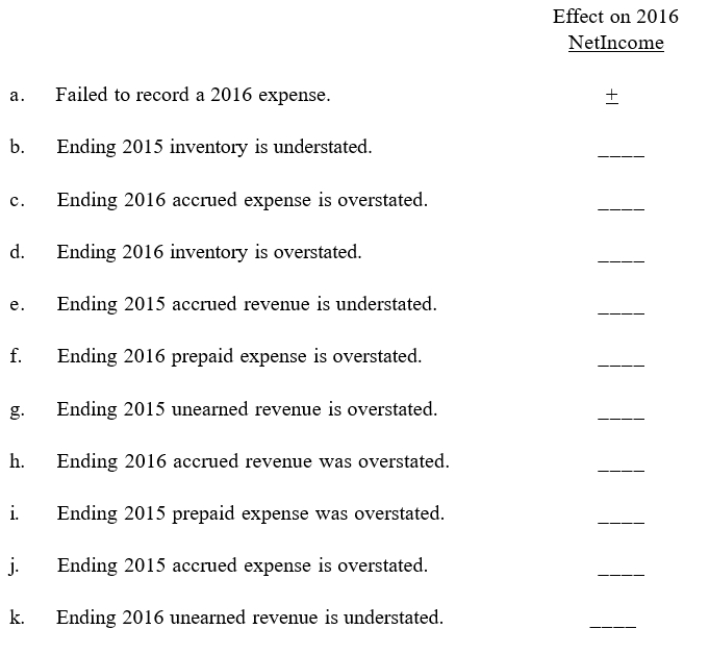 Required:
Indicate the effect each error would have on 2016 net income by placing a plus sign +), minus sign −) or NI no impact) in the space provided. Part a) has been completed as an example.
Required:
Indicate the effect each error would have on 2016 net income by placing a plus sign +), minus sign −) or NI no impact) in the space provided. Part a) has been completed as an example. (Essay)
4.9/5 (70)
(70) When a change in method is inseparable from a change in estimate, the change is accounted for
(Multiple Choice)
4.9/5 (82)
(82) Refer to Exhibit 22-2. Accordingly, the appropriate accounting change was made in 2019. How much depreciation expense for this machine should Nathan record for the year ended December 31, 2019?
(Multiple Choice)
4.9/5 (85)
(85) A conglomerate corporation must make retrospective adjustments to account for a material change in reporting entity every year that it adds a new subsidiary or sells off a formerly owned subsidiary.
(True/False)
4.8/5 (89)
(89) Leah Co. reported $7,000 of net income for 2016. The following errors were then discovered: · Ending 2015 accrued expense was understated by $800.
· Ending 2016 unearned revenue was overstated by $75.
· Ending 2015 unearned revenue was overstated by $380.
Ignoring income taxes, what is the correct amount of 2016 net income?
(Multiple Choice)
4.8/5 (80)
(80) Generally accepted methods of accounting for a change in accounting principle include
(Multiple Choice)
4.9/5 (80)
(80) All of the following would be reported retrospectively by restating prior period's financial results except
(Multiple Choice)
4.7/5 (82)
(82) On January 1, 2016, Roy Company acquired equipment at a cost of $500,000. Roy used the double-declining-balance method to depreciate the equipment with a ten-year life and no salvage value. On January 1, 2018, Roy changed to straight-line depreciation for this equipment, and the IRS accepted this change as being eligible as a change in accounting estimate with prospective treatment. Assuming an income tax rate of 30%, what is the amount of the restatement of January 1, 2018 retained earnings?
(Multiple Choice)
4.9/5 (81)
(81) Every correction of an error that requires restatement of prior year financial statements requires a journal entry to increase or decrease the beginning balance of Retained Earnings.
(True/False)
4.7/5 (77)
(77) Disadvantages of using the retrospective application method do not include which of the following?
(Multiple Choice)
4.8/5 (82)
(82) What are the two methods for reporting changes as approved by GAAP provide a brief explanation of each?
(Essay)
4.8/5 (70)
(70) On January 1, Year 1, the Dole Company purchased an asset that cost $154,000. The asset had an expected useful life of seven years and no estimated residual value. The company initially decided to use sum-of-the-years'-digits SYD) depreciation for both financial accounting and income tax purposes. Depreciation expense for the straight-line
method and the sum-of-the-years'-digits method is as follows: Year Straight-line over7Years SYD over oYears Difference 1 \ 22,000 \ 38,500 \ 16,500 2 22,000 33,000 11,000 3 22,000 27,500 5,500 4 22,000 22,000 0 5 22,000 16,500 (5,500) 6 22,000 11,000 (11,000) 7 ) At the beginning of Year 4, Dole changed from the sum-of-the-years'-digits method to the straight-line method of depreciation for financial reporting purposes. The company's income tax rate is 30%. In Year 3 and Year 4, Dole had
$90,000 pretax income before depreciation and income taxes.
Required:
a. Complete the following section of the income statement:
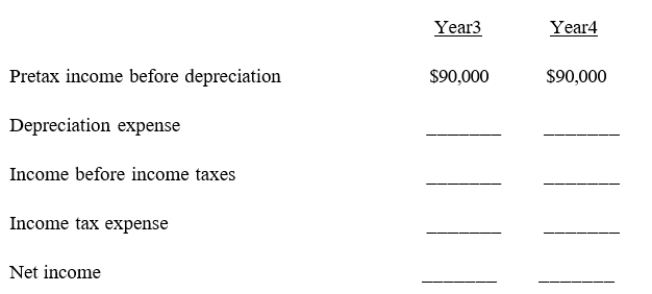 b. Prepare the journal entries to record the depreciation expense, tax expense, and the effect of the accounting change if any) in Year 4.
 (Essay)
4.9/5 (86)
(86) 
Filters
- Essay(0)
- Multiple Choice(0)
- Short Answer(0)
- True False(0)
- Matching(0)